

- What are payment orchestration features?
- The 10 essential features at a glance
- 1. Unified connectivity across providers
- 2. Configurable smart payment routing
- 3. Payment cascading and automatic failover
- 4. Provider-independent payment tokenization
- 5. Fraud and authentication orchestration
- 6. Payment method and checkout control
- 7. Real-time payment analytics and provider monitoring
- 8. Centralized transaction lifecycle management
- 9. Automated reconciliation and settlement visibility
- 10. Enterprise governance, access, and deployment control
- How should enterprise teams prioritize these features?
- How to evaluate payment orchestration features beyond a checklist
- How Akurateco supports enterprise payment orchestration
- Building an enterprise payment control layer
Enterprise payment teams rarely struggle because they have too few tools. The harder problem is that payment providers, acquirers, fraud systems, token vaults, dashboards, and reconciliation processes often operate as separate layers.
A payment orchestration platform is supposed to centralize that environment. However, connecting several providers through one interface is only the starting point. The platform also needs to control transaction routing, recover eligible failures, preserve payment credentials, coordinate fraud and authentication, monitor provider performance, and support finance operations after authorization.
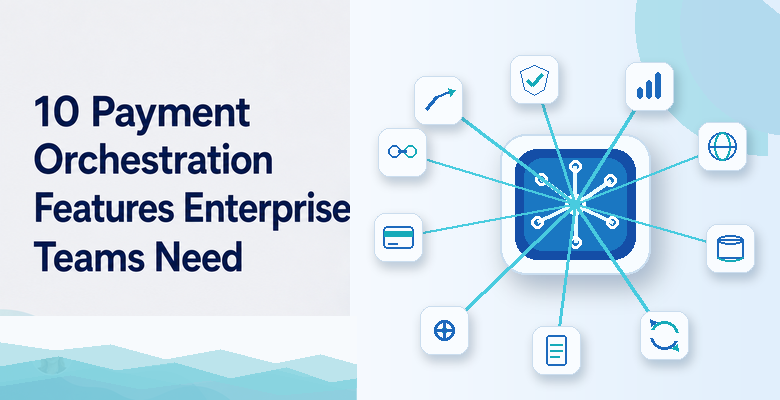
The right payment orchestration features turn a collection of integrations into an operational payment system. The following ten capabilities are the ones enterprise teams should evaluate most closely.
What are payment orchestration features?
Payment orchestration features are the capabilities that help a business connect, control, optimize, and monitor payments across multiple providers. They cover both transaction processing and the operational work surrounding it.
A mature orchestration platform combines PSP and acquirer connectivity with routing rules, payment methods, fraud tools, tokenization, reporting, settlement visibility, and reconciliation. This allows payment teams to manage the full payment lifecycle without embedding separate provider logic throughout the merchant’s infrastructure.
The value of each feature depends on its operational depth. A platform may claim to support routing, for example, but only allow a few static rules. A provider connector may exist but lack refunds, recurring payments, 3D Secure data, or settlement reporting.
Enterprise teams should therefore evaluate not only whether a feature appears on a product page, but also how it behaves in real payment flows.
The 10 essential features at a glance
| Payment orchestration feature | Main purpose | Teams that rely on it |
| Unified provider connectivity | Manage multiple PSPs, acquirers, and methods through one layer | Engineering, payments, product |
| Smart payment routing | Select the most suitable provider for each transaction | Payments, finance, product |
| Cascading and failover | Recover eligible failures and maintain continuity | Payments, engineering, support |
| Provider-independent tokenization | Protect credentials and reduce provider lock-in | Security, payments, subscriptions |
| Fraud and authentication orchestration | Coordinate risk decisions and 3D Secure flows | Risk, fraud, compliance |
| Payment method and checkout control | Adapt acceptance by market, channel, and customer | Product, growth, payments |
| Real-time analytics and monitoring | Compare performance and detect changes | Payments, finance, management |
| Transaction lifecycle management | Control captures, refunds, voids, and recurring operations | Operations, support, finance |
| Reconciliation and settlement visibility | Match provider records with merchant data | Finance, accounting, payments |
| Enterprise governance and deployment control | Manage access, changes, data, and infrastructure | Security, IT, compliance |
1. Unified connectivity across providers
An enterprise orchestration platform should provide one integration layer for multiple PSPs, acquirers, gateways, and alternative payment methods. This reduces the need to maintain separate provider logic inside the merchant’s core systems.
A unified API gives the merchant a common structure for initiating payments and receiving results. The orchestration platform translates that request into the provider-specific format required by each route.
This abstraction becomes more valuable as the provider portfolio grows. Without it, every new connection may introduce different:
- Authentication requirements
- Request and response formats
- Status models
- Decline codes
- Capture and refund operations
- Webhook behavior
- Recurring payment logic
- Reporting and settlement files
Connector count alone is not enough. Enterprise teams should verify whether a connector supports the exact lifecycle required by the business, including authorization, capture, partial capture, void, refund, recurring transactions, authentication data, status checks, and reporting.
Akurateco currently positions its orchestration platform around a unified integration layer and more than 700 provider, bank, acquirer, and payment-method connections. Its developer documentation supports card, alternative payment method, hosted checkout, and hosted-field integration paths.
2. Configurable smart payment routing
Smart routing determines where a transaction should be sent before authorization. Enterprise teams need routing logic that reflects their own markets, provider contracts, risk requirements, and performance goals.
Basic routing may rely on fixed conditions. For example, the platform can direct transactions according to currency, country, card scheme, BIN, payment method, transaction value, or business entity.
More advanced decisioning can also consider:
- Historical approval performance
- Current provider availability
- Provider response time
- Domestic versus cross-border processing
- Processing cost
- MID capacity or transaction limits
- Risk score
- Recurring or one-time transaction type
- Contractual traffic commitments
The platform should first exclude routes that cannot process the transaction and only then compare the remaining providers. A low-cost provider is irrelevant if it does not support the required currency, authentication model, or transaction type.
Enterprise teams should also be able to update routing rules without rebuilding checkout logic. Akurateco’s Intelligent Payment Routing supports pre-authorization decisions based on transaction and provider parameters, while cascading and failover handle different types of unsuccessful processing.
3. Payment cascading and automatic failover
Payment cascading and failover protect different parts of the payment flow. Cascading retries an eligible unsuccessful transaction through another route, while failover maintains processing when a provider is technically unavailable.
A platform should not treat every decline as a reason to retry. It must classify the response and understand whether another authorization attempt is permitted.
The logic should distinguish between:
- Hard issuer declines
- Soft or potentially recoverable declines
- Provider-side errors
- Connection failures
- Timeouts
- Pending or unknown transaction states
Unknown states require particular care. A provider timeout does not always mean the authorization failed. If the first provider eventually approves the transaction, an uncontrolled retry could produce a duplicate charge.
Reliable cascading therefore depends on idempotency, status checks, retry limits, and clear transaction-state management.
The payment team should be able to configure which responses activate another route, which providers may be used next, and how many attempts are permitted. Smart routing, cascading, and failover should work together, but their triggers and objectives must remain separate.
4. Provider-independent payment tokenization
A centralized payment tokenization layer protects sensitive payment credentials and allows merchants to use stored payment data across supported providers without exposing the original card number throughout their infrastructure.
Tokenization replaces a primary account number with a surrogate value. PCI SSC notes that different token models have different purposes, while EMV payment tokens may be restricted to a specific merchant, device, or payment scenario.
For enterprise teams, orchestration-level tokenization can support:
- Card-on-file payments
- One-click checkout
- Recurring billing
- Subscription renewals
- Credential updates
- Controlled retry strategies
- Migration between payment routes
The important question is whether the merchant’s stored credentials are tied to one provider. Provider-specific tokens may create friction when the payment team wants to redirect recurring transactions or change its acquiring strategy.
A strong platform should explain which token types it supports, where the vault is hosted, how tokens can be used across routes, and what happens if the merchant later migrates away.
Tokenization can reduce the amount of sensitive card data exposed across merchant systems, but it does not automatically remove every PCI DSS responsibility. PCI DSS applies to entities that store, process, transmit, or can affect the security of cardholder data.
5. Fraud and authentication orchestration
Payment orchestration should coordinate fraud controls, authentication, and provider routing rather than treating them as isolated steps. A transaction needs to reach a route that can correctly process its risk and authentication context.
Enterprise merchants often use several risk tools:
- Internal fraud rules
- External scoring providers
- Device intelligence
- Blacklists and whitelists
- Velocity checks
- Behavioral signals
- 3D Secure services
- Provider-side risk controls
The orchestration layer should determine when these checks happen, how their results affect routing, and which data must follow the transaction to the selected acquirer.
EMV 3-D Secure enables merchants and issuers to exchange transaction, payment-method, and device information for cardholder authentication. Depending on risk, the issuer may use a frictionless flow or require an additional challenge.
This matters operationally. If one provider returns a soft decline requiring authentication, the platform may need to initiate 3DS and retry correctly. If a transaction is cascaded, the next route must support the relevant authentication data.
6. Payment method and checkout control
An orchestration platform should help enterprise teams manage how payment methods are presented and processed across markets, devices, currencies, and customer segments.
Global payment acceptance is not simply a matter of adding more logos to checkout. Each method may introduce different:
- Customer interaction flows
- Redirect or server-to-server models
- Confirmation timelines
- Refund capabilities
- Recurring payment support
- Currency requirements
- Authentication steps
- Status notifications
The platform should allow product and payment teams to determine which methods are available for a specific market, transaction type, customer group, or sales channel.
Useful capabilities include hosted payment pages, hosted fields, server-to-server card payments, wallet and alternative-method integrations, checkout localization, and configurable payment-method availability.
The orchestration layer should also preserve a common merchant-side experience where possible. The customer may use several different methods, but the merchant still needs standardized transaction statuses, reporting, support workflows, and reconciliation data.
Akurateco’s developer platform supports hosted checkout, hosted payment fields, server-to-server card processing, and server-to-server alternative payment methods through the same broader payment infrastructure.
7. Real-time payment analytics and provider monitoring
Real-time payment analytics should show not only what happened, but where performance changed and what the payment team can do about it. Enterprise teams need visibility by provider, route, market, issuer, method, and transaction type.
An overall approval rate can hide significant differences. One acquirer may perform well for domestic transactions but poorly for cross-border cards. Another may approve more high-value purchases but return more timeouts during peak periods.
Useful monitoring dimensions include:
- Approval rate by provider
- Approval rate by issuer country or BIN
- Performance by payment method
- Domestic versus cross-border traffic
- First-time versus recurring payments
- Decline distribution
- Provider latency
- Timeout and technical-error rate
- Cascading recovery rate
- Cost per successful transaction
- Refund and chargeback patterns
The platform should let teams connect insights to action. If analytics identifies an underperforming provider, the payment team should be able to modify routing or traffic allocation without starting a new integration project.
Akurateco’s dashboard supports consolidated payment data, provider-performance monitoring, configurable widgets, CSV/XLS exports, and data streams into business-intelligence systems such as Tableau or Looker.
8. Centralized transaction lifecycle management
Enterprise teams need a single operational view of each payment from initiation through authorization, capture, refund, dispute, and final settlement. Authorization alone is not the complete payment lifecycle.
After an initial approval, a transaction may require:
- Full or partial capture
- Authorization void
- Full or partial refund
- Recurring charge
- Subscription renewal
- Status confirmation
- Chargeback investigation
- Manual review
- Customer-support action
These operations may need to be sent to the same provider, MID, or terminal used for the original authorization. The orchestration platform must preserve those relationships while presenting a consistent internal transaction model.
A centralized transaction view helps support teams answer practical questions:
- Was the payment approved?
- Was it captured?
- Did a provider timeout occur?
- Was another route attempted?
- Which decline reason was returned?
- Has the refund reached the provider?
- Which webhook or callback was sent?
Akurateco’s admin panel includes transaction monitoring, advanced search, callbacks, configurable decline information, and granular user permissions.
9. Automated reconciliation and settlement visibility
A payment orchestration platform should connect transaction processing with finance operations. Enterprise teams need to match orders, authorizations, captures, refunds, fees, and settlements across multiple providers.
Each acquirer or PSP may use different:
- Transaction identifiers
- Settlement schedules
- Time zones
- Fee formats
- Currency-conversion rules
- Report structures
- Status definitions
A payment may be authorized on one day, captured on another, and settled later after fees or currency conversion. Finance teams must match that external provider record with the merchant’s internal order and payment data.
Centralized reconciliation can standardize provider records and help identify:
- Missing settlements
- Duplicate entries
- Amount differences
- Fee discrepancies
- Unmatched refunds
- Incorrect statuses
- Currency differences
The platform should support both automated matching and exception workflows. Enterprise teams should also ask how raw provider data can be exported, whether settlement reports are preserved, and how discrepancies are investigated.
Akurateco describes centralized transaction data, settlement tracking, reporting, and reconciliation as part of its payment orchestration environment.
10. Enterprise governance, access, and deployment control
Enterprise payment orchestration requires a control plane for users, configuration changes, integrations, data access, and infrastructure. A technically capable platform can still create risk if operational governance is weak.
Enterprise teams should evaluate:
- Role-based access controls
- Granular permissions
- Audit logs
- Test and production environments
- Routing-rule approval processes
- Credential management
- Webhook and callback controls
- Data exports and API access
- Data-residency options
- Deployment models
- Incident and support procedures
Not every employee should be able to edit routing, issue refunds, view sensitive information, or change provider credentials. The platform should make responsibilities clear across payment operations, engineering, finance, fraud, compliance, and customer support.
Deployment may also influence the final decision. Some businesses are comfortable with SaaS, while others need private-cloud, cloud-agnostic, or on-premises deployment options because of internal security policies, local regulations, or data-residency requirements.
Akurateco supports SaaS, on-premises, private-cloud, and cloud-agnostic deployment scenarios. Its admin functionality also includes customizable roles and action-level permissions.
How should enterprise teams prioritize these features?
Not every company needs to implement all ten capabilities at once. The right sequence depends on the problem creating the greatest payment or operational cost.
| Current challenge | Features to prioritize first |
| Dependence on one PSP or acquirer | Unified connectivity, smart routing, failover |
| High or inconsistent decline rates | Analytics, routing, cascading, authentication |
| Subscription payment failures | Tokenization, recurring lifecycle controls, cascading |
| Global expansion | Provider connectivity, payment methods, checkout control |
| Fragmented fraud operations | Fraud orchestration, authentication, analytics |
| Heavy manual finance workload | Transaction management, reconciliation, settlement visibility |
| Limited infrastructure control | Governance, API access, deployment flexibility |
| Frequent provider incidents | Monitoring, failover, transaction-state controls |
A company expanding into a new region may begin with local connectivity and payment methods. A subscription platform may prioritize credential portability and recurring-payment recovery. A high-volume retailer may focus first on provider monitoring, failover, and reconciliation.
How to evaluate payment orchestration features beyond a checklist
A feature name does not show whether the functionality is mature enough for enterprise operations. Teams should test real workflows and failure scenarios before selecting a platform.
Ask the following questions during evaluation:
Does each connector support the full required lifecycle?
Confirm support for authorization, capture, partial capture, voids, refunds, recurring payments, 3DS, status checks, and settlement reporting.
Can payment teams change rules without engineering releases?
Determine which routing, cascading, payment-method, and fraud configurations can be managed through the platform.
How are unknown transaction states handled?
Test timeouts, delayed callbacks, duplicate requests, partial failures, and provider outages.
Who owns the payment data?
Review token portability, transaction exports, raw provider data, API access, and migration procedures.
How granular is access control?
Check whether permissions can separate routing, refunds, reporting, fraud, credentials, and user administration.
What happens after implementation?
Enterprise orchestration is an ongoing operational function. Evaluate monitoring, incident response, account management, connector maintenance, and support ownership.
How Akurateco supports enterprise payment orchestration
Akurateco provides a centralized orchestration layer for enterprise merchants that need to manage providers, transaction routes, payment methods, fraud controls, analytics, and operational workflows from one platform.
Its payment orchestration offering combines unified provider connectivity, smart routing, cascading, tokenization, fraud tools, a payment dashboard, API access, transaction management, and flexible deployment options. The platform is designed to help merchants reduce fragmented integrations and gain more control over payment performance across markets.
For an enterprise team, the practical value is not the number of features in isolation. It is the ability to connect them into one payment operating model:
- Analytics informs routing decisions.
- Routing selects the initial provider.
- Cascading and failover respond to eligible failures.
- Tokenization supports recurring and stored-credential flows.
- Fraud and authentication controls protect the transaction.
- Transaction management supports post-authorization operations.
- Reconciliation connects payment activity with finance data.
- Governance controls who can change the system.
Akurateco can act as a payment orchestration partner for merchants that want to improve provider flexibility and operational control without building and maintaining every infrastructure component internally.
Building an enterprise payment control layer
Enterprise payment operations become harder each time a company adds another provider, region, currency, method, risk tool, or reporting process. The solution is not simply to keep adding integrations. The business needs a control layer that coordinates how those components work together.
The ten features in this guide provide a practical evaluation framework. They show whether an orchestration platform can support not only payment acceptance, but also routing decisions, credential management, fraud controls, provider incidents, post-authorization operations, finance workflows, and enterprise governance.
For payment teams that have outgrown static integrations, Akurateco offers an orchestration environment designed to centralize these capabilities and provide greater control over payment performance and infrastructure complexity.
FAQ
What are the most important payment orchestration features?
The most important features are unified provider connectivity, smart routing, cascading, failover, tokenization, fraud and authentication orchestration, payment-method control, real-time analytics, transaction lifecycle management, reconciliation, and enterprise governance. Together, these capabilities help payment teams control the entire transaction flow rather than manage separate provider integrations.
What is the difference between payment routing and payment cascading?
Payment routing selects the preferred provider before the first authorization attempt. Payment cascading occurs after an eligible unsuccessful response and redirects the transaction to another compatible route. Cascading should follow defined decline, retry, transaction-state, and duplicate-prevention rules.
Why is tokenization important in payment orchestration?
Tokenization replaces sensitive card data with a surrogate value and can support card-on-file and recurring payments. At orchestration level, it may also reduce dependence on a single provider by allowing supported credentials to be used across different routes without exposing the original card number.
How does payment orchestration support enterprise fraud management?
Payment orchestration can centralize internal fraud rules, external risk scores, device data, blacklists, whitelists, and 3D Secure authentication. It can then use those results to approve, reject, authenticate, or route a transaction according to the merchant’s risk strategy.
Does payment orchestration replace a PSP?
No. A payment orchestration platform usually connects and manages PSPs, acquirers, gateways, and payment methods rather than replacing their processing roles. It provides the control layer that determines how providers are used and centralizes transaction data and operational workflows.
How can Akurateco help enterprise payment teams?
Akurateco helps enterprise merchants connect multiple payment providers and manage routing, cascading, failover, tokenization, fraud controls, analytics, transaction operations, and reconciliation through a centralized payment orchestration platform. It also supports different deployment models for businesses with specific infrastructure or data-control requirements.