

MPGS stands for Mastercard Payment Gateway Services, now branded as Mastercard Gateway. It is Mastercard’s payment gateway platform for merchants, payment service providers, financial institutions, and platforms that need to accept, secure, and manage digital payment transactions through a single integration.
Akurateco has supported a production MPGS connector since May 2021. More than five years of operating and updating the integration informs the guidance in this article, including support for changing API versions, authentication flows, and acquirer-specific requirements.
“It was a strategic move that will help our customers reach out to a wider target audience and grow their market share in new regions,” says Volodymyr Kuiantsev, CEO of Akurateco.
What Is Mastercard Payment Gateway Services (MPGS)?
Mastercard Payment Gateway Services, commonly known as MPGS, is a global payment gateway now offered under the Mastercard Gateway name. It enables merchants, payment service providers, acquirers, financial institutions, and software platforms to accept and manage payments through a single integration.
The gateway links a business’s payment system to acquiring banks. It routes payments across supported markets, currencies, channels, and payment methods. Businesses can use it to accept payments online, on mobile devices, and in stores. Also, it helps them manage payments, verify customers, and enter new markets more easily.
Backed by Mastercard’s global payments infrastructure and expertise, Mastercard Gateway is designed for businesses that need secure, scalable payment processing and connections to acquiring partners.
What Does MPGS Stand For?
The MPGS meaning is Mastercard Payment Gateway Services, the name of Mastercard’s payment gateway solution for accepting and managing digital payments worldwide. It helps businesses process transactions securely, connect with acquiring partners, and support payment operations across multiple markets.
MPGS vs. Mastercard Gateway: Is There a Difference?
Mastercard Gateway and Mastercard Payment Gateway Services (MPGS) are not competing products. Instead, they refer to the same payment gateway, as its branding and capabilities have evolved over time.
MPGS is the established name and acronym that still appears in older materials, technical documentation, and existing integrations. Today, however, Mastercard presents the platform under the shorter name. For this reason, businesses may encounter both terms when reviewing documentation, comparing providers, or managing an existing integration.
At the same time, the product name should not be confused with the UK corporate entity. Mastercard Payment Gateway Services Limited is an active company registered with Companies House, rather than a separate gateway product.
How Mastercard Gateway Works
MPGS operates as a global payment processing platform that facilitates secure and efficient transactions for businesses of all sizes.
An MPGS payment can begin through an online checkout, mobile application, embedded payment experience, or supported point-of-sale flow. From there, the gateway manages the transaction across several stages, from payer authentication and authorization to capture and reporting. However, the exact flow depends on the integration method, payment method, acquirer setup, and services enabled for the merchant.
The MPGS Transaction Flow
Although payment flows can vary, a typical Mastercard Gateway transaction follows these steps:
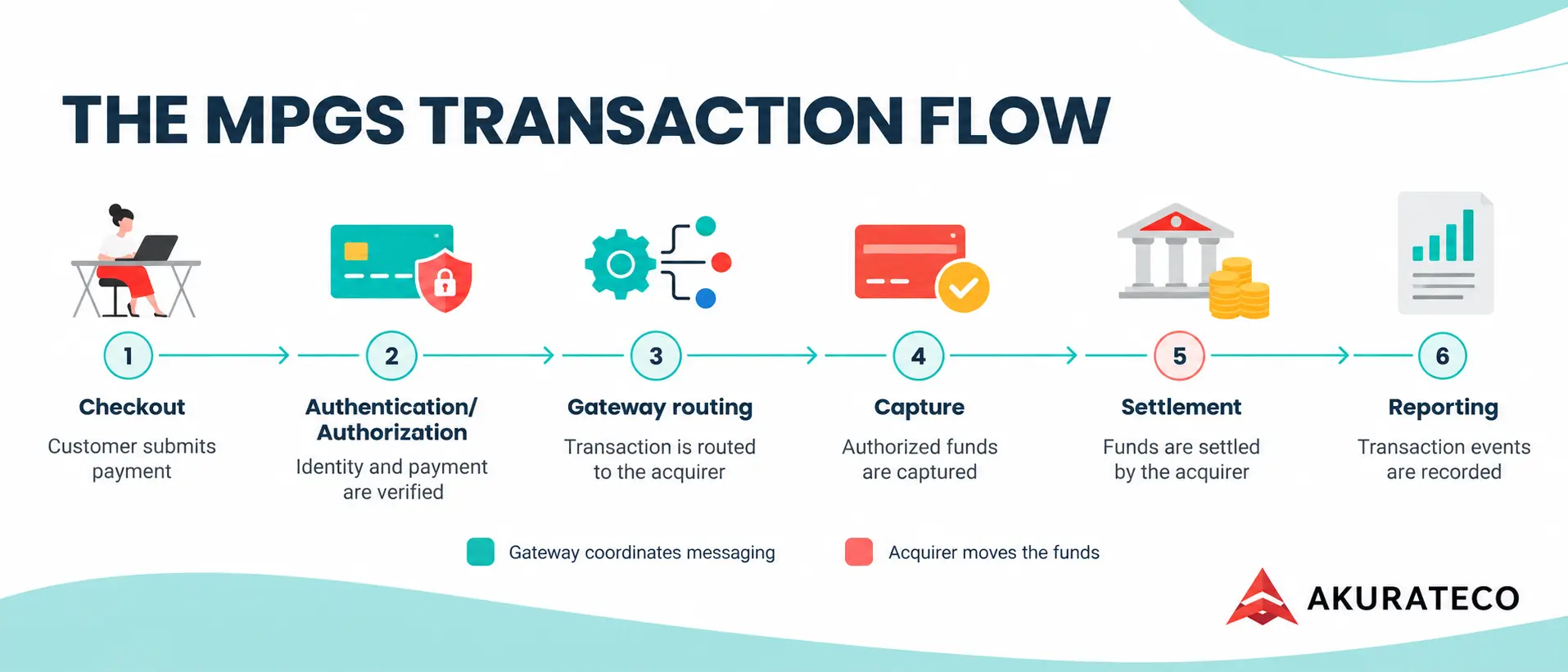
- Checkout initiation. First, the customer selects a payment method and submits the required payment details. Depending on the integration, this information may be collected through a hosted checkout, a mobile SDK, a payment session, or the merchant’s own payment interface.
- Payer authentication and authorization. At this next stage, the gateway can initiate payer authentication where required, such as through EMV 3-D Secure. The merchant then submits an AUTHORIZE or PAY request so the transaction can be assessed by the relevant payment parties.
- Gateway routing and response. When the request is created, Mastercard Gateway securely routes it to the merchant’s configured acquirer or payment provider. The acquirer processes the request through the relevant payment network and issuer, after which the gateway returns the authorization result to the merchant.
- Capture. If the merchant uses a separate authorization-and-capture flow, a successful authorization reserves the requested amount but doesn’t complete the transfer. The merchant later submits a CAPTURE request, often when the order is ready to be fulfilled. Alternatively, a PAY transaction combines authorization and capture into one operation.
- Settlement. After capture, the transaction proceeds to settlement. At this stage, the acquirer coordinates the movement of funds through the payment network according to the merchant’s acquiring agreement. Mastercard Gateway facilitates the transaction messaging, but the acquirer remains responsible for processing settlement and crediting the merchant.
- Reporting. The final phase is when the gateway records relevant transaction events. Merchants can use its reporting capabilities to review authorizations, captures, refunds, authentication activity, risk responses, and settlement responses for reconciliation and operational analysis.
Together, these stages allow Mastercard Gateway to manage the payment journey from checkout to reporting, while the acquirer and issuer remain responsible for authorization decisions and fund settlement.
Payment Authorization and Payer Authentication
Mastercard Gateway receives the transaction request and forwards it through the configured acquiring connection. The customer’s bank decides whether to approve or decline the payment. It may review the identity-check result, available funds, and signs of fraud. The gateway returns that decision to the merchant in a standardized transaction response.
Before authorization, EMV 3-D Secure may verify the cardholder through either a frictionless or challenge flow. In parallel, AI-powered risk tools can analyze transaction data for signs of fraud. While 3-D Secure confirms the payer’s identity, AI screening assesses the overall transaction risk.
Routing, Capture, Settlement, and Reporting
Mastercard Gateway routes authorization and capture messages between the merchant and the configured acquirer or payment processor. Once a payment is authorized, the merchant can submit a capture request immediately or later, depending on the transaction flow.
Settlement is handled separately by the acquirer, which clears the transaction and credits the merchant under their acquiring agreement. Meanwhile, Mastercard Gateway records transaction activity and provides reporting data for monitoring and reconciliation.
Security and Risk Management
Mastercard Gateway uses several tools to protect payments, including tokenization, 3-D Secure, and fraud checks. They reduce exposure to card data, help confirm the customer’s identity, and find possible fraud.
When setting up Mastercard Gateway fraud tools, businesses can also apply risk screening before or after authorization, depending on their provider and integration.
However, no single security feature removes every fraud-prevention, PCI DSS, or regulatory obligation. PSPs must still manage compliance and risk controls according to their integration model, payment flows, acquiring agreement, and operating markets.
Tokenization and PCI DSS Scope
Encryption is a technology that transforms sensitive data into ciphertext to enhance the security of sensitive payment information, such as credit card numbers. In simple terms, it replaces them with a random string of characters called tokens that have no intrinsic value.
MPGS can replace card details with a secure token. However, tokenization does not remove every PCI DSS obligation. The merchant’s PCI DSS duties depend on how it connects to MPGS. They also depend on whether its systems receive, send, or store card data. Hosted or session-based integrations may reduce that scope, while direct API flows can leave more of the payment environment subject to PCI DSS requirements.
EMV 3-D Secure and Fraud Controls
MPGS integrates advanced fraud detection tools, including EMV 3-D Secure authentication, real-time transaction monitoring, and AI-driven risk analysis. However, available controls depend on the merchant profile, acquirer, region, and integration setup.
MPGS Features, Coverage and Regional Adoption
MPGS brings several payment tools into one system. These include acquiring connections, online and in-store payments, tokenization, identity checks, fraud tools, and reports. Together, they help businesses simplify payment operations and gain greater control over the payment flow.
MPGS is not only for merchants. PSPs, banks, marketplaces, and software platforms can also use it to manage payments and support growth.
Mastercard Gateway at a Glance
For a quick overview, the fact box below summarizes Mastercard Gateway’s key capabilities and global coverage.
| Category | Details |
| Current product name | Mastercard Gateway, formerly Mastercard Payment Gateway Services (MPGS) |
| Platform type | Multi-acquirer, omnichannel payment gateway |
| Intended users | Merchants, financial institutions, acquirers, PSPs, and software providers |
| Acquiring connectivity | 200+ global acquirer connections |
| Regional coverage | 170+ countries supported |
| Payment methods | 30+ supported payment methods |
| Payment channels | Online, mobile, and in-person |
| Core capabilities | Payment processing, payer authentication, tokenization, fraud controls, transaction management, and reporting |
Documented Adoption in the Middle East, Africa and Asia-Pacific
A useful Mastercard global payment services overview should include documented examples of how the gateway supports different payment models and regions. With that in mind, we look at the cases below, which demonstrate regional adoption of MPGS.
In September 2024, Amazon Payment Services announced its Mastercard Gateway integration across the Middle East and Africa. The partnership covered Bahrain, Egypt, Jordan, Kuwait, Lebanon, Oman, Qatar, South Africa, and the UAE, while making the gateway available as a payment solution across 40 regional markets. For Amazon Payment Services merchants, the integration aimed to expand payment acceptance and reduce the need for separate integrations.
In May 2023, Mastercard expanded fraud tools in Asia-Pacific through its Vesta integration with MPGS. Eligible customers could opt into Vesta’s risk-scoring and payment-guarantee services, illustrating how Mastercard regional payment solutions can combine gateway processing with additional fraud-management capabilities.
A separate Mastercard integration in the Maldives shows another MPGS use case. In May 2023, Mastercard worked with Maldives Transport & Contracting Company and Bank of Maldives to introduce an MPGS-powered open-loop transit and digital-ticketing system. The solution enabled contactless card payments on buses and ferries, as well as online ticket purchases through a mobile application. Another real-world example is TESS Payments’ implementation in Qatar, where MPGS was deployed alongside local payment connectors as part of a broader PSP infrastructure.
Together, these examples show Mastercard Gateway supporting PSP payment acceptance, e-commerce fraud management, and public-transport payments across the Middle East, Africa, and Asia-Pacific. However, they represent specific announced deployments rather than proof of equal availability across every country, bank, or acquiring connection.
Omnichannel Payment Acceptance
Mastercard Gateway supports payment acceptance across online, mobile, digital wallet, and in-store channels. Businesses can manage payments from one place. These may come from hosted checkouts, APIs, apps, payment terminals, Apple Pay, or Google Pay.
As a result, merchants can offer more consistent payment experiences while managing transaction activity in one environment. For businesses using a Mastercard online payment gateway, this can reduce operational complexity and make it easier to expand into new channels without building a separate payment flow for each one.
Scalability and Flexible Payment Flows
MPGS is designed to handle high transaction volumes, making it ideal for growing businesses. Mastercard Gateway supports modular payment flows that businesses can configure around different transaction types, channels, and operating models. Companies can choose the features they need. These may include tokens, recurring payments, local payment methods, identity checks, and reports.
For PSPs, SaaS platforms, marketplaces, and other companies evaluating Mastercard B2B payment gateway solutions, this flexibility can simplify the management of varied merchant and customer requirements.
The gateway’s ability to support growth depends on the connection, acquiring partner, system design, and commercial agreement. Mastercard Gateway can support changing payment needs. However, it does not promise the same speed or payment volume for every business.
Reporting and Payment Operations
MPGS provides detailed reporting and analytics tools that businesses can use to track transaction performance, identify trends, and optimize their payment strategies. For teams focused on Mastercard payment processing efficiency, centralized data can reduce manual work and support faster operational decisions.
MPGS API, Hosted Checkout and Documentation
Mastercard Gateway offers several ways to connect. Each option gives the business a different level of checkout control and access to card data. Businesses can use its APIs to manage transaction operations such as authorization, capture, refunds, authentication, and recurring payments.
Alternatively, Hosted Checkout uses a payment page managed by Mastercard Gateway. This means the merchant handles less card data, but has less control over the page. Other documented options include Hosted Session, mobile SDKs, Hosted Batch, and shopping cart plugins.
For technical requirements, supported operations, API versions, and implementation details, developers should use the official Mastercard Gateway documentation. MPGS documentation includes conceptual guidance, integration-method comparisons, API references, authentication requirements, and error-handling information.
Mastercard Gateway API
The Mastercard Gateway API gives merchants, PSPs, and platforms deeper control over checkout experiences and backend payment flows. It suits businesses that want to build their own payment interfaces and manage transaction stages within existing systems. Meanwhile, the official MPGS API documentation defines the available request formats, fields, responses, and errors.
API credentials show which merchant account sent the request. They also help protect access to the gateway. The PSP or acquirer provides the credentials and access rights. These settings control which gateway features the merchant can use.
API versions help Mastercard add or update features without changing every connection at once. Each version defines the fields and operations available to the integration, while the MPGS payment gateway API documentation records the relevant technical specifications.
Available API features depend on the merchant’s setup. They may include identity checks, approvals, captures, refunds, cancelled payments, tokens, recurring payments, fraud checks, and payment records. Exact availability varies by provider, acquirer, payment method, and enabled services.
MPGS Hosted Checkout
For businesses that want a simpler way to accept payments, the hosted model provides a checkout page managed by Mastercard Gateway. Merchants can embed it on their website or open it as a separate page. Because Mastercard Gateway collects the payment details, the merchant has less checkout infrastructure to build and maintain.
An API-led checkout gives businesses more control over the design, payment flow, and customer journey. However, it also requires more development work and greater responsibility for payment data and ongoing maintenance.
The choice depends on the business’s priorities. Hosted Checkout can speed up launch, while an API integration offers more flexibility and customization.
Official Documentation, Merchant Portal and Test Resources
The Mastercard Gateway documentation explains the available integration methods, API versions, security tools, testing options, and error codes. These Mastercard Developers portal resources should be the main reference for technical teams. Features may differ by provider and merchant setup.
For MPGS portal access, merchants use the login link and credentials supplied by their payment provider or acquirer. There is no single public portal for all users.
The provider also supplies sandbox credentials. Meanwhile, Mastercard’s official testing resources include MPGS test cards and test scenarios for checking payment flows before launch.
How to Integrate Mastercard Payment Gateway
A Mastercard payment gateway integration can follow one of two paths. Businesses can build a direct connection to MPGS and manage the setup, security, testing, and updates themselves. Alternatively, they can use a maintained connector from a payment software provider, which reduces development work and can speed up launch. For the broader process, see how direct integrations compare with the alternatives.
This MPGS integration guide explains both options so you can compare the level of control, technical effort, and ongoing support each one requires.
Option 1: Direct Mastercard Gateway API Integration
A direct integration gives businesses full control over their payment setup, checkout flow, and backend processes. It works best for organizations that already have a commercial agreement with a provider or acquirer and an in-house engineering team.
This option also requires the business to manage security, compliance, testing, updates, and ongoing support. For that reason, it suits companies with enough technical and operational resources to maintain the connection over time.
Prerequisites: Commercial, Technical, and Compliance
Before development starts, businesses should confirm the Mastercard compliance and integration requirements for their setup. This includes the commercial agreement with an acquirer or payment provider, access to the required markets, and support for the planned payment methods and transaction flows.
The provider or acquirer supplies the merchant credentials, security keys, and access to the relevant gateway services. Teams should confirm which API version, authentication method, and features their account supports.
The connection type affects the work required. It also affects which systems fall under PCI DSS. A direct API connection gives the business more control. However, its team must secure, test, update, and maintain the connection. The business must manage its agreements with acquiring partners. It must also follow card-security rules and local laws.
Build, Test in Sandbox, and Go Live
Start by building the required payment flows, such as authorization, capture, refunds, and recurring payments. Add payer authentication, tokenization, security controls, and clear error handling based on the official Mastercard Gateway documentation.
Next, use Mastercard API sandbox environments and test data to check each flow from start to finish. Test approved and declined payments, 3-D Secure paths, refunds, timeouts, and other common errors. Some acquirers may also require certification before launch.
Once testing is complete, move the integration to production in stages. Monitor payment results, errors, and response times after launch. The team must also maintain the connection, review API changes, update security controls, and fix issues as they arise.
Option 2: MPGS Integration Through Akurateco
PSPs can connect to MPGS through Akurateco instead of building the integration from scratch. The connector has been in production since May 2021 and can reduce development work and speed up launch. Businesses can also explore Akurateco’s available payment connectors when planning additional acquiring, wallet, local payment method, or alternative payment integrations.
Akurateco manages the connector and its technical updates. The PSP or acquirer still handles commercial agreements, merchant oversight, local rules, and its own compliance duties.
Configure and Enable the MPGS Connector
First, Akurateco enables the MPGS connector for the PSP or acquirer. The team then adds the required MPGS credentials and links the connection to the correct merchant account and MID.
Next, users configure the payment flows, currencies, methods, and routing rules in the admin panel. The exact settings depend on the MPGS account, acquirer terms, and services enabled for the business. Akurateco’s documentation confirms that MID settings control parts of the payment flow.
Before launch, the PSP tests approved and declined payments, callbacks, refunds, and other key flows. Akurateco provides test tools and a sandbox mode for developers. Once the tests pass, the team enables the production connection and monitors the first live payments.
Supported Akurateco MPGS Flows
Akurateco’s MPGS connector supports several card, wallet, and authentication flows. The current integration includes:
- Multiple MPGS API versions to support different Mastercard and bank requirements.
- Card flows: Single Message Service (SMS), Dual Message Service (DMS), and recurring payments.
- Apple Pay and Google Pay: wallet payments with routing, cascading, and DMS flows.
- 3-D Secure: 3DS 1, 3DS 2.1, 3DS 2.2, and frictionless authentication.
- Optional parameter settings for terminals, business models, and acquirer requirements.
- Ongoing connector updates to reflect changes in MPGS specifications and bank requirements.
This coverage allows PSPs and acquirers to configure MPGS around their payment setup without building and maintaining each flow from scratch.
What Implementation Looks Like: Discovery to Go-Live
The process starts with discovery. Akurateco reviews the PSP’s markets, payment methods, card and wallet flows, 3-D Secure needs, routing rules, and acquirer setup. This helps define the right connector settings before development begins.
Next, the team adds the MPGS credentials and configures the merchant accounts, MIDs, currencies, and payment flows. Akurateco also helps connect MPGS with the PSP’s existing payment providers, routing rules, merchant accounts, and payment flows.
The PSP then tests the connection in a sandbox. Key cases include successful and failed payments, 3-D Secure flows, refunds, recurring payments, Apple Pay, Google Pay, and any scenarios required by the acquirer.
After validation, the team enables the production connection and checks the first live transactions. From there, Akurateco can help review routing, payment results, and connector settings as volumes and business needs change.
The impact of that routing optimization can be significant. Across Akurateco’s MENA deployments, authorization rates improved by 15–22% and failed transactions decreased by 20–25%, particularly in multi-acquirer and cross-border setups, according to Akurateco’s MENA deployment data.
Direct MPGS Integration vs. Akurateco
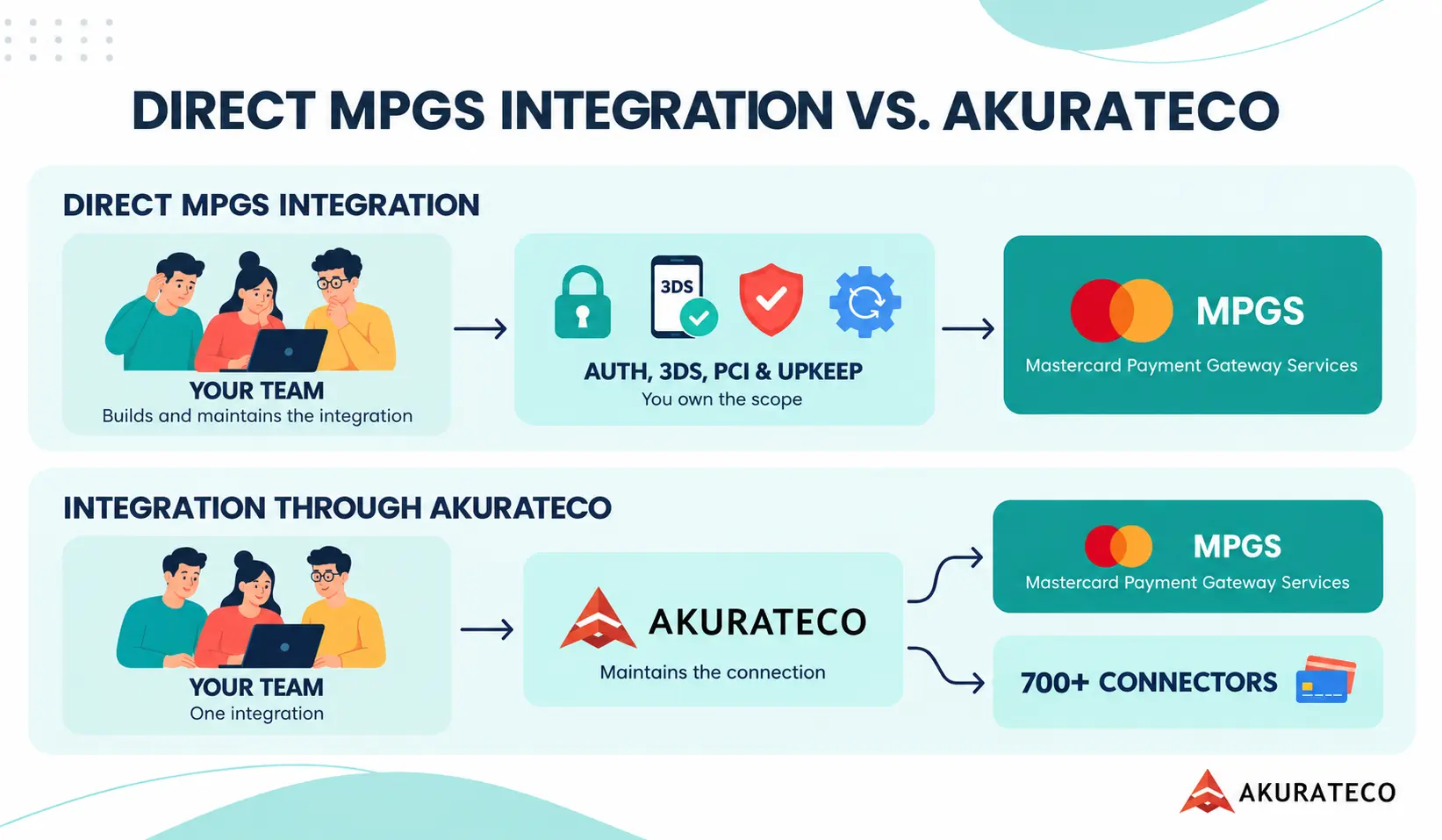
Both options provide access to MPGS, but they place work and control in different hands. A direct integration gives the business more control, while Akurateco reduces the work needed to build, test, and maintain the connection.
| Factor | Direct MPGS integration | MPGS integration through Akurateco |
| Time to market | Longer setup | Faster launch |
| Engineering effort | Requires in-house developers | Minimal technical involvement |
| Compliance & security | Fully managed by business | Handled by the provider |
| Customization | High (but requires effort) | Flexible with pre-built tools |
| Cost efficiency | Higher initial investment | Lower upfront costs |
| Scalability | Requires manual expansion | Easily scalable with the provider’s infrastructure |
FAQ
What does MPGS stand for?
MPGS stands for Mastercard Payment Gateway Services, now known as Mastercard Gateway. It lets businesses accept and manage digital card payments worldwide, online, in-store, or via mobile.
Is Mastercard a payment gateway or a card network?
Mastercard is a payment network. It connects banks, merchants, and cardholders. MPGS is a payment gateway. It sends payment data between a business and its acquirer.
Does MPGS provide an API and Hosted Checkout?
Yes. MPGS offers an API for businesses that want more control over payment flows. It also offers Hosted Checkout, where Mastercard Gateway manages the payment page. The official Mastercard Gateway documentation explains both options.
How do you integrate Mastercard Payment Gateway?
You can build a direct MPGS connection with your own team. This gives you more control. But it also requires development, testing, PCI DSS work, and ongoing maintenance. Another option is to connect through Akurateco. MPGS is already built into the platform, which also offers 700+ connectors. This can speed up launch and give you access to card, wallet, 3-D Secure, and routing flows without building the connector from scratch.
How much does Mastercard Gateway cost?
Mastercard does not publish one standard price for all users. Mastercard payment gateway fees depend on the acquirer or payment provider, the market, transaction volume, payment types, and added services. Businesses should ask their provider for a quote and a full list of setup, monthly, and transaction fees.
How long does MPGS integration take?
There’s no guaranteed timeline. It depends on the integration method, payment flows, team size, compliance work, testing, and acquirer approval. A ready connector may speed up the process, while a direct API integration often takes longer.