

- What Is a Payment Gateway, and How Does It Work?
- Why Build Your Own Payment Gateway? Pros and Cons
- Build or Buy? A 5-Question Decision Check
- How to Build a Payment Gateway from Scratch: Step-by-Step
- How to Build a Payment Gateway from Scratch: Step-by-Step
- Key Factors to Consider When Building a Payment Gateway
- How Much Does It Cost to Build a Payment Gateway?
- Can You Create a Payment Gateway for Free?
- Custom vs. White-Label Payment Gateway: Which Option Is Better?
- How Akurateco Helps You Launch Your Own Payment Gateway Faster
- Real Results: How PSPs Succeed With Akurateco
- Conclusion
Building a payment gateway involves developing and certifying software that securely handles payment data, sends transactions for approval, routes them, and manages settlement. Once you add integrations, compliance, infrastructure, and operations, the project can take several months and cost hundreds of thousands of dollars.
The Federal Reserve Payments Study reports that U.S. card payments hit 187.7 billion transactions worth $11.5 trillion in 2024, growing 6% per year since 2021. Cards now account for 79% of all noncash payments. The Fed’s latest research reports that mobile wallet payments also jumped to 14.4 billion in 2022, up from 2.9 billion in 2018. For payment providers, these trends mean building infrastructure that is capable of processing high volumes of transactions and supporting wallets alongside cards, as many merchants expect today.
Payment service providers, acquiring banks, SaaS companies, and ISOs should first consider how much responsibility comes with building a gateway. Owning the technology gives you more control over payments, merchant services, data, pricing, and product development, but it also means you take on ongoing work in engineering, compliance, security, and operations.
This guide walks you through 12 practical steps to build your own payment gateway. It also explains the real costs, key architecture elements, security measures, and important questions to consider before deciding to build in-house.
If you want to offer payment services under your own brand but don’t want to build every part yourself, a white-label platform like Akurateco can be a more practical route.
What Is a Payment Gateway, and How Does It Work?
A payment gateway is a technology that lets merchants accept online payments securely by connecting a customer’s payment method, such as a card or digital wallet, to the merchant’s acquiring bank or processor. It validates, encrypts, and transmits the sensitive payment data between these parties, then returns the issuer’s response to the merchant.
It’s easy to confuse terms like payment gateway, payment processor, payment service provider, and merchant account. Each plays a different role in the payment system.
| Component | Main function | Provides | Key role |
|---|---|---|---|
| Payment Gateway | Collects payment data from the customer and passes it on | Data encryption, transmission, transaction approval or rejection | Bridge between the website, customer, and processor |
| Merchant Account | Specialized bank account for accepting non-cash payments | Fund reception, handling of chargebacks and refunds | Virtual wallet for the merchant |
| Payment Service Provider | Offers a suite of fintech tools, including a payment gateway | Payment gateway, analytics, risk management, multi-method payment support | All-in-one payment solution provider |
| Payment Processor | Transfers transaction data between banks and payment systems | Communication between issuing and acquiring banks | Executes the financial part of the transaction |
The term “payment processor” is used in two ways. In the context of card transactions, the processor passes authorization and settlement messages between the acquiring bank, the card network, and the issuing bank. When referring to payment service providers (PSPs), by contrast, it usually means the entire platform that a provider operates, including a gateway, connections to the acquirers and payment methods, and the processing carried out under the provider’s license. In this second sense, developing your own payment processor is equivalent to developing your own payment gateway, and the steps outlined in this guide apply to both cases.
A standard payment transaction follows five basic steps:
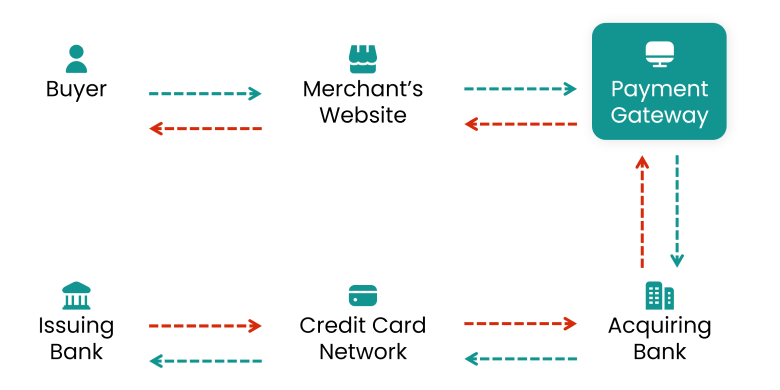
- The customer initiates payment on the merchant’s website.
- The payment gateway captures and encrypts the payment information.
- The payment processor connects to the card network for authorization.
- The issuer bank, which is the customer’s bank, approves or declines the transaction.
- The gateway returns the issuer’s response to the merchant and, in real time, confirms the result to the customer.
Settlement is a distinct stage since the processor forwards the approved transactions via the card network and the money is transferred from the issuing bank to the acquiring bank, which in turn pays the merchant.
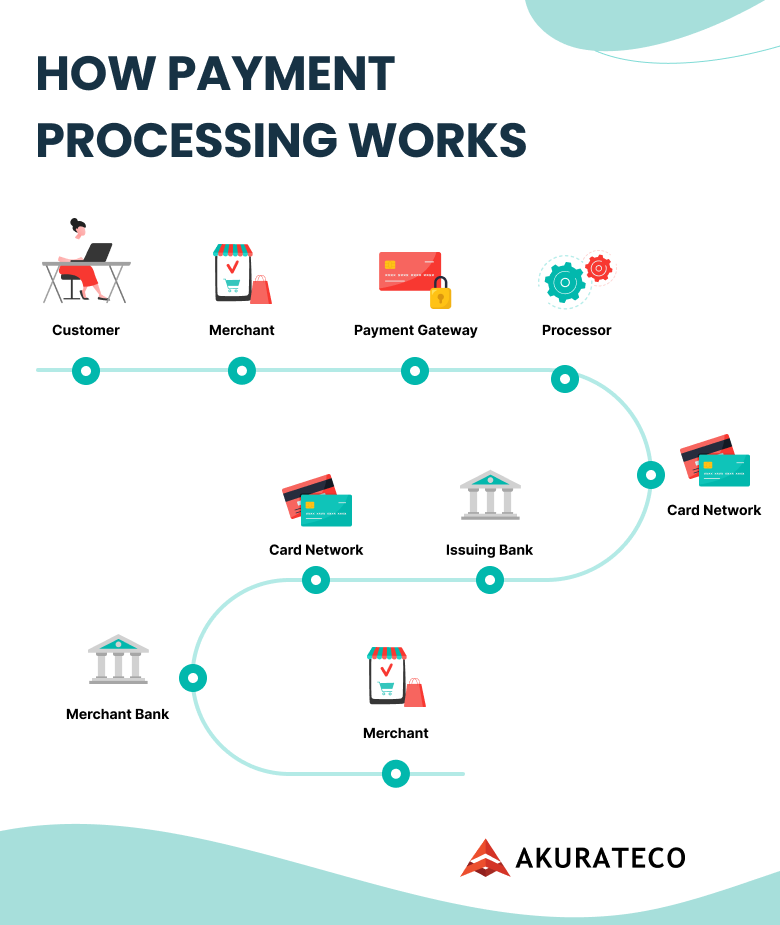
Simply put, a payment gateway functions as a secure means of communication between the customer, the merchant, the processor, the acquirer, and the issuer, ensuring that the sensitive payment data is sent to the right parties and that the merchant gets a reliable result for the transaction.
Why Build Your Own Payment Gateway? Pros and Cons
Companies generally choose to develop their own payment gateway when payments become a key element of their product or of their revenue model. Rather than adjust their operations to suit a third-party gateway, they prefer to have control over how transactions are accepted, routed, monitored, and reported.
While the possible benefits are considerable, the fact of setting up a payment gateway also involves taking on a permanent responsibility for important financial infrastructure.
Fee control
A business selects its processors and acquirers, negotiates commercial terms, determines merchant prices, and manages its margins. Larger-scale operations may benefit from lower external gateway fees. But you still have to pay interchange fees, network fees, acquiring costs, fraud losses, hosting expenses, and staffing costs.
Customization
An in-house platform can be tailored to suit a particular business model, region, merchant segment, or transaction flow, including custom routing, checkout, integrations, billing, reporting, and merchant-management tools. The same applies to every feature, which then has to be built, tested, secured, and maintained internally.
Data ownership
The use of a proprietary gateway gives one direct access to transaction data, information about merchant activity, responses from providers, declined transactions, refunds, chargebacks, settlements, and performance indicators. On the one hand, it improves routing, reporting, pricing, fraud analysis, and product development. But on the other hand, it also requires greater responsibility for data security and access control.
Market differentiation
You build your own infrastructure and can, in turn, offer specialized payment methods, risk controls, reporting tools, routing options, and merchant experiences that distinguish you as a PSP or fintech. At the same time, this benefit heavily depends on continuous investment in provider integrations, security, payment methods, and product development.
Costs and operational responsibilities
Building and operating a gateway requires engineering, DevOps, QA, security, compliance, product, and payment operations resources, alongside infrastructure, certifications, fraud management, reconciliation, merchant support, and ongoing releases. When estimating the expenses of internally developed software, maintenance must also be included and can amount to approximately 20 percent of the initial development cost annually.
| Pros | Cons |
|---|---|
| Control over the product roadmap and payment flows | High initial build cost |
| Flexibility in merchant pricing and provider selection | Permanent PCI DSS and security responsibility |
| Direct ownership of transaction and performance data | Complex fraud and chargeback operations |
| Custom integrations and merchant experiences | Long integration and certification timelines |
| Potential long-term savings at high volume | Continuous maintenance and 24/7 support |
It will make the most sense to build the system when payment technology is treated as a strategic business asset, and the company is willing to keep it as its permanent financial infrastructure.
Build or Buy? A 5-Question Decision Check
Whether to license a white-label payment gateway software or to develop it in-house should be based on the strategic value of owning the technology, the budget available, and the required launch timeline.
Before you decide whether to build or buy, you should answer these five questions.
- Is payments your core product?
It’s easier to justify building when the payment technology is central to the company’s revenue and competitive position rather than merely a supporting function.
- Can you fund a permanent payments and compliance team?
After the launch, the work continues with annual audits, software updates, integrations, infrastructure monitoring, fraud operations, support, and compliance updates.
- Do you need to generate revenue from processing itself?
It makes sense to own the infrastructure when transaction fees, merchant services, and payment technology are major sources of revenue.
- Is launching within six months critical?
An in-house build is probably not the best idea for the company that needs predictable near-term market entry.
- Do you already have PCI DSS and payment-security expertise?
Without internal expertise, the company will need to hire specialists, consult outside consultants, and spend extra time on remediation and certification.
Several “no” answers usually indicate that purchasing or licensing infrastructure is more practical. For a complete analysis, read our build-vs-buy guide for PSPs.
How to Build a Payment Gateway from Scratch: Step-by-Step
A payment gateway goes beyond simply providing a checkout page or a transaction API since it also has to link together merchants, processors, acquirers, payment methods, security systems, and reporting tools with the operational teams.
The process, as outlined in the 12 steps, extends from defining the business model to running the platform in production.
1. Understand the business model of a payment gateway
Before you begin the build, you should decide how the gateway is going to generate revenue and what role it will play in the payment ecosystem.
Revenue can be obtained through transaction markups, setup fees, regular platform charges, access to a gateway, fraud-management tools, reporting services, currency conversion, or other value-added services.
Define the merchants, industries, regions, payment methods, and transaction flows the gateway will support. Akurateco’s guide to how payment gateways generate revenue explains the most common pricing schemes in greater detail.
2. Set goals and needs
Define the gateway’s functional, technical, operational, and regulatory requirements.
Specify the expected transaction volumes, the currencies, the types of merchants, the settlement models, the provider connections, the payment methods, the user roles, the reporting requirements, and the deployment regions.
The requirements must also include specifications regarding availability, response times, data-retention rules, security controls, disaster-recovery objectives, and the duties of each internal team.
3. Hire a skilled development team
Form a team that has experience in software engineering, payment processing, infrastructure, and cybersecurity.
Most projects will need a product manager, a business analyst, a solution architect, backend and frontend developers, DevOps engineers, QA engineers, security specialists, and compliance professionals.
Knowledge of the payment domain is essential, since transaction states, retries, captures, refunds, chargebacks, settlements, and provider responses cannot be handled in the same way as ordinary e-commerce records.
4. Choose technology stack
Choose programming languages, frameworks, databases, infrastructure, observability tools, message queues, and deployment technologies that match the gateway’s performance and security requirements.
The technology stack must allow for horizontal scaling, provide service isolation, enable automated deployment, include disaster recovery, manage secrets securely, and ensure reliable processing when there are traffic spikes or when the service provider fails.
Decide whether the gateway will be located on-premises in your own data center or with a cloud provider. Although cloud hosting makes scaling easier, it doesn’t eliminate the PCI DSS obligations since you share responsibility for the cardholder-data environment with the provider.
5. Design architecture
Design a scalable architecture taking into account the anticipated transaction loads, merchant configuration, provider connectivity, and the operational requirements.
Describe how the payment API, token vault, routing engine, provider connectors, reporting services, ledger, merchant-management system, and administrative interface will talk to each other.
The architecture should also establish the cardholder-data environment in such a way that systems outside of this boundary are not unnecessarily included within the scope of PCI DSS.
6. Implement core features
Set up the central gateway functions, covering payment creation, authorization, capture, voids, refunds, the retrieval of transaction status, error handling, recurring payments, and tokenization.
For a commercial PSP platform, the core functionality should also include merchant onboarding, user roles, fees, limits, routing configurations, transaction monitoring, reporting, and operational tools.
7. Ensure system security
Implement layered controls to protect payment information and gateway operations.
These controls should include encryption, tokenization, hosted payment fields, access management, network segmentation, fraud prevention, audit logging, rate limiting, and protected key storage.
Payment routing should remain separate from the fraud and security controls that determine whether a transaction is safe to process.
8. Integrate with payment processors
Connect the gateway to the APIs of processors, acquirers, banks, payment methods, fraud providers, and other required services.
Every connector must have request mapping, response normalization, authentication, timeout handling, retry logic, status synchronization, reconciliation support, and ongoing maintenance whenever the external provider changes its API.
9. Run a system test
Run unit, integration, contract, performance, resilience, security, and end-to-end tests.
Check completed transactions as well as the edge cases such as duplicate requests, timeouts, partial captures, delayed webhooks, processor outages, authentication failures, and inconsistent statuses.
Load and failover testing should confirm that the gateway can continue processing or fail safely when individual components become unavailable.
10. Obtain the essential certifications and licenses
Make sure that all the certifications, registrations, contractual approvals, and audits needed for the gateway’s business model and the jurisdictions it aims at are completed.
This could involve PCI DSS validation, penetration testing, certification by the processor or acquirer, meeting the requirements of the card schemes, complying with data-protection controls, and obtaining authorization as a regulated payment provider.
Technology certification and regulatory licensing are separate workstreams. The exact obligations depend on whether the company supplies gateway software or also performs acquiring, money movement, merchant settlement, or other regulated services. Providers that move or settle merchant funds may need, for example, state money transmitter licenses and FinCEN MSB registration in the US, or an EMI or PI license in the EU and UK, together with an AML and KYC program.
11. Go into live mode
Carry out the deployment of the gateway via a controlled launch in the production environment.
How to Build a Payment Gateway from Scratch: Step-by-Step
Begin by selecting certain merchants, service providers, types of transactions, or regions, and then gradually increase the volume. Arrange for these initial merchants to be onboarded using KYC/KYB checks and provide them with a sandbox in which to test the system before introducing live traffic. Employ monitoring, dashboards, logs, and alerts to keep track of latency, errors, approval rates, processor availability, queue delays, reconciliation discrepancies, and any suspicious activity.
12. Conduct ongoing maintenance
Establish permanent processes for software updates, provider changes, vulnerability management, infrastructure scaling, support, certification renewals, and incident response.
The team must continuously maintain integrations, improve routing, update fraud rules, add payment methods, renew certificates, and adapt to regulatory and card-scheme changes.
Architecture Blueprint: What You Are Actually Building
The design of the payment gateway architecture starts with establishing the boundary of the card-data environment. The fundamental components are:
- Card-data environment. Card numbers, card verification codes, encryption keys, and detokenization services remain within a tightly controlled environment. Instead of getting the actual card details, merchant dashboards, analytics systems, support tools, and the majority of business applications are given tokens or masked data.
- Token vault. A secure vault receives sensitive payment data and substitutes it with a non-sensitive token, after which other gateway services can use the token to handle ongoing or later transactions without having to store the original card number.
- Transaction state machine. A transaction moves from created to authorized, captured, and settled. However, the system also has to handle failed authorizations, partial captures, voids, refunds, reversals, chargebacks, and expired transactions. Specific rules govern state transitions rather than allowing each service to freely alter statuses.
- Idempotency keys. They serve to prevent customers and merchants from experiencing duplicate charges. If a merchant resubmits a timed-out request using the same key, the gateway will return the original result rather than setting up a second transaction.
- Message queues. Queues isolate services and take over tasks that do not need to block the initial payment request. These include webhooks, reporting, reconciliation, notifications, and provider-status checks run asynchronously.
- Signed webhooks. Merchants receive signed events for authorization, capture, refund, chargeback, and settlement-status changes. The contract defines signature verification, duplicate-event handling, retry intervals, and event identifiers.
- Internal ledger and daily reconciliation. The ledger records the financial effect of transactions, fees, refunds, chargebacks, and settlements. The reconciliation procedure involves comparing these records with the reports provided by the processor or acquirer and then forwarding any discrepancies for investigation.
Read Akurateco’s guide to payment gateway architecture for a deeper technical explanation of gateway components and data flows.
The Core API Surface
To build a payment gateway API, start with a small, stable contract that covers the full payment lifecycle.
The purpose is not to expose every internal service. Merchants need predictable operations, clear error responses, and consistent transaction states across different processors.
| Endpoint or operation | Purpose | Key edge cases |
|---|---|---|
| Create payment or authorize | Create a transaction and request authorization | Duplicate requests, authentication requirements, timeouts, soft declines |
| Capture | Capture all or part of an authorized amount | Partial capture, expired authorization, already captured payment |
| Refund | Return all or part of a captured payment | Multiple refunds, refund limits, asynchronous processor result |
| Void | Cancel an authorization before capture | Already captured, expired, or previously voided transaction |
| Retrieve status | Return the gateway’s current transaction state | Delayed provider updates, pending state, status mismatch |
| Webhook contract | Notify merchants about asynchronous events | Signature verification, duplicate events, retries, delivery order |
Every request must have a unique merchant reference, include an idempotency key when appropriate, carry out validation of the amount and currency, use structured error codes, and adhere to a consistent response model.
The webhook contract should document event types, payload versions, signature generation, verification instructions, retry behavior, and the conditions under which merchants should retrieve the latest transaction status.
The article outlines the minimum API surface at contract level and doesn’t include production code or a working processor integration.
Security Implementation Checklist
PCI DSS and security principles translate into these technical controls:
- Hosted payment fields isolate card-data collection from the merchant’s general application.
- Tokenization replaces card numbers before other gateway services store or process transactions.
- Encryption in transit protects merchant, processor, administrative, and internal-service connections.
- Encryption at rest protects databases, backups, logs, and files containing sensitive information.
- HSM or KMS infrastructure protects cryptographic keys and supports controlled rotation and revocation.
- Network segmentation isolates the cardholder-data environment from analytics and corporate systems.
- 3-D Secure 2 supports issuer authentication and challenge flows.
- Fraud scoring evaluates transaction, device, merchant, payer, velocity, and behavioral signals.
- Audit logging records administrative actions, configuration changes, and access to sensitive systems.
- Rate limiting protects payment APIs against abuse, credential attacks, and accidental retry loops.
- An incident response plan explains how to find, report, control, share information about, and fix problems.
Key Factors to Consider When Building a Payment Gateway
To make the platform commercially viable, the transaction API is only one of the elements that need to be taken into account. The platform operator has to consider how the system will perform with respect to multiple merchants, payment methods, processors, markets, and operational teams.
Scalability and uptime
The gateway has to be able to cope with an increasing number of merchants, the rising volume of transactions, traffic spikes, and the integration with various providers without there being a single point of failure.
Capacity planning should cover application services, databases, queues, tokenization systems, dashboards, reports, and connector traffic.
High availability also demands redundancy, automated failover, backups, testing of the disaster recovery plan, and clearly stated recovery objectives.
Fraud and chargeback management
Fraud controls must incorporate transaction rules, velocity checks, signals from the payer and the device, merchant-level configurations, blocklists, allowlists, and third-party scoring.
The chargeback function should enable operational teams to be informed about disputes, associate them with the relevant transaction, gather evidence, keep an eye on the deadlines, and report any trends to the merchants.
Checkout experience
The operator of a platform should optimize the checkout process for the various merchants it serves.
All the features relating to hosting pages, the payment fields, redirects, the authentication process, mobile behavior, local languages, and the way in which payment methods are displayed can influence the conversion rates of your merchants.
The system should allow configuration at the merchant level without it being necessary to carry out custom engineering for each different checkout option.
Multi-currency and local payment methods
Accepting international payments involves more than just showing prices in various currencies.
The gateway must manage currency validation, provider availability, settlement currencies, regional restrictions, payment-method-specific fields, refunds, and reporting.
By providing supporting cards, making use of bank transfers, offering wallets, and including local payment methods, merchants are able to give their customers the payment options that they already trust.
Value-added services
Many platform operators want to expand the platform beyond basic payment acceptance. For that, they add recurring billing, digital wallets, Buy Now, Pay Later, invoicing, payment links, network tokenization, account updater services, payment analytics tools, and automated onboarding.
These services increase merchant retention and create additional revenue streams.
Microservices approach
A microservices approach can isolate payment processing, merchant management, provider connectors, reporting, reconciliation, billing, fraud management, and notifications.
As long as the boundaries are well thought out, teams can deploy and scale services independently.
Microservices do, however, lead to complexity typical of distributed systems. The architecture has to deal with duplicated events, eventual consistency, communication between services, monitoring, coordinating deployments, and recovery.
How Much Does It Cost to Build a Payment Gateway?
To give a realistic cost estimate, it is necessary to include more than just the cost of the first software release.
The entire amount of investment includes spending on product engineering, certification, infrastructure, integrations with providers, security tooling, ongoing operations, and long-term maintenance.
ScienceSoft estimates that a custom payment gateway can cost $100,000–$300,000+ and take approximately 6–11 months to build.
These figures are only preliminary benchmarks and do not include full three-year cost-of-ownership estimates.
| Cost component | What it includes | Cost behavior |
|---|---|---|
| Development team | Product management, architecture, backend, frontend, DevOps, QA, security, and documentation | High initial cost followed by permanent staffing |
| PCI DSS Level 1 certification and audits | Assessment preparation, remediation, external auditing, and penetration testing | Initial and recurring annual cost |
| Infrastructure and hosting | Production environments, databases, queues, backups, monitoring, logging, and disaster recovery | Recurring fixed and usage-based cost |
| Fraud tooling | Rules, scoring, device intelligence, case management, and chargeback tools | Subscription, usage, and loss-related cost |
| Card-scheme and provider certification | Processor testing, acquirer approval, and connector certification | Per-integration and recurring update cost |
| 24/7 operations staffing | Monitoring, incidents, support, reconciliation, fraud operations, and infrastructure management | Permanent recurring cost |
| Ongoing maintenance | Security updates, API changes, compliance changes, testing, and new functionality | Approximately 20% of initial build cost annually |
The final figure depends on the number of integrations, payment methods, merchant tools, supported markets, availability requirements, deployment model, and level of customization.
A basic transaction API connected to one processor is not comparable to a commercial PSP platform with merchant onboarding, routing, cascading, billing, reconciliation, reporting, fraud management, and 24/7 support.
Teams that want outside engineering support can review the scope of payment gateway development services.
The Break-Even Question
Owning a gateway becomes cheaper than paying an external technology provider only when annual savings are greater than the gateway’s amortized build cost and fixed operating expenses.
The break-even calculation requires two main inputs: annual fixed costs and savings per transaction. These values are then used to determine the annual transaction volume needed to break even. Processing a high monetary value does not automatically create a break-even point because the relevant metric is the avoidable fee per transaction.
A simplified formula is:
Break-even annual transactions = annual operating cost plus annualized build cost, divided by savings per transaction.
For example, assume a company spends $300,000 on the initial build and amortizes it over three years. If annual operations cost $250,000, the annual cost base is $350,000.
If owning the gateway saves $0.05 per transaction, the break-even point is:
$350,000 ÷ $0.05 = 7,000,000 transactions per year.
The example does not take into account financing costs, fraud losses, downtime, unplanned integrations, or the opportunity cost of delaying market entry. That’s why companies need to work out conservative, expected, and high-volume scenarios prior to giving their approval of the project.
Can You Create a Payment Gateway for Free?
No. By using open-source components, you can set up your own payment gateway without having to pay software license fees, but running it in a production environment will still entail high costs.
The unavoidable expenses include:
- Hosting, databases, backups, monitoring, and network infrastructure
- PCI DSS assessments and penetration testing
- Processor, acquirer, and payment-method fees
- Engineering, DevOps, security, and QA personnel
- Continuous oversight and incident response
- Provider integrations and certification
- Fraud prevention and chargeback operations
- Compliance and legal work
- Maintenance and vulnerability remediation
Open-source software changes how certain engineering costs are allocated. It does not eliminate the responsibility for operating secure and compliant payment infrastructure.
What About Open-Source Payment Gateways?
An open source payment gateway can provide useful building blocks rather than a complete operating business.
Projects such as Hyperswitch offer open-source payment orchestration and modular payment functionality. Kill Bill provides open-source billing and payment infrastructure with APIs and gateway plugins.
Such projects might include a transaction model, a connector framework, routing facilities, a billing engine, APIs, or administrative features. They are capable of decreasing the amount of software that has to be developed from scratch.
A self-hosted payment gateway still involves the need for deployment, security hardening, integrating with providers, preparing for PCI DSS, monitoring, obtaining certification, carrying out reconciliation, providing operational support, and carrying out continuous upgrades.
The software license can be free, but running the platform is not.
If you want to compare the two routes in more detail, look at how open-source and white-label orchestration platforms compare.
| Factor | Open-source and self-hosted | White-label gateway |
|---|---|---|
| Upfront cost | Low or no software license fee, but substantial engineering and infrastructure cost | Commercial setup and subscription |
| Time to launch | Commonly several months, depending on integrations and certification | Faster when required functionality and connectors are available |
| PCI burden | Primarily owned by the implementing company | Divided according to the deployment and contractual model |
| Who operates it | The company’s engineering, compliance, security, and operations teams | Core software is maintained by the technology provider |
| Three-year cost | Staff, infrastructure, audits, integrations, security, and maintenance | Setup, subscription, configuration, integrations, and client-side operations |
Custom vs. White-Label Payment Gateway: Which Option Is Better?
Whether to choose a custom build or a white-label platform should be decided based on product strategy, engineering capacity, the capital available, and the expectations regarding the launch.
A custom payment gateway provides control over the codebase, architecture, integrations, product roadmap, and operating model. However, the company is still responsible for engineering, testing, security, certifications, provider maintenance, monitoring, documentation, and support.
For instance, adding just one connector can take two months. Let’s assume you need dozens of connectors, which may be the case for many companies. The total time and costs then add up rapidly.
A white-label platform offers a ready-made technical base that you can brand and set up for your business. In this model, you keep control of the merchants, pricing, commercial terms, provider relationships, and market strategy, while the vendor provides and maintains the core software.
| Factor | Custom gateway | White-label gateway |
|---|---|---|
| Control | Maximum control over code and architecture | Brand, merchant, commercial, configuration, and operational control |
| Upfront cost | High engineering, infrastructure, certification, and recruitment cost | Lower initial investment based on setup and configuration |
| Time to market | Commonly several months or longer | Faster and more predictable |
| Maintenance owner | Internal engineering and operations teams | Core platform maintained by the technology vendor |
| Compliance owner | Company owns the complete technical scope | Responsibilities are divided according to deployment and business model |
A custom platform is most suitable for organizations with mature payment-engineering teams and a strategic reason to own every technical layer.
White-label infrastructure is usually more practical when speed, operational readiness, and predictable costs matter more than complete source-code ownership. For a more detailed look at this model, see the complete guide to white-label gateways.
How Akurateco Helps You Launch Your Own Payment Gateway Faster
Many PSPs, acquiring banks, and other payment providers use white-label technology because they need control over a branded payment service without building the full infrastructure themselves.
Akurateco’s white-label payment gateway gives clients a ready-made foundation to launch and run a payment platform under their own brand.
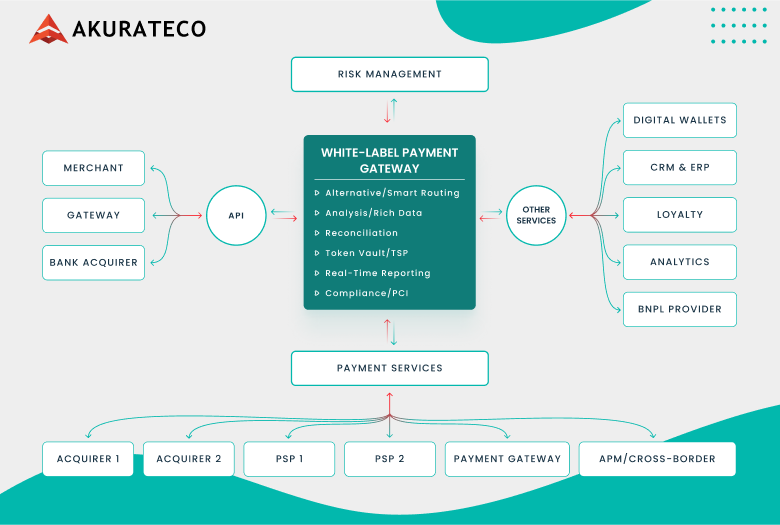
Instead of creating merchant management, provider connectivity, reporting, billing, reconciliation, security tools, and back-office functionality as separate projects, companies can configure them within one ecosystem.
Clients keep control over branding, merchants, pricing, commercial terms, target markets, and provider strategy. Akurateco is responsible for maintaining and updating the core software, supporting the integrations, and providing various deployment models.
The ecosystem includes:
- Smart routing
- Cascading
- Recurring billing
- Automated merchant onboarding
- Payment analytics and reporting
- Fraud-prevention tools
- PCI DSS Level 1–certified infrastructure
- Chargeback-management functionality
- Merchant, fee, and limit configuration
- Provider-agnostic connectivity with 700+ integrations and custom connectors on request
A white-label gateway does not replace the legal, licensing, acquiring, risk, and commercial responsibilities of operating a payment business. It provides the technical foundation needed to manage those responsibilities without independently creating every software component. Akurateco provides the gateway and orchestration layer on top of your acquirers; it does not process transactions itself.
Request a tailored demo to compare the required integrations, configuration, deployment model, and expected launch process.
Real Results: How PSPs Succeed With Akurateco
A white-label platform is most valuable when it helps a payment business solve a specific regulatory, integration, localization, or scaling challenge.
Dinero Pay and TESS show how Akurateco’s infrastructure meets the market and operational requirements of the MENA region.
Dinero Pay — Saudi Arabia
Dinero Pay needed to launch a mobile-focused payment platform in Saudi Arabia while meeting local hosting, data-protection, and financial-sector requirements.
If the client had developed the entire gateway infrastructure and the wallet integrations in-house, this would have led to a higher cost and a delay in launching in the market.
Akurateco set up its white-label platform for use on Oracle Cloud Infrastructure and provided support for integrations with Apple Pay, Google Pay, Tabby, and Tamara.
The local infrastructure configuration, merchant onboarding, routing, retries, analytics, training, and fraud-prevention tools were also part of the project.
Outcome: Dinero Pay achieved SAMA certification, reduced engineering and operational costs, accelerated integrations, and enabled merchants to offer major mobile wallets and local BNPL methods.
Read the complete Dinero Pay case study.
TESS — Qatar
TESS required a payment infrastructure that could scale to meet Qatar’s data-localization requirements, connect with both local and international providers, achieve PCI DSS certification, and enable a future move from a SaaS arrangement to a dedicated environment.
The company initially launched through Akurateco’s SaaS platform. Akurateco supported connections to providers including MPGS, Doha Bank, and NAPS, assisted with certification, and prepared the platform for migration to Microsoft Azure infrastructure.
Outcome: TESS secured its Qatar Central Bank PSP license and PCI DSS certification, entered the market quickly, and gained high-profile clients, including a major regional telecommunications provider.
Read the complete TESS case study.
Conclusion
Setting up a gateway is a major infrastructure initiative which only becomes worthwhile for companies that have strong payment expertise, plenty of capital, a large volume of transactions, and long-term engineering resources. When considering this option, teams must balance the advantages of having full control and flexibility over the technology against the costs and responsibilities of running it.
For many PSPs acquiring banks, SaaS platforms, and ISOs, white-label payment gateway software like Akurateco offers a faster alternative, combining brand ownership with ready-made provider connectivity, payment routing, reporting, fraud controls, and merchant management tools.
FAQ
Can I create my own payment gateway?
Yes, but it’s complex. Custom payment gateway development requires extensive knowledge of payment processing, PCI DSS, security, encryption, and applicable regulatory requirements. You’ll need to integrate with acquirers, processors, and other payment providers, manage transaction routing, and ensure your system is secure and scalable.
How to set up a payment gateway?
Setting one up takes five stages: define business and technical requirements, build the core payment functions, secure the platform to PCI DSS, integrate with acquirers and processors, and launch in phases with selected merchants. The 12 steps in this guide break each stage down.
What licenses or registrations do you need to run a payment gateway?
The exact licenses and registrations depend on the services you provide and the countries where you operate. You may need a registered legal entity, PCI DSS certification, an acquiring bank or processor sponsorship, data-protection registration, and authorization as a payment institution or another regulated payment provider if you handle funds or provide regulated payment services.
Do I need to build a payment gateway for my website?
No. Most online merchants simply integrate an existing gateway. Custom building is mainly relevant to PSPs, PayFacs, ISOs, and other platforms that manage complex payment flows or serve multiple merchants.
Can you build a payment gateway like Stripe?
In principle, yes. A realistic first version needs hosted checkout, tokenized card storage, recurring billing, merchant and administrative dashboards, developer APIs, reporting, and dispute handling. However, Stripe-level scale requires hundreds of engineers and direct card-scheme and financial-institution relationships, so most companies target a focused first version for specific merchants, regions, and payment methods.
Can you build a payment platform like PayPal?
Yes, in principle, but a PayPal-like platform is much broader than a payment gateway. It may require digital wallets, stored balances, peer-to-peer transfers, merchant payments, identity verification, AML monitoring, payouts, fraud operations, dispute handling, and a regulated internal ledger. Most companies begin with one focused payment product instead of recreating a global platform.
How much does it cost to build a payment gateway?
ScienceSoft estimates that building a custom payment gateway costs approximately $100,000–$300,000+, depending on its features, integrations, architecture, security requirements, and deployment model. The total investment may be higher once PCI DSS certification, infrastructure, fraud tools, provider integrations, 24/7 operations, and ongoing maintenance are included.
How long does it take to build a payment gateway?
A custom payment gateway typically takes between six and twelve months to build. Stripe cites a range of 6–12 months, while ScienceSoft estimates 6–11 months for a custom project. PCI DSS preparation, security remediation, processor certifications, card-scheme approvals, and connector integrations can extend the timeline.
How do payment gateways make money?
Payment gateways earn revenue through transaction, recurring platform, setup, and other technology-related fees. These charges are separate from interchange, scheme fees, and acquiring costs, which go to other participants in the payment chain. Providers that also offer processing or acquiring may earn additional margin from those services.
What is the difference between a payment processor and a payment gateway?
In the card flow, a payment gateway securely captures and transmits payment information from the customer to the payment processor. A payment processor handles the transaction after the gateway sends it, working with banks and card networks to authorize and settle the payment.
Can you build your own payment processor?
Yes. For most PSPs, it is the same project as building a payment gateway: a platform with a gateway, acquirer connections, and processing under their own license. Becoming a processor in the card-network sense is a separate step that requires acquiring-bank sponsorship and registration with the card schemes.
How to become a payment gateway?
Becoming a payment gateway or provider means launching a payment business with the necessary licensing or sponsorship, secure infrastructure, financial integrations, compliance procedures, and merchant operations. See Akurateco’s guide to the payment gateway business model for the business side.
Can I use a white-label payment gateway instead of building one?
Yes. White-label payment gateways provide ready-made infrastructure that can be branded as your own. For most PSPs, a white-label solution is the faster route to market. It can also reduce operational and compliance workload, although regulatory and PCI DSS responsibilities still depend on the business model, integration, and jurisdiction.