

Payment system architecture shows how the components that accept, authorize, route, settle, and record payments are organized and connected. It directly affects approval rates, transaction costs, payment reliability during a provider outage, and how quickly you can launch new payment methods and markets.
This guide breaks payment architecture down into its components and layers, follows one transaction through them, and covers the main architecture approaches and design best practices.
What is payment system architecture?
Payment system architecture is the blueprint that shows which part of a payment system does what and where the data goes. It assigns each task to a specific component and sets the points where a transaction leaves the system for outside parties, such as acquirers and card networks. It also marks where card data is stored and transmitted, which helps define the scope of a PCI DSS assessment.
A payment gateway represents one layer of this system. The gateway sends the payment request from checkout to a processor or acquirer and returns the response along the same path. Payment system architecture looks at the gateway together with risk checks, routing between acquirers, settlement, reconciliation, and reporting. We cover payment gateway architecture and its components in a separate guide.
Payment infrastructure is the shared base that many payment systems connect to, such as card networks and clearing houses. Payment system architecture is the design of one organization’s own system: which components a PSP, acquiring bank, or enterprise merchant runs and how they connect to that shared base. Two PSPs can connect to the same card networks and still build very different architectures.
Core components of a payment system
A payment system is built from several core components, from the checkout where the customer pays to the ledger and reports where each payment ends up. Some run in-house. Others, such as acquiring and the card networks, often come from partners. In a typical payment platform architecture, one product covers several components. For example, a payment orchestration platform usually combines the gateway with routing.
Channels and checkout
A customer meets the payment system through a website, a mobile app, a POS terminal, or a payment link. The channel decides which payment methods the customer sees and how card details are captured.
Payment gateway
A payment gateway acts as an intermediary between merchants and banking institutions, securely encrypting and transmitting transaction data. It does not approve or decline payments.
Payment orchestration and routing
A system with more than one acquirer needs a routing decision for every transaction. Routing rules make that decision based on card brand, issuing country, currency, processing cost, or each acquirer’s approval rate. If an acquirer is down or returns a decline that can be retried, cascading sends the transaction to another acquirer in the same checkout session.
Payment processor, acquirer, and card networks
In card payments, three parties usually sit between the merchant and the cardholder’s bank:
- The acquirer is the bank or licensed institution that contracts with the merchant and takes on the risk of its card sales.
- The processor runs the technical side, often for the acquirer, and exchanges authorization and clearing messages with the card networks.
- Card networks such as Visa and Mastercard route each request to the issuing bank and set the rules for clearing and settlement.
Merchant accounts and ledger
Merchants need a merchant account with an acquirer to accept card payments. Settled funds reach the merchant on the acquirer’s payout schedule.
The ledger is the system’s internal record of every money movement: sales, fees, refunds, chargebacks, reserves, and payouts. In a double-entry ledger, every balance traces back to the transactions behind it.
Fraud prevention and security
Tokens ensure fewer systems hold card data. With 3D Secure, the issuer checks that the real cardholder is paying. Risk scoring flags suspicious transactions before they are sent for authorization.
Clearing, settlement, and reconciliation
After capture, the acquirer sends transactions to clearing, card networks work out who owes what, and funds usually move in daily batches. Reconciliation then checks settlement files against internal records. It helps catch missing payments and unexpected fees.
Reporting and data
Approval rate by acquirer and country, decline reasons, chargebacks, and fees can provide key insights teams can act on to optimize payments. Since each provider sends data in its own format, the system maps it into one common model first.
Compliance
Compliance rules apply to every component above. PCI DSS sets security requirements for any system that stores, processes, or transmits card data. GDPR governs the personal data of people in the EU, and PSD2 requires strong customer authentication for most electronic payments in the European Economic Area. Other markets add their own rules, such as data residency requirements that keep payment data in the country.
The layers of a payment system
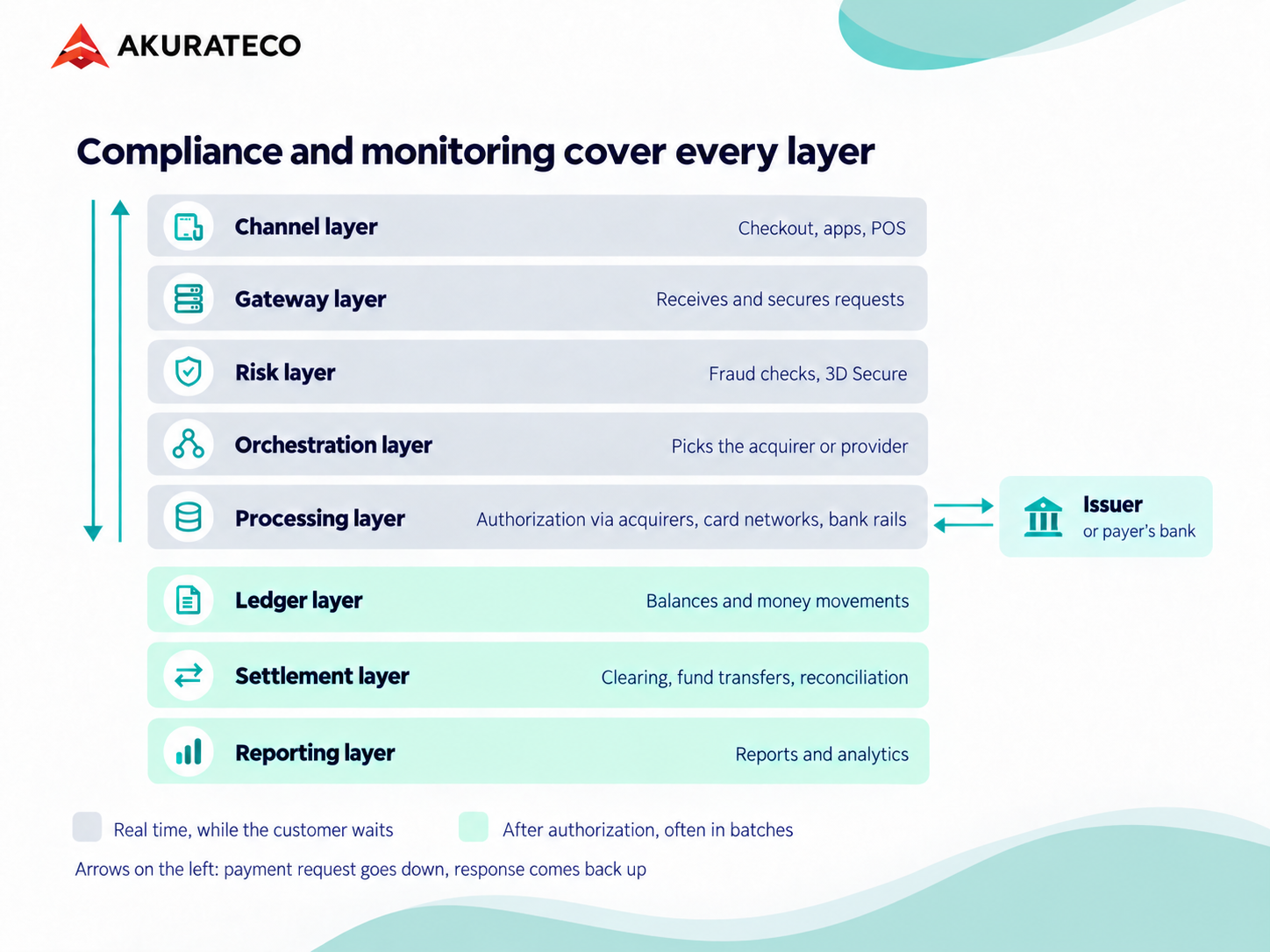
Most payment systems are organized in layers, and each layer has one job. In a layered payment processing architecture, checkout sits at the top, and the ledger, settlement, and reporting sit at the bottom. Because each layer talks to its neighbors through defined interfaces, a team can add an acquirer in the routing layer without changing checkout.
| Layer | What it does | Typical components |
|---|---|---|
| Channel layer | Captures payment details where the customer pays | Checkout pages, hosted payment page, mobile SDKs, POS terminals, payment links |
| Gateway layer | Receives and secures payment requests | Payment API, tokenization |
| Risk layer | Screens each transaction before authorization | Fraud rules, risk scoring, 3D Secure |
| Orchestration layer | Picks the acquirer or provider for each transaction | Routing engine, cascading rules, acquirer and payment method connectors |
| Processing layer | Gets each payment authorized by the issuer or the payer’s bank | Processors, acquirers, card networks, instant payment rails |
| Ledger layer | Records every balance and money movement | Double-entry ledger, merchant accounts, fee and reserve rules |
| Settlement layer | Moves funds and matches them against internal records | Clearing files, settlement reports, reconciliation engine, payouts |
| Reporting layer | Turns transaction data into reports and alerts | Dashboards, data warehouse, finance exports |
How a transaction moves through the layers
In a typical payment processing system architecture, a card payment moves through the layers in two phases. Authorization runs in real time, where the request travels down from checkout to the issuer, and the approval or decline comes back up within seconds. Settlement runs later, when the money moves and the ledger and reports are updated.
- At checkout, the channel layer collects the card details and sends a payment request with the amount and currency to the gateway.
- The gateway validates the request and tokenizes the card number. It also assigns a transaction ID that every later step reuses, which is what makes reconciliation possible at the end.
- Risk checks score the transaction, and a high score can block it or send the customer to 3D Secure before anything reaches an acquirer.
- Routing picks the acquirer based on rules such as card brand, currency, or recent approval rate.
- An authorization request then goes from the acquirer’s processor through the card network to the issuer, which approves or declines it.
- The response travels back up the same path to checkout. Before a decline that can be retried reaches checkout, the orchestration layer may try another acquirer.
At this point, the customer sees a result, but no money has moved yet.
- After capture, the acquirer submits the day’s transactions for clearing. Card networks calculate what each party owes and settle the funds, and the acquirer sends settlement files that list every transaction and fee.
- Reconciliation matches those files against internal records by transaction ID. Matched payments are posted to the ledger as settled. Anything that does not match goes to a review queue, and reports pick up the final figures.
Our step-by-step guide to a card payment covers who does what between the cardholder and the issuer.
Choosing the right architecture
There are different architectural approaches to implementing a payment system:
1. Monolithic Architecture
Payment systems have traditionally been built as monoliths. It’s the kind of architecture where every function is in one tightly coupled codebase. That keeps early development simple. But growing companies often hit its limits, because the whole application scales as one block and every update means a full release.
2. Microservices Architecture
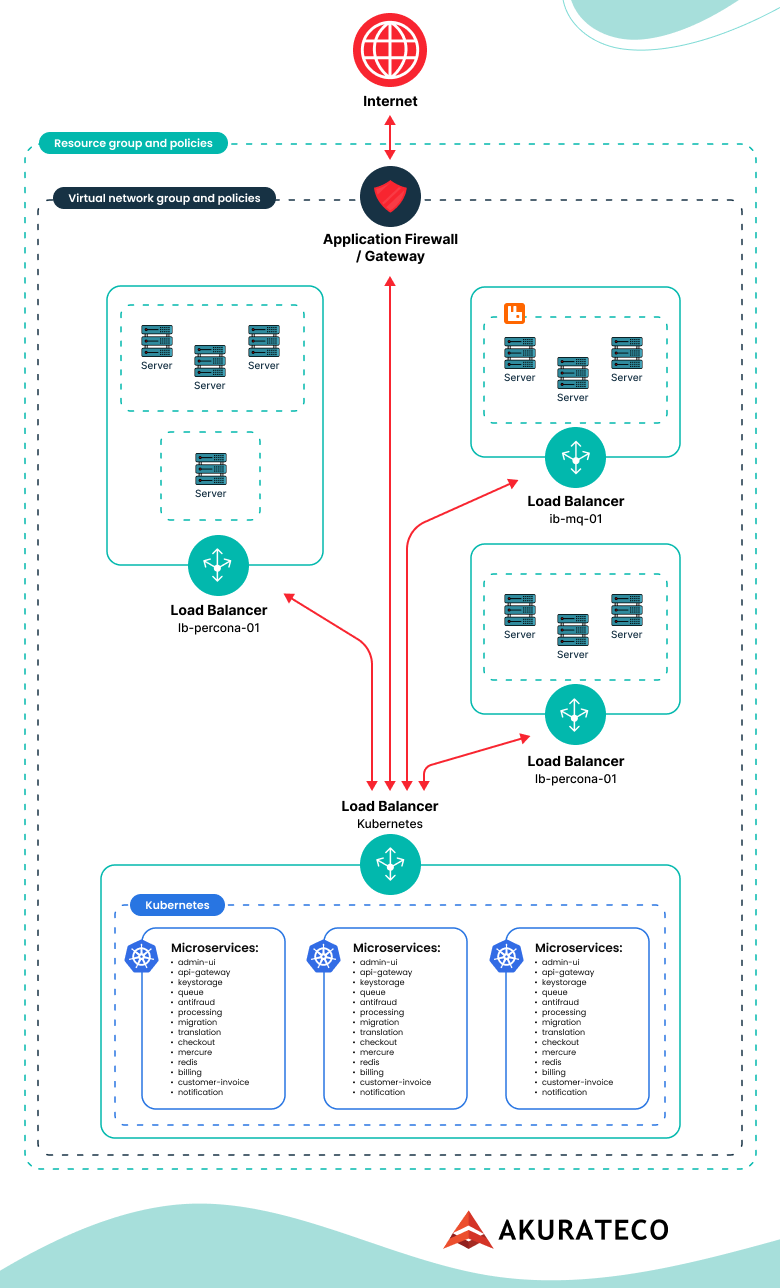
Microservices break the system into independent services that talk to each other through APIs. Scaling and updating each service separately becomes easier.
That independence is also the downside. Each connection between services needs security, monitoring, and a plan for when it fails.
3. Cloud Payment Solutions
With cloud computing on the rise, many payment platforms are moving from their own data centers to the cloud. Automatic scaling absorbs traffic peaks, and several availability zones keep the system up if one fails. Cloud payment systems can also run in regions close to customers, which suits companies with international operations. Infrastructure costs can drop too, because capacity follows demand.
4. Event-Driven Architecture
In an event-driven payment architecture, each component publishes what happened, such as “payment authorized” or “refund completed”, to a message broker. Services subscribe to the events they need, so the ledger, merchant webhooks, and reports update in near real time without the gateway calling each of them.
With a durable queue, events for a service that is down wait until it recovers, so updates are delayed rather than lost. Many brokers deliver at least once. That means the same event can arrive twice and every consumer has to process it idempotently. Stored events also give reconciliation a full history of each payment’s status changes.
Event-driven design usually works alongside microservices. The authorization call stays synchronous because the customer is waiting for an answer, while the steps after it can run on events.
Designing for scale, resilience and security
A scalable payment system architecture also has to be resilient and secure. It keeps payments flowing through traffic peaks and provider outages without charging anyone twice or exposing card data. The following six payment system design practices make that possible.
Horizontal scaling and peak loads
Scaling out means adding more instances of a service instead of moving it to a bigger server. This works when services are stateless and keep payment state in a shared database or cache, so any instance can take any request. Peaks such as Black Friday or salary days are known in advance, which leaves time to load-test well above normal volume.
High availability and failover
No single server, database, data center, or provider should be able to stop payments.
In practice, each service runs in at least two availability zones, and the database is replicated. Key markets get more than one acquirer, so routing can switch when one goes down. Health checks and automatic failover matter as much as the spare capacity, because a standby that nothing switches to does not help.
Idempotency and a consistent ledger
Each request should carry an idempotency key, so the system can recognize a repeat and return the original result instead of charging again. The ledger works on the same principle: entries are never modified, only reversed with new entries, so that each balance remains consistent and can be audited.
Observability and alerting
Logs, metrics, and traces must track each payment across the various layers using its transaction ID, and alerts should monitor both business signals and the servers since a sudden decrease in the approval rate at one acquirer can indicate a problem before any error chart does.
Security by design
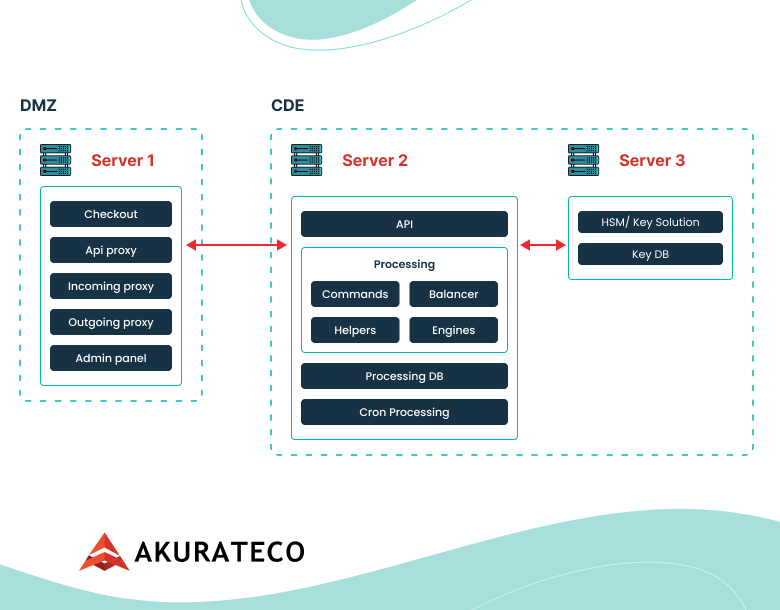
The earlier card numbers are swapped for tokens, the fewer internal services ever see real card data. Data moves between services over TLS. Stored data is encrypted as well, with keys kept in a hardware security module or a managed key service, apart from the data they protect. Network segmentation then gives the systems that handle card data a zone of their own.
Compliance by design
The fewer components touch card data, the smaller the PCI DSS scope and thus the lighter each assessment. Data residency needs the same early attention. When a market requires payment data to stay in the country, the system has to run a regional deployment there. A regional setup is much harder to add to a finished system than to plan from the start.
Build, buy or combine the components
With a full in-house build, the team takes on compliance across jurisdictions, security and fraud prevention, a large upfront investment, and every integration with banks and processors. It provides control, but it is often not the most cost-effective or fastest option. To learn the scope of an in-house project, read our guide about what building your own gateway involves.
Buying means running on a vendor’s ready-made platform, usually under your own brand. It is the fastest route and moves most of the integration and compliance work to the vendor, in exchange for less control over the roadmap.
The middle path keeps the components that set the company apart, such as the ledger or risk models, and connects them to a ready gateway or orchestration layer.
For a full comparison, see build vs buy a payment gateway.
Where Akurateco fits
For PSPs, acquiring banks, and enterprise merchants, Akurateco provides ready-made gateway and orchestration layers for this architecture, with 700+ integrations and PCI DSS v4.0.1, Level 1 compliance. It runs as SaaS, On-Premises, or in a cloud-agnostic setup, wherever data rules require. Akurateco is not a payment processor and does not process transactions itself; clients bring their own acquiring. Teams still comparing vendors can start with our overview of payment orchestration platforms.
Conclusion
Architecture decisions end up in the numbers payment teams track every day, visible in approval rates, cost, how well the system holds up when a provider fails, and how fast it can change.
If you are planning a new stack or modernizing an old one, you can hand the gateway and orchestration layers to Akurateco and focus engineering on what makes your offering different.
FAQ
What is payment system architecture?
Payment system architecture shows how a payment system is put together. It defines which components the system uses, what each one does, and how a payment moves between them, from checkout to settlement and reporting.
What are the main components of a payment system?
A payment system is made up of nine core components: checkout channels; a payment gateway; payment orchestration and routing; processors, acquirers, and card networks; merchant accounts and a ledger; fraud prevention and security; clearing, settlement, and reconciliation; reporting and data; and compliance.
What are the main payment system architecture approaches?
The four common approaches are monolithic architecture (simple to start, but scales and updates as one block), microservices architecture (modular, scalable, resilient), cloud-based architecture (auto-scaling, high availability, potentially lower infrastructure cost), and event-driven architecture (near real-time updates, safer retries).
How do you design a payment system?
It’s important to first map the components and layers the system needs. Pick the architecture next. Failover, idempotency, observability, security, and compliance belong in the first design. The last decision is what to build in-house and what to take ready-made, such as the gateway and orchestration layers.
What are the three types of payment systems?
In central-bank terms, a payment system is a shared network that moves money between banks, which this guide calls payment infrastructure. A common split is large-value, batch, and fast payment systems. A November 2024 paper on FedNow by Charles Kahn, written for a Federal Reserve Bank of Boston conference, describes the Federal Reserve’s three services this way: Fedwire moves large interbank payments, FedACH processes payments in batches, and FedNow releases funds within seconds, 24/7.