

- What is single-API multi-acquirer integration?
- Why enterprises move beyond direct acquirer integrations
- Direct acquirer integrations vs payment orchestration
- How single-API multi-acquirer integration works
- Where smart routing and cascading fit
- What enterprise payment teams should centralize
- Build in-house or use a payment orchestration platform?
- What to evaluate before choosing a solution
- Common mistakes to avoid
- Conclusion
Enterprise payment teams rarely struggle because they have too few providers. More often, they struggle because every provider adds another API, another reporting format, another reconciliation flow, another fallback process, and another operational dependency.
A payment orchestration platform helps solve this by giving enterprises a single integration layer for managing multiple acquirers, PSPs, gateways, payment methods, and transaction routes. Instead of connecting each acquirer separately, the merchant connects once to the orchestration layer and manages payment logic centrally.
For large merchants, this is not only a technical convenience. It affects approval rates, provider resilience, regional expansion, cost control, reconciliation, and the payment team’s ability to make changes without turning every provider decision into a development project.
What is single-API multi-acquirer integration?
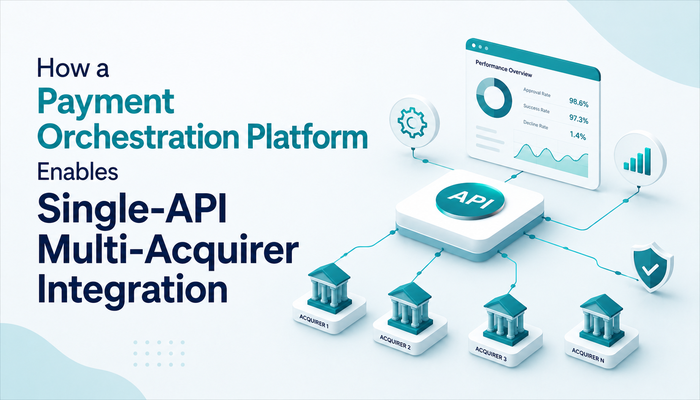
Single-API multi-acquirer integration is a payment architecture where an enterprise merchant connects to one orchestration layer instead of integrating separately with every acquirer or PSP. The orchestration layer then manages provider connectivity, transaction routing, failover logic, reporting, and operational controls.
In a direct integration model, every new acquirer creates additional technical and operational work. Your team has to manage API documentation, message formats, error codes, provider-specific testing, settlement files, reconciliation logic, monitoring, and ongoing maintenance. For a detailed breakdown of this process, see Payment Gateway Integration: A Step-by-Step Guide for Business Owners.
In a single-API model, the payment orchestration platform becomes the central control layer between checkout and the provider network. It does not remove the importance of acquirers. It makes them easier to manage, compare, route between, and scale.
This approach is especially useful for enterprise merchants that operate across several countries, currencies, product lines, or customer segments. The more complex the payment footprint becomes, the more valuable centralized payment infrastructure becomes.
Why enterprises move beyond direct acquirer integrations
Direct acquirer integrations can work at early scale, but they become harder to manage when the business expands across regions, payment methods, and risk profiles. The issue is not only technical integration. It is the operational complexity that follows.
A merchant working with one acquirer may have limited backup options when approval rates drop, outages occur, costs change, or local payment requirements become more demanding. Adding a second or third acquirer helps, but it also creates fragmentation if each connection is managed separately.
Common enterprise problems include:
- slow provider onboarding;
- inconsistent transaction data;
- fragmented decline reporting;
- manual reconciliation across acquirers;
- limited ability to test provider performance;
- poor fallback logic after soft declines;
- routing decisions that require development work;
- unclear visibility into cost, approval rate, and latency by provider.
A multi-acquirer setup should give the payment team more flexibility. Without the right infrastructure, it can create more operational noise.
Direct acquirer integrations vs payment orchestration
A multi-acquirer strategy is not the same as payment orchestration. You can have several acquirers and still lack centralized routing, analytics, cascading, and reporting.
| Approach | How it works | Advantages | Limitations | Best for |
| Direct acquirer integrations | The merchant integrates with each acquirer separately | Full direct control over each connection | High maintenance, fragmented reporting, slower provider changes | Smaller setups with limited provider needs |
| Single PSP setup | One PSP manages most processing | Simple to operate | High dependency on one provider, limited fallback flexibility | Early-stage or low-complexity payment operations |
| Multi-acquirer without orchestration | Several providers are connected, but logic is managed separately | More provider choice | Operational fragmentation, manual optimization, inconsistent data | Transitional setups |
| Payment orchestration platform | One API connects the merchant to multiple acquirers, PSPs, methods, and routing rules | Centralized control, routing, cascading, analytics, provider visibility | Requires strategic setup and governance | Enterprise merchants processing at scale |
For enterprise payment teams, the goal is not to add providers for the sake of adding providers. The goal is to turn provider optionality into measurable operational control.
How single-API multi-acquirer integration works
Single-API multi-acquirer integration places an orchestration layer between the merchant’s checkout or payment system and the provider network. The merchant sends payment requests to one platform, and the platform applies routing, provider selection, retries, monitoring, and reporting logic.
A typical workflow looks like this:
| Stage | What happens | Systems involved | Operational value |
| Payment initiated | Customer starts a card, wallet, bank transfer, or local payment method transaction | Checkout, merchant backend | Standardizes the starting point |
| Request sent through one API | Merchant sends transaction data to the orchestration layer | Merchant system, orchestration API | Reduces provider-specific integration complexity |
| Routing logic applied | The platform selects a provider based on rules or performance data | Routing engine, provider configuration | Improves control over cost, region, risk, and performance |
| Transaction processed | The selected acquirer or PSP processes the payment | Acquirer, PSP, issuer, scheme | Keeps provider choice flexible |
| Cascading triggered if needed | Eligible failed transactions are retried through another provider | Cascading engine, backup provider | Helps recover soft declines |
| Data centralized | Transaction status, decline reasons, provider response, and settlement data are collected | Dashboard, analytics, reporting tools | Improves monitoring and reconciliation |
| Optimization loop | Payment teams review performance and adjust rules | Payment operations, finance, risk | Turns payment data into operational decisions |
This model gives enterprises a more manageable way to scale payment infrastructure. New acquirers, payment methods, or routing rules can be introduced through the orchestration layer instead of becoming separate integration projects every time.
Where smart routing and cascading fit
Smart routing and cascading are the mechanisms that make a multi-acquirer setup operationally useful. Without them, multiple acquirers may simply sit next to each other without meaningful optimization.
Smart routing selects the most relevant provider for a transaction based on defined parameters. These may include region, currency, BIN, card type, issuer, payment method, transaction amount, risk level, provider cost, or historical performance.
Cascading acts as a controlled fallback process. If a transaction fails for an eligible reason, the platform can retry it through an alternative provider within the configured payment flow. This is especially relevant for soft declines, temporary provider issues, or routing mismatches.
For example, an enterprise merchant may decide that:
- domestic European card traffic should go through a local acquirer first;
- high-value transactions should follow a specific risk route;
- certain BIN ranges should avoid providers with weaker issuer performance;
- recurring payments should use providers with stronger token and retry performance;
- backup routing should activate only for specific decline categories.
The value is not automation alone. The value is governed automation: routing logic that reflects commercial goals, risk rules, provider performance, and customer experience.
What enterprise payment teams should centralize
A single API is only useful if it centralizes more than transaction submission. Enterprise payment teams need control over the full payment operating layer.
| Capability | Why it matters | What to look for |
| Provider connectivity | Reduces dependency on one PSP or acquirer | Ability to connect multiple acquirers, PSPs, APMs, wallets, and local methods |
| Routing rules | Gives the payment team control over payment paths | Routing by country, currency, BIN, card type, amount, risk level, provider performance |
| Cascading logic | Helps recover eligible failed transactions | Configurable retries, decline-code logic, provider fallback rules |
| Payment analytics | Turns transaction data into decisions | Approval rate, decline reason, provider latency, route performance, cost visibility |
| Reconciliation support | Reduces manual finance work | Centralized transaction, settlement, and provider data |
| Risk controls | Protects performance without blocking good customers | Fraud filters, risk rules, provider-specific controls |
| Dashboard and reporting | Gives teams one operational view | Custom dashboards, exports, provider comparison, performance monitoring |
| Scalability | Supports new markets without rebuilding infrastructure | Flexible API, provider expansion, localization, multi-currency support |
For enterprise merchants, this central layer becomes a practical control room for payment operations. It helps payment, finance, risk, and product teams work from the same data instead of interpreting separate provider reports.
Build in-house or use a payment orchestration platform?
Enterprises can build multi-acquirer infrastructure internally, but the decision should be based on long-term maintenance, not only initial development. Building the first integration is rarely the hard part. Maintaining provider logic over time is where the real cost appears.
An in-house setup may make sense for companies with a large payment engineering team, highly specific processing requirements, and the budget to maintain provider connectivity, dashboards, reconciliation logic, routing rules, fraud controls, monitoring, and compliance processes internally.
A payment orchestration platform is usually more practical when the business needs multi-provider flexibility but does not want every payment optimization decision to depend on internal development resources.
| Decision factor | In-house build | Payment orchestration platform |
| Initial control | High | High, within platform configuration |
| Speed to add providers | Slower | Faster through existing connectivity |
| Routing flexibility | Custom-built | Configurable through orchestration rules |
| Maintenance burden | Internal team owns it | Platform partner handles core infrastructure |
| Reporting consistency | Must be built and normalized | Centralized by design |
| Reconciliation effort | Often fragmented unless heavily engineered | Easier to standardize across providers |
| Best fit | Very large teams with unique infrastructure needs | Enterprises that need flexibility, visibility, and faster optimization |
Akurateco fits this second model: instead of managing fragmented PSP and acquirer integrations separately, enterprise merchants can use an orchestration-first approach to route, monitor, and optimize transactions across providers from a centralized layer.
What to evaluate before choosing a solution
Choosing a payment orchestration platform is not only a technical procurement decision. It is an infrastructure decision that affects payment performance, provider negotiation, market expansion, finance operations, and customer experience.
Before choosing a platform, enterprise teams should evaluate:
- Provider coverage
Can the platform support the acquirers, PSPs, APMs, wallets, and local payment methods you need now and may need later? - API flexibility
Does the API support the payment flows, data fields, statuses, and edge cases your business requires? - Routing depth
Can you route by region, currency, amount, BIN, issuer, card type, risk level, provider performance, and business priority? - Cascading controls
Can you define when retries should happen, which providers should be used, and which decline categories should not be retried? - Data normalization
Does the platform standardize provider responses, decline reasons, transaction statuses, and settlement data? - Analytics and monitoring
Can payment teams compare acquirer performance by market, payment method, route, and customer segment? - Reconciliation support
Does the platform reduce manual matching across provider files, settlements, refunds, and transaction records? - Risk and fraud configuration
Can risk rules be adjusted without damaging legitimate approval rates? - Operational governance
Can payment teams change routing logic safely, track changes, and avoid uncontrolled experimentation? - Scalability
Can the platform support new countries, currencies, providers, and payment methods without creating a new integration backlog?
The strongest platforms do not simply connect providers. They help enterprise teams operate payments as a controlled, measurable, and adaptable system.
Common mistakes to avoid
A multi-acquirer setup can improve payment resilience, but only when it is designed carefully. Poor implementation can increase complexity without improving performance.
Common mistakes include:
- adding acquirers without defining routing logic;
- treating all declines as retryable;
- optimizing only for approval rate while ignoring cost and risk;
- failing to normalize provider response codes;
- separating payment analytics from reconciliation;
- giving payment teams no direct control over routing changes;
- relying on one PSP as the “main” provider without real fallback governance;
- expanding into new markets before checking local acquiring and method coverage.
The most effective payment teams treat orchestration as an operating model, not just a technical layer. They define rules, monitor results, compare providers, and continuously adjust routes based on performance data.
Conclusion
Single-API multi-acquirer integration is not only an API simplification project. For enterprise merchants, it is a way to build a more flexible payment operating model.
The practical question is not whether your business can connect to several acquirers. It is whether your payment team can manage those acquirers intelligently, compare performance, route transactions effectively, recover eligible failed payments, and keep reporting and reconciliation under control.
A payment orchestration platform gives enterprises the infrastructure layer needed to do this without turning every provider decision into a new development cycle. For merchants managing complex payment operations, Akurateco can act as a payment orchestration partner that helps simplify provider connectivity, routing, transaction monitoring, reporting, and scalability without requiring a full infrastructure rebuild.
FAQ
What is single-API multi-acquirer integration?
Single-API multi-acquirer integration is a payment setup where an enterprise merchant connects once to an orchestration layer and uses it to access multiple acquirers, PSPs, and payment methods. It reduces separate provider integrations and centralizes routing, fallback logic, reporting, and transaction monitoring.
Why do enterprise merchants use multiple acquirers?
Enterprise merchants use multiple acquirers to reduce dependency on one provider, improve regional coverage, support different payment methods, optimize costs, and create fallback options when provider performance changes. A multi-acquirer setup also helps payment teams compare performance across markets and route transactions more strategically.
How does a payment orchestration platform support multi-acquirer routing?
A payment orchestration platform receives transaction requests through one API, applies routing rules, and sends each transaction to the most suitable acquirer or PSP. Routing can be based on country, currency, card type, issuer, amount, risk level, provider cost, approval performance, or business priorities.
What is the difference between smart routing and cascading?
Smart routing chooses the best provider before the transaction is sent. Cascading happens after a transaction fails and retries eligible payments through an alternative provider. Routing is about selecting the optimal first path; cascading is about recovering transactions when the first path does not work.
Is single-API integration better than direct acquirer integrations?
Single-API integration is usually better for enterprises managing multiple acquirers, PSPs, countries, and payment methods. Direct integrations can offer control, but they often create maintenance, reporting, and reconciliation complexity. Orchestration provides a centralized way to manage providers without rebuilding every connection separately.
How can Akurateco help enterprise merchants manage multiple acquirers?
Akurateco helps enterprise merchants manage multiple providers through a payment orchestration platform that supports centralized connectivity, smart routing, cascading, transaction monitoring, analytics, and reporting. This helps payment teams improve control over provider performance without maintaining every acquirer integration independently.