

- What are payment rails?
- How do payment rails work?
- What are the main types of payment rails used today?
- Card rails
- Bank transfer rails
- Real-time payment rails
- Direct debit rails
- Cross-border payment rails
- Open banking payment flows
- Wallet rails and alternative payment methods
- Crypto and blockchain payment rails
- Payment rails vs payment methods vs payment gateways
- Why payment rails matter for businesses with complex payment operations
- How to choose the right payment rail
- What makes multi-rail infrastructure difficult?
- How payment orchestration helps manage payment rails
- Build vs buy: how should companies approach rail connectivity?
- Practical examples of payment rail decisions
- Common mistakes when working with payment rails
- Conclusion
For most payment teams, the problem is not simply accepting a card, bank transfer, wallet, or local payment method. The real challenge is knowing which infrastructure sits behind each transaction, how money moves, how fast it settles, what can go wrong, and how much control you actually have over the process.
That infrastructure is usually described as payment rails.
Payment rails are the systems, networks, schemes, and messaging layers that move payment instructions and funds between customers, merchants, banks, PSPs, acquirers, and other financial institutions. They are what make a transaction possible behind the scenes.
For a small merchant, rails may feel invisible because the PSP handles most of the complexity. But for marketplaces, platforms, and high-volume online businesses, rails quickly become a strategic payment-operations question. They affect approval rates, transaction cost, settlement timing, reconciliation, fraud exposure, regional coverage, and scalability.
This article explains what payment rails are, how they work, the main types used today, and why payment orchestration becomes important when a business starts working with multiple rails, providers, and markets.
What are payment rails?
Payment rails are the underlying infrastructure used to move money or payment instructions from one party to another.
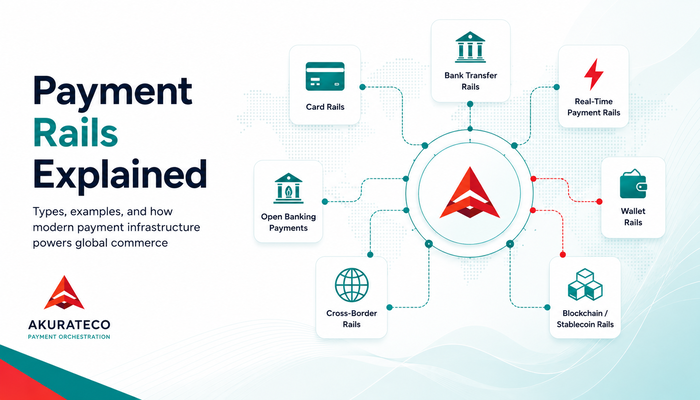
A payment rail can be a card network, bank transfer system, real-time payment system, direct debit scheme, cross-border messaging network, wallet network, or blockchain-based system. Each rail has its own rules, technical standards, settlement process, risk model, and operating limitations.
In simple terms:
- A payment method is what the customer chooses.
- A payment rail is the infrastructure that moves the payment.
- A payment gateway or PSP connects the merchant to the payment ecosystem.
- A payment orchestration layer helps manage multiple providers, methods, and rails from one place.
For example, a customer may choose “pay by card” at checkout. Behind that simple option, the transaction may pass through a gateway, PSP, acquirer, card network, issuing bank, fraud system, and settlement process. The card network is the rail, but the full payment flow involves many more systems.
That distinction matters. Adding more payment methods does not automatically mean a company has strong payment infrastructure. A merchant may offer many checkout options but still have weak routing logic, fragmented reporting, limited settlement visibility, and no fallback when a provider fails.
How do payment rails work?
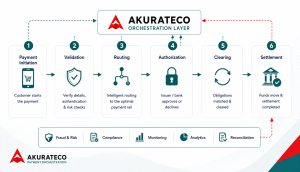
Payment rails work by carrying payment instructions between parties and supporting the movement, confirmation, clearing, or settlement of funds. The details vary by rail type, but most payment flows follow a similar operational sequence.
| Stage | What happens | Systems involved | Why it matters |
| Payment initiation | A customer, merchant, platform, or business starts the payment | Checkout, API, invoice link, banking app, wallet, POS | Poor initiation flow can create abandonment or failed payments |
| Validation | Payment details, account data, limits, authentication, and risk checks are reviewed | PSP, bank, issuer, fraud tools, open banking API | Weak validation increases fraud and rejection risk |
| Routing | The payment is sent through a provider, acquirer, bank, rail, or network | Gateway, processor, routing engine, PSP, acquirer | Better routing can improve cost and approval performance |
| Authorization or acceptance | The relevant bank, issuer, or network accepts or rejects the payment | Issuer, acquirer, card network, bank, scheme | This is where many customer-facing payment failures occur |
| Clearing | Payment obligations are calculated or confirmed between institutions | Scheme, clearing system, network, bank | Clearing affects timing, data quality, and downstream reporting |
| Settlement | Funds move between financial institutions or settlement accounts | Banks, central infrastructure, settlement agent | Settlement timing affects cash flow and reconciliation |
| Reporting and reconciliation | Transaction, fee, settlement, and status data are matched | Merchant portal, ledger, finance tools, reporting systems | Poor reconciliation creates manual work and financial risk |
The operational details differ significantly across rails.
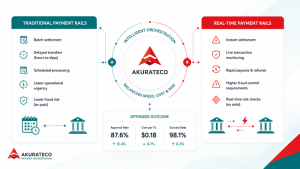
A card payment may be authorised in seconds, while settlement happens later. A batch bank transfer may be cheaper but slower. A real-time payment may move funds almost instantly but require stronger upfront risk controls because the payment can be difficult to reverse.
This is why rail choice is not just a technical preference. It affects how a business manages fraud, cash flow, refunds, failed transactions, customer experience, and finance operations.
What are the main types of payment rails used today?
The main types of payment rails used today are card rails, bank transfer rails, real-time payment rails, direct debit rails, cross-border rails, open banking payment flows, wallet rails, and crypto or blockchain rails.
Each rail type serves a different purpose. No single rail is best for every use case.
| Payment rail type | Examples | Common use cases | Main limitation |
| Card rails | Visa, Mastercard, American Express, local card schemes | Ecommerce, retail, subscriptions, marketplaces | Fees, chargebacks, issuer declines |
| Bank transfer rails | SEPA Credit Transfer, ACH, Bacs, local account-to-account systems | B2B payments, payroll, supplier payments, account funding | Slower settlement on some batch systems |
| Real-time payment rails | Faster Payments, SEPA Instant, Pix, UPI, RTP, FedNow, FAST | Instant payouts, refunds, account funding, urgent transfers | Fraud risk, limits, regional fragmentation |
| Direct debit rails | SEPA Direct Debit, Bacs Direct Debit, ACH debit | Subscriptions, utilities, loan repayments, recurring billing | Mandates, returns, disputes |
| Cross-border rails | SWIFT, correspondent banking, regional clearing systems | International transfers, treasury, supplier payments | Intermediary fees, FX complexity, slower delivery |
| Open banking payments | API-initiated bank payments in supported markets | Bank-to-bank checkout, invoice payments, account funding | Bank coverage and UX consistency |
| Wallet rails | PayPal, Apple Pay, Google Pay, regional wallets, super apps | Consumer checkout, mobile commerce, local payment preferences | Coverage, fees, dependency on wallet ecosystem |
| Crypto or blockchain rails | Stablecoins, blockchain settlement networks | Selected cross-border, treasury, or digital asset use cases | Regulation, liquidity, volatility, adoption limits |
For PSPs and fintech companies, the practical question is rarely “Which rail is best?” The better question is: Which rail is best for this transaction, in this country, for this customer type, at this transaction value, with this risk profile?
That is where payment infrastructure becomes more complex.
Card rails
Card rails are still one of the most important payment infrastructures for ecommerce, retail, subscriptions, travel, marketplaces, and digital services.
Card rails are popular because they are familiar, global, and convenient. They support authorization, capture, refunds, recurring payments, chargebacks, tokenization, and strong consumer payment habits.
But they also come with operational trade-offs:
- Processing fees can be higher than bank-based rails.
- Transactions may be declined by issuers.
- Chargebacks create financial and operational overhead.
- Cross-border card processing may add FX and scheme costs.
- Approval rates vary by issuer, acquirer, BIN, country, and merchant category.
For enterprise merchants and PSPs, card performance is often a routing problem. The same card transaction may perform differently depending on the acquirer, processor, region, and transaction context.
That is why payment routing matters. It gives payment teams the ability to send transactions through the route most likely to succeed, instead of relying on a single static provider setup.
Bank transfer rails
Bank transfer rails move funds between bank accounts. They are commonly used for B2B payments, payroll, supplier payments, account funding, marketplace payouts, and high-value transfers.
Examples include SEPA Credit Transfer in Europe, ACH in the United States, Bacs in the UK, and many domestic account-to-account systems around the world.
Bank rails are often attractive because they can be cost-efficient, especially for large transaction volumes or higher-value payments. They can also be useful where card payments are too expensive, unnecessary, or poorly suited to the transaction type.
However, bank transfer rails can be slower than card authorization or instant payment systems, depending on the scheme. They may also require stronger operational handling around references, reconciliation, failed payments, returns, and beneficiary validation.
For finance teams, the biggest issue is often not the transfer itself. It is matching the payment to the correct invoice, customer, merchant, settlement batch, or internal ledger entry.
Real-time payment rails
Real-time payment rails allow money to move almost instantly or near-instantly between accounts. They are increasingly important for instant payouts, account funding, refunds, marketplace disbursements, payroll advances, wallet top-ups, and bank-to-bank checkout.
Examples include Faster Payments in the UK, SEPA Instant in Europe, Pix in Brazil, UPI in India, RTP and FedNow in the United States, and FAST in Singapore. The scale of real-time payments is already substantial. Brazil’s Pix handled more than 63 billion transactions in 2024, up roughly 50% year over year, while India’s UPI processed over 172 billion transactions in the same year, according to figures compiled in Akurateco’s 2026 PSP infrastructure whitepaper.
Real-time rails can improve customer experience because users do not have to wait hours or days for funds to arrive. They can also reduce some of the friction associated with traditional bank transfers.
But real-time payments create a different risk profile. If funds move quickly, the business needs strong controls before the transaction is sent. Fraud checks, account validation, transaction monitoring, velocity rules, sanctions screening, and risk scoring become more important because there may be less time to recover funds after a mistake or fraudulent transfer.
For PSPs and fintechs, real-time rails are powerful, but they cannot be treated as simple “faster bank transfers.” They need proper operational controls around risk, limits, monitoring, and reconciliation.
Direct debit rails
Direct debit rails allow a business to pull funds from a payer’s bank account based on a mandate or authorization. They are widely used for recurring payments such as subscriptions, utilities, insurance, loan repayments, memberships, and B2B billing.
Direct debit can be more cost-efficient than card payments for recurring billing. It also reduces the problem of expired cards, which is common in subscription businesses.
However, direct debit introduces its own operational requirements. Businesses need to manage mandates, payment notices, return codes, failed collections, dispute windows, and retry logic. Settlement may not be immediate, and failed payments may appear after the initial collection attempt.
For companies with recurring revenue models, direct debit can be highly effective. But it needs clean customer communication, strong mandate management, and reliable reporting.
Cross-border payment rails
Cross-border payment rails support international money movement. They are used for supplier payments, treasury operations, marketplace payouts, remittances, global payroll, international ecommerce, and financial services products.
Cross-border payments often involve more complexity than domestic payments. A single transaction may include correspondent banks, FX conversion, compliance checks, sanctions screening, intermediary fees, and different settlement timelines.
SWIFT is often discussed in this context, although it is more accurately understood as a financial messaging network rather than a system that directly moves funds itself.
The operational challenges of cross-border rails include:
- Unclear delivery timelines.
- Intermediary bank fees.
- FX spread and conversion costs.
- Limited payment status visibility.
- Compliance and screening requirements.
- Reconciliation issues across currencies and settlement accounts.
For fintech companies and enterprise merchants expanding internationally, cross-border rail strategy should be evaluated alongside local acquiring, local payment methods, settlement currency, and reporting requirements.
Open banking payment flows
Open banking payments allow customers or businesses to initiate bank payments through secure APIs, usually with customer authentication through their bank.
In supported markets, open banking can create a strong alternative to card payments. It is especially relevant for account funding, invoice payments, financial services, ecommerce, and certain B2B use cases.
The benefit is that payments can move directly from bank account to bank account, often with lower costs than cards and reduced card-related chargeback exposure.
The challenge is consistency. Bank coverage, user experience, authentication flow, limits, and payment status handling may vary by market, bank, and provider. For merchants, this means open banking payments need to be integrated into the broader payment stack rather than treated as a standalone experiment.
For PSPs, open banking can be an important capability. But it works best when combined with clear routing logic, fallback options, reporting, and reconciliation.
Wallet rails and alternative payment methods
Wallets and alternative payment methods are often presented to customers as checkout options, but behind the scenes they depend on their own infrastructure, rules, settlement processes, and provider relationships.
Examples include PayPal, Apple Pay, Google Pay, regional wallets, mobile money systems, and super-app payment ecosystems.
Wallets can improve conversion because they reduce checkout friction and match local customer preferences. In some markets, local wallets or mobile money systems are not optional extras. They are essential payment methods.
The operational challenge is that each wallet may bring its own reporting format, settlement cycle, fee model, dispute rules, and integration requirements. For a merchant or PSP operating across many markets, this quickly becomes another source of payment fragmentation.
Crypto and blockchain payment rails
Crypto and blockchain rails are used in selected payment, treasury, settlement, and digital asset use cases. Stablecoins are often discussed as a way to move value across borders faster than traditional correspondent banking rails. Remittances illustrate why alternative cross-border rails are attracting attention. Sub-Saharan Africa received about $54 billion in remittance inflows in 2023, while transfer costs averaged 8–10% per transaction, well above the UN Sustainable Development Goal target of 3% — a cost gap explored in Akurateco’s Africa remittance research.
However, these rails are not a universal replacement for existing payment infrastructure. They come with regulatory, liquidity, compliance, wallet-management, volatility, and acceptance challenges.
For most PSPs and enterprise merchants, crypto rails are not the default choice for mainstream customer payments. They are more relevant in specific contexts where the business has a clear use case, compliance framework, and operational model.
A practical payment team should evaluate crypto rails the same way it evaluates any other rail: What problem does this solve? What risk does it introduce? How will settlement, reconciliation, compliance, and customer support work?
Payment rails vs payment methods vs payment gateways
Payment rails, payment methods, and payment gateways are often discussed together, but they are not the same thing.
| Concept | What it means | Example |
| Payment method | The option the customer or business user chooses | Card, bank transfer, PayPal, Apple Pay, SEPA Direct Debit |
| Payment rail | The infrastructure that carries the payment instruction or supports money movement | Visa, Mastercard, SEPA, ACH, Faster Payments, SWIFT |
| Payment gateway | The technical layer that captures and processes payment data | Hosted payment page, API, transaction gateway |
| PSP or processor | The provider that connects merchants to payment methods, acquiring banks, processors, or rails | PSP, PayFac, acquirer processor |
| Payment orchestration platform | The control layer that manages multiple providers, routes, methods, and transaction flows | Multi-PSP routing, cascading, reporting, merchant management |
This distinction is important for decision-makers.
A merchant may say, “We need more payment methods.” But the operational need may actually be better provider coverage, stronger approval rates, local acquiring, more efficient settlement, or unified reconciliation.
A PSP may say, “We need to integrate a new rail.” But the real requirement may include merchant configuration, reporting, transaction monitoring, fraud controls, routing rules, and operational support.
Payment rails are only one part of the infrastructure question.
Why payment rails matter for businesses with complex payment operations
Payment rails matter because they shape how a business moves money, serves customers, enters markets, controls costs, and manages risk.
For PSPs, rail coverage can define the merchant segments they can serve. A PSP that supports more local methods, bank rails, card acquiring options, and payout rails can offer stronger market coverage. But this only works if the infrastructure is manageable.
For fintech companies, rails often sit inside the product itself. A wallet, BNPL provider, neobank, crypto platform, marketplace, or embedded finance product may need account funding, payouts, recurring collections, refunds, treasury movement, and compliance checks inside one customer journey.
For enterprise merchants, payment rails affect:
- Checkout conversion.
- Approval rates.
- Payment processing cost.
- Refund speed.
- Settlement timing.
- Chargebacks and disputes.
- Market expansion.
- Finance operations.
- Reconciliation workload.
- Provider dependency.
The rail is not always visible to the end user, but its impact is visible in payment performance.
How to choose the right payment rail
The right payment rail depends on the use case. A high-value B2B invoice, a subscription payment, an ecommerce checkout, a marketplace payout, and an instant refund should not automatically use the same rail.
Payment teams should evaluate rails using practical criteria.
| Decision factor | What to ask | Example |
| Speed | Does the payment need to move instantly, same day, or later? | Instant payout vs scheduled supplier payment |
| Cost | Is the rail priced as a fixed fee, percentage, FX spread, or blended rate? | Bank transfer may be cheaper than card for high-value payments |
| Geography | Is the payment domestic, regional, or cross-border? | Local bank rail vs international wire |
| Customer preference | What does the customer expect in this market? | Wallets in mobile-first markets, cards in mature ecommerce markets |
| Risk | How reversible is the payment? What fraud controls are needed? | Instant payouts need stronger upfront screening |
| Transaction value | Is the payment low-value and high-volume or high-value and occasional? | Marketplace micro-payouts vs treasury transfers |
| Settlement | When does the business need access to funds? | Same-day liquidity vs delayed settlement |
| Reconciliation | Can the payment be matched cleanly to orders, invoices, merchants, or accounts? | B2B payments need strong references and reporting |
| Scalability | Can the rail support future markets, currencies, and providers? | Local rails may be needed for regional expansion |
A good rail strategy is not only about having many options. It is about knowing when to use each option.
What makes multi-rail infrastructure difficult?
Multi-rail infrastructure becomes difficult when every provider, rail, and payment method has its own integration, dashboard, status logic, settlement file, risk process, and reporting format.
This is where many payment teams run into problems.
At first, adding a second or third PSP looks like diversification. It creates more options. But over time, every new connector adds maintenance work. Every provider has different APIs, decline codes, webhooks, settlement reports, refund logic, chargeback flows, and operational rules.
The result is often a fragmented payment stack.
Common issues include:
- Multiple dashboards for different PSPs.
- Inconsistent transaction statuses.
- Manual reconciliation across providers.
- Limited visibility into approval performance.
- No automated fallback after failed transactions.
- Poor routing logic.
- Duplicated fraud rules.
- Slow integration of new payment methods.
- High engineering dependency.
- Difficulty onboarding and managing merchants.
- Finance teams spending too much time matching settlement data.
More rails can create more flexibility, but only if the business has a control layer above them.
Without that layer, payment infrastructure becomes harder to operate with every new market, provider, or method.
How payment orchestration helps manage payment rails
Payment orchestration helps businesses manage multiple payment rails, PSPs, acquirers, fraud tools, payment methods, and reporting flows through one infrastructure layer.
It does not replace payment rails. It gives payment teams a way to control how those rails are accessed, selected, monitored, and optimized.
A payment orchestration platform can support:
- Multi-PSP connectivity.
- Smart transaction routing.
- Cascading after eligible failed payments.
- Merchant configuration and management.
- Unified reporting.
- Fraud and risk controls.
- Payment method management.
- Provider performance monitoring.
- Settlement and reconciliation visibility.
For example, if a card transaction is declined by one acquirer for a soft reason, cascading can retry the transaction through another configured route. If one provider performs better for a specific country, currency, BIN range, or merchant category, routing rules can reflect that logic.
For PSPs and fintech companies, Akurateco supports this model by providing white-label payment software and payment orchestration infrastructure for companies that need to manage complex payment environments without building every layer from scratch.
This is especially relevant when a business wants to launch a payment solution, expand to new markets, improve approval rates, reduce processing costs, or unify a fragmented payment stack.
Build vs buy: how should companies approach rail connectivity?
Companies can build direct integrations in-house, rely on one PSP, manage several PSPs separately, or use an orchestration platform. Each approach has trade-offs.
| Approach | Pros | Cons | Best for |
| Build in-house | Maximum control, custom logic, direct ownership | Expensive, slow, high maintenance, compliance burden | Large companies with deep payment engineering resources |
| Use one PSP | Fast launch, simple setup, low initial complexity | Provider dependency, limited routing, limited fallback | Early-stage merchants or simple payment flows |
| Use several PSPs separately | More coverage, some redundancy | Fragmented reporting, manual routing, operational complexity | Companies transitioning beyond one provider |
| Use payment orchestration | Multi-provider control, routing, cascading, unified reporting | Requires proper configuration and governance | PSPs, fintechs, marketplaces, and enterprise merchants |
| Use white-label payment software | Faster launch of branded payment infrastructure | Less custom than full in-house build | PSPs, PayFacs, fintechs, and platforms launching payment services |
Building everything internally can make sense for companies with large engineering teams, regulatory expertise, and long-term infrastructure budgets. But for many PSPs, fintechs, and enterprise merchants, the cost is not only development. It is maintenance, monitoring, compliance, reporting, reconciliation, and provider updates.
That is why a white-label payment gateway or orchestration-first model can be more practical. It gives companies infrastructure control while reducing the need to build every connector and operational layer internally.
Practical examples of payment rail decisions
A marketplace may use card rails for customer checkout, bank rails for merchant payouts, and real-time rails for urgent withdrawals. The infrastructure needs to connect all of these flows while keeping merchant balances, fees, refunds, disputes, and settlement reports consistent.
A fintech wallet may need open banking payments for account funding, card rails for card-based top-ups, real-time rails for instant withdrawals, and cross-border rails for international transfers. The customer sees one product, but the backend may rely on several rails.
A PSP serving merchants across regions may need card acquiring, local payment methods, direct debit, alternative payment methods, and payout rails. The PSP also needs merchant onboarding, routing logic, fraud rules, reporting, and reconciliation tools.
An enterprise ecommerce merchant may want to improve approval rates by connecting multiple acquirers. But unless it also manages routing, cascading, reporting, and settlement data, it may simply replace one dependency with a more complicated set of dependencies.
These examples show why rail strategy should not be separated from payment infrastructure strategy.
Common mistakes when working with payment rails
The most common mistake is treating payment rails as a checklist. More rails do not automatically mean better performance.
Payment teams should avoid these mistakes:
- Adding payment methods without understanding the rails behind them.
- Assuming one PSP can support every market equally well.
- Ignoring settlement and reconciliation until after launch.
- Treating real-time payments as low-risk because they are convenient.
- Building custom integrations without budgeting for long-term maintenance.
- Using the same routing logic for every country, currency, and transaction type.
- Measuring payment success only by transaction volume, not by approval rate, cost, settlement reliability, and operational workload.
- Failing to create fallback routes for eligible failed transactions.
A strong payment setup is not defined by the number of logos shown at checkout. It is defined by how well the business controls the full transaction lifecycle.
Conclusion
Payment rails are one of the most important parts of payment infrastructure, even though they are rarely visible to the end user. They determine how payments move, how fast funds settle, how much transactions cost, how risk is handled, and how easily finance teams can reconcile payment data.
For PSPs, fintech companies, and enterprise merchants, the goal is not simply to connect more rails. The goal is to build an infrastructure model that can choose the right rail, route transactions intelligently, manage failed payments, control risk, and provide clear reporting across the full payment lifecycle.
That is where payment orchestration becomes valuable. For companies managing complex payment infrastructure, Akurateco can act as a technology partner that helps simplify orchestration, routing, provider connectivity, merchant management, reporting, and scalability without requiring a full infrastructure rebuild.
FAQ
What are payment rails?
Payment rails are the systems, networks, schemes, and messaging layers that move payment instructions or funds between payers, merchants, banks, PSPs, and financial institutions. Examples include card networks, bank transfer systems, real-time payment systems, direct debit schemes, cross-border networks, wallet systems, and blockchain rails.
What are the main types of payment rails?
The main types of payment rails are card rails, bank transfer rails, real-time payment rails, direct debit rails, cross-border rails, open banking payment flows, wallet rails, and crypto or blockchain rails. Each rail differs in speed, cost, settlement timing, reversibility, regional coverage, and operational risk.
What is the difference between a payment rail and a payment method?
A payment method is the option a customer chooses, such as card, bank transfer, wallet, or direct debit. A payment rail is the infrastructure that carries the payment instruction or supports the movement of funds behind that method. One payment method can rely on different rails depending on market and provider setup.
Is SWIFT a payment rail?
SWIFT is commonly discussed in the context of cross-border payment rails, but it is more accurately described as a secure financial messaging network. It helps financial institutions exchange payment instructions. The actual movement and settlement of funds usually depends on correspondent banks and participating financial institutions.
Why do PSPs need multiple payment rails?
PSPs need multiple payment rails to support different markets, currencies, merchant categories, transaction types, and customer preferences. Multi-rail access can improve coverage, reduce provider dependency, support local payment methods, and create fallback options when one route is unavailable or underperforming.
How does payment orchestration help with payment rails?
Payment orchestration helps manage multiple payment rails, PSPs, acquirers, payment methods, fraud tools, and reporting flows through one infrastructure layer. It supports routing, cascading, provider fallback, merchant configuration, transaction monitoring, and reconciliation, which helps payment teams scale without managing each integration separately.