

- What is payment orchestration?
- How does payment orchestration work, and why does it exist?
- Key benefits of payment orchestration
- Payment orchestration vs. payment gateway
- Who uses payment orchestration?
- Do you actually need payment orchestration?
- Challenges and limitations of payment orchestration
- How to choose a payment orchestration platform
- What implementing payment orchestration looks like
- What payment orchestration costs
- Conclusion
- What it is: Payment orchestration is a middleware layer that connects multiple PSPs, acquirers, gateways, payment methods, and other payment services through a single API.
- How it works: It sits between checkout and every connected provider as one system, so a transaction and every decision made about it, like routing, cascading, and the rest, run through that single point.
- Who it is for: Merchants (including SaaS platforms and subscription services), PSPs, and acquiring banks running multiple providers or markets with high transaction volume (from 100K+ transactions across 2 or more markets).
- Who may not need it: A business on one PSP in one market with no expansion plans is unlikely to see meaningful gains from adding an orchestration layer.
What is payment orchestration?
According to data from Custom Market Insights, the payment orchestration market reached USD 1.8 billion in 2025 and is projected to reach USD 13.4 billion by 2034.
Payment orchestration is a middleware layer that connects multiple PSPs, APMs, gateways, and other payment services through a single API. It is also known as a payment orchestration layer. It helps merchants and PSPs connect, manage, and optimize payment flows across multiple providers, payment methods, acquirers, fraud tools, and reporting systems. Payment teams get one control layer for routing, cascading, transaction monitoring, reconciliation, and provider management.
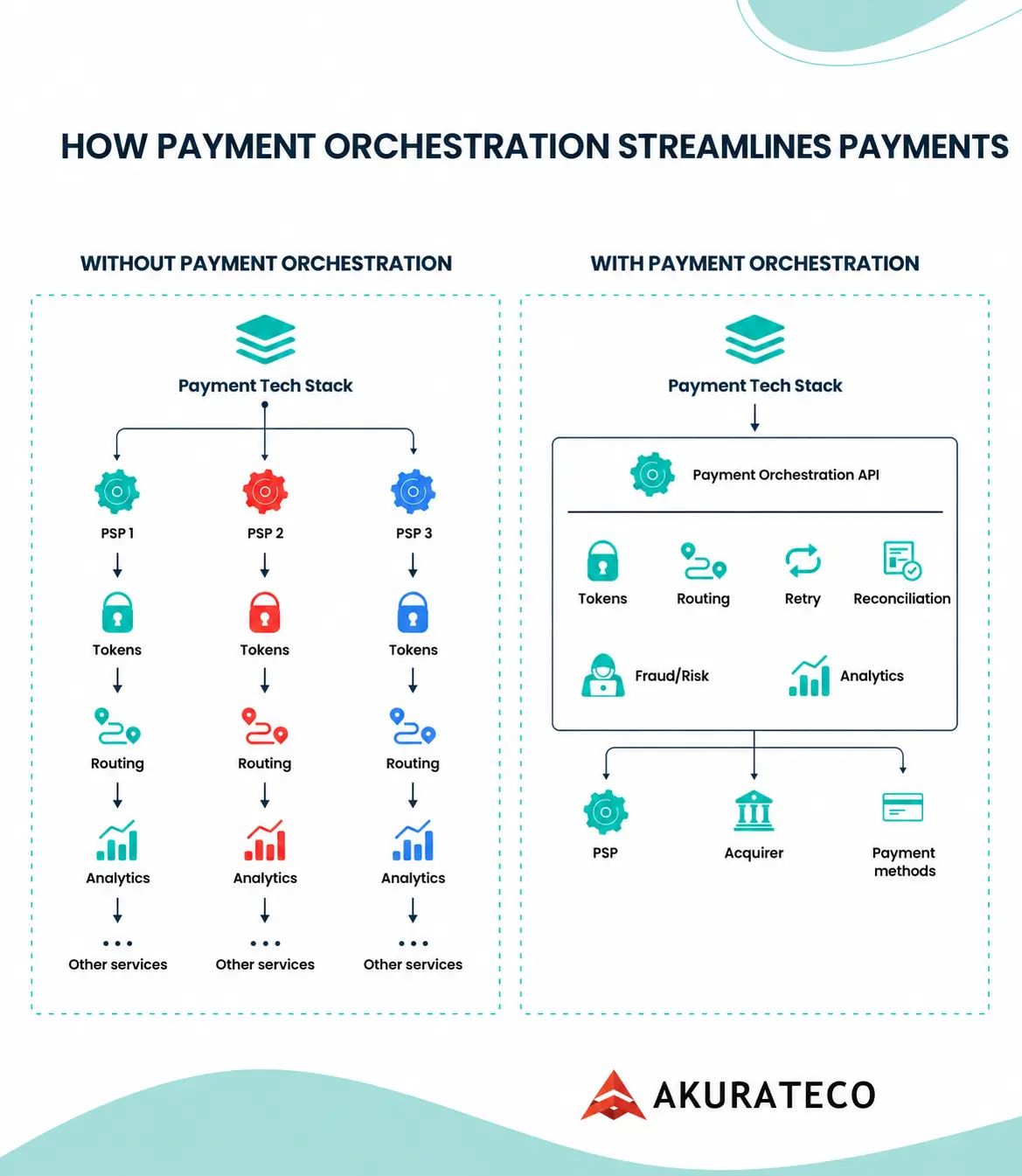
In day-to-day payment operations, orchestration covers a few core functions:
- Provider management makes it easier to add, compare, or replace providers without rebuilding the entire payment setup.
- Payment method management controls which payment methods are available across markets and customer segments.
- Transaction routing selects a PSP or acquirer based on rules such as geography, currency, cost, availability, or performance.
- Failover and retries determine what happens when a provider declines, fails, or times out.
- Reporting and reconciliation consolidate payment data from different providers into a more consistent operational view.
- Resilience reduces dependence on a single payment provider and gives teams more control over payment continuity.
Key insight: The main value of payment orchestration is centralized control over a complex payment setup. It reduces the operational burden of a multi-provider setup by consolidating routing rules, failover logic, provider management, and performance data into a single layer.
How does payment orchestration work, and why does it exist?
With more providers, merchants and PSPs can improve coverage and resilience. Without orchestration, they also create fragmented data, duplicate technical work, inconsistent reporting, and slower decisions. As a result, fragmented payment operations drive up integration, reporting, and management costs.
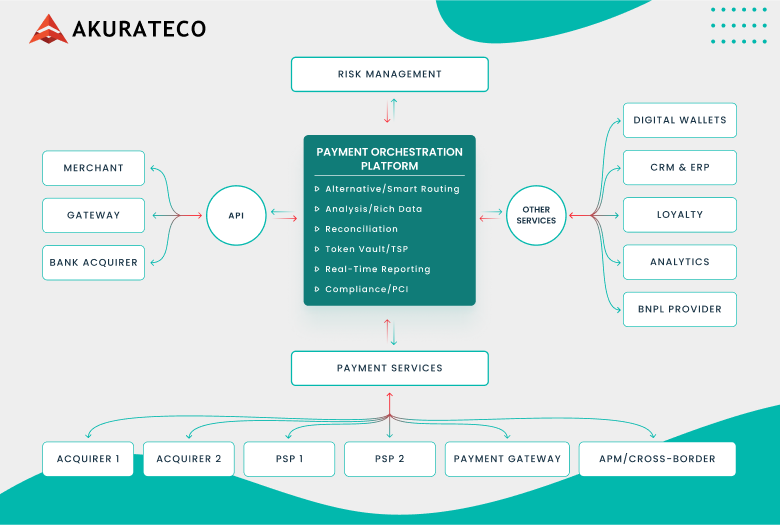
Several core components of payment orchestration make it possible to unify, automate, and optimize the entire payment flow:
- Integration. It provides unified access to multiple PSPs, acquirers, APMs, and other third-party services, such as digital wallets, CRM/ERP, loyalty systems, analytics, and BNPL providers. It consolidates your payments, providing full visibility into each provider, transaction, acquirer, and integration.
- Orchestration logic. For transaction optimization, smart routing directs each payment to the best-performing provider (acquirer, PSP, gateway, or APM) based on cost, region, or success rate. Cascading reroutes declined transactions (recoverable soft declines) from one payment provider to another, as many as needed, within a single payment attempt.
- Security and compliance. This is built to support compliance with global standards such as PCI DSS v4.0.1, GDPR, and PSD2, and includes tokenization, third-party scoring, and AI-based fraud prevention.
- Analytics. It unifies data across all payments and offers real-time dashboards, reconciliation, and reporting tools, reducing manual work and delivering data-driven insights into customer behavior and preferences.
- Merchant management tools, self-service features, and automation. Together, they enable merchants to configure settings, giving them full control over their payment strategy.
A typical payment orchestration flow looks like this when a customer makes a payment:
- Transaction initiation. A customer reaches checkout, selects a payment method, and submits the payment.
- Card details checks. This process includes data validation (format, BIN lookup) and, where required, 3D Secure authentication. The issuer’s system either completes this authentication silently in the background (frictionless flow) or prompts the customer to verify the payment through their bank.
- Smart routing. Based on configured rules, the orchestration platform directs the transaction to the most suitable available gateway in real time. The decision can consider factors such as geography, currency, availability, cost, or provider performance.
- Gateway processing. The gateway sends the transaction to the relevant processor, which submits it to the acquirer.
- Authorization attempt. The acquirer routes the request, including AVS, CVV, and the 3D Secure result, through the card network (e.g., Visa, Mastercard) to the issuer. The issuer then approves or declines and returns the decision along the same path.
- Cascading (optional in the flow). The transaction is automatically routed to an alternate payment provider, triggering a new authorization attempt. This loop repeats until approval is granted or the configured sequence ends.
- Acceptance. The acquiring bank confirms the approved authorization and relays it back through the gateway to the merchant. Funds are held, not yet transferred.
- Capture. The merchant confirms it wants to collect the authorized funds, immediately or in a later batch.
- Settlement and reconciliation. The acquirer/processor settles captured transactions with the issuer via the card network. The orchestration layer then brings provider data together, links settlement records to the original transactions, and gives finance teams one place to review the results.
Note: This control layer coordinates how a transaction moves and reports on it, but it typically does not hold, settle, or take custody of funds. Merchant-of-record status and the underlying acquiring relationship stay with the connected PSPs and acquirers. Settlement happens between them and the merchant’s bank, not through the orchestration layer itself. Akurateco is not a payment processor and does not process transactions itself. It operates as orchestration and gateway infrastructure on top of acquirers.
Key benefits of payment orchestration
Payment orchestration becomes useful when payment operations start to spread across several providers, markets, and systems. It can help recover failed transactions, control processing costs, reduce manual work, improve resilience, and give teams a clearer view of how each provider performs.
Raise approval rates by routing each transaction to the best-performing provider
Not all providers perform equally across all regions, card types, transaction values, or merchant categories. A routing rule can be built around those differences. It checks specific transaction traits, like the card’s BIN range, the ticket size, and how each provider has been converting over a rolling time window. Then, it sends the transaction to whichever provider is performing best for that exact combination right now.
Note: In this example, we use hypothetical figures to show you how routing can improve approval rates.
A €40 transaction on a French-issued card might route to a provider with strong local acquiring in France. A $2,000 transaction on a US-issued card goes to one that handles high-ticket sizes more reliably.
Key insight: Higher approval rates directly affect revenue. Since provider performance varies, a better route can recover payments that would otherwise be declined, so the business preserves a sale it might have lost.
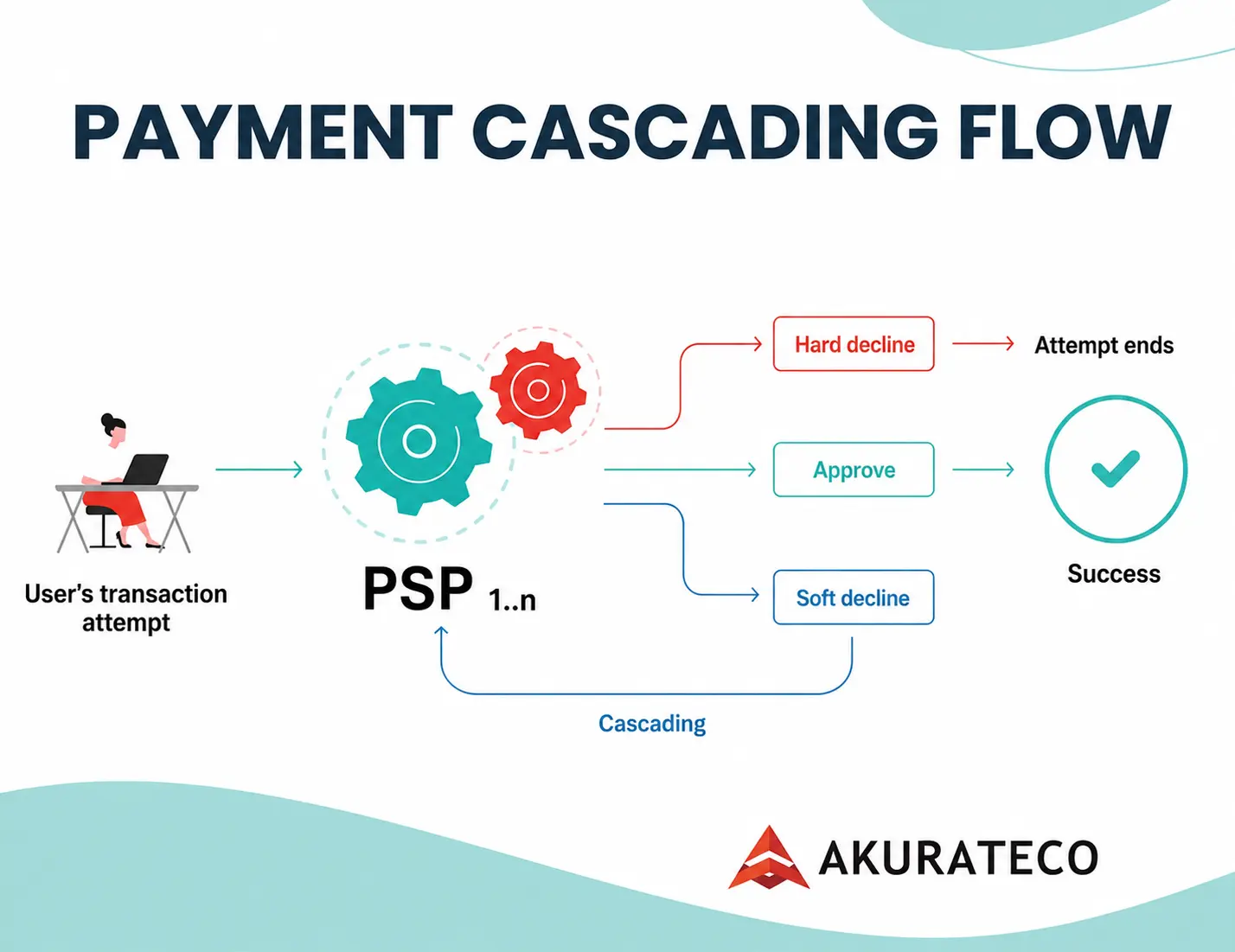
Recover soft declines automatically with cascading
Payment cascading ensures there is an alternative path for transactions after a soft decline. Instead of ending the payment attempt immediately, the platform can retry the transaction through another configured provider or route until it is approved or the configured retry sequence ends. Hard declines should not be retried blindly because they may increase cost, risk, or customer friction.
Cut processing costs without trading away approval rate
Payment orchestration reduces costs by routing transactions through lower-cost paths while maintaining acceptable performance. This does not mean always choosing the cheapest provider. It factors in balancing cost, approval probability, settlement speed, reliability, and risk.
Note: In this example, we use hypothetical figures to show how routing can balance cost and approval performance.
Provider A might approve 90% of transactions at a 1% fee, while Provider B approves 87% at a 0.8% fee. It is a 3-percentage-point approval gap against a 0.2-percentage-point fee saving. On 1,000 transactions averaging $100 each, Provider A nets roughly $89,100 after fees, and Provider B nets about $86,300. The lower fee saves about $200 in processing costs, but the weaker approval rate costs $3,000 in transactions that never happen.
Key insight: Routing by fee alone would have picked the provider that actually loses more money, and that is the trade-off orchestration makes visible.
Enter new markets without rebuilding your stack
When a company enters new markets, payment complexity increases quickly. Local payment methods, acquiring relationships, currencies, fraud patterns, and regulatory requirements may differ by region.
Direct integrations can require new technical work. With orchestration, the business can use a more repeatable model: add or activate providers, configure routing rules, adapt checkout methods, and monitor performance through the same control layer.
Better resilience and provider redundancy
One provider means one point of failure. If it goes down, slows down, hits a regional restriction, or runs into any other outage, and there is no backup route, the business just has to wait it out.
Orchestration prevents that scenario. When one route drops, the platform reroutes traffic before the customer even notices.
See every provider’s performance from one dashboard
When payment data is split across providers, it becomes harder to compare results and spot issues. Different statuses, dashboards, reports, and settlement files make that worse.
Payment orchestration brings multiple PSPs, acquirers, gateways, payment methods, and services into one hub. So it becomes easier to track approvals, declines, provider performance, routing, costs, refunds, chargebacks, and settlements.
Run providers, routing, and reconciliation from one control layer
Payment orchestration gives in-house payment teams more control over day-to-day operations — managing providers, routing rules, refunds, fraud controls, reconciliation, tokenization, and reporting from a central system instead of separate provider portals.
Developers maintain one integration instead of several PSP connections. Operations get centralized reporting and less manual reconciliation, and QA can test more consistent flows across providers.
Our experience speaks for itself — a recent case proved how payment orchestration can significantly boost efficiency. One merchant was struggling with long and complex integrations for months. By transitioning from fragmented multi-PSP management to a unified orchestration layer, they significantly shortened integration timelines by up to 5 business days, shares Anastasiia Brener, a CCO of Akurateco. We worked with a mid-sized retail client to consolidate fragmented PSP integrations, reporting, routing, and security controls through payment orchestration. In this retail case, we gave the client access to 700+ connectors, helped achieve a 30% increase in approvals through intelligent routing and cascading, and reduced processing costs by 25%. These results reflect this specific implementation and should not be treated as general performance benchmarks.
Apply fraud and risk setup from one place across every provider
Set tokenization, risk scoring, and fraud rules, and then, as you learn what works, you can refine them per provider instead of rebuilding fraud logic every time you add a PSP. The same layer supports compliance with PCI DSS v4.0.1, GDPR, and PSD2.
Payment orchestration vs. payment gateway
A payment gateway does one job: move payment data from checkout into the processing ecosystem. Orchestration sits a level above that. It runs multiple gateways, PSPs, acquirers, payment methods, and payment services together from one control layer instead of leaving each one to work on its own.
| Comparison point | Payment gateway | Payment orchestration |
| Primary role | Transfers payment data between checkout and the payment-processing ecosystem | Coordinates payment flows across multiple providers and services |
| Multi-provider connectivity | Typically connects to one processor, acquirer, or provider setup | Connects and manages multiple PSPs, gateways, acquirers, and payment methods |
| Routing and cascading | Usually limited or provider-specific | Supports routing and cascading across connected providers |
| Reporting and visibility | Primarily covers transactions processed through the gateway | Consolidates data and performance visibility across multiple providers |
| Typical use case | Merchants with simpler payment needs, often operating in one market with one PSP that already provides sufficient coverage and control | Merchants and PSPs with high volumes, international operations, or multiple PSPs, acquirers, currencies, and payment methods |
A gateway helps process a payment. Orchestration manages the wider payment flow across multiple providers, including routing, retries, failover, reporting, and provider control. Read our gateway vs orchestration article that explains the difference in detail.
Who uses payment orchestration?
Orchestration serves a different purpose depending on where a business sits in the payments chain. The key difference is the operating model. The table below breaks down how three key players use orchestration and the infrastructure behind each.
| Audience | Payment orchestration use case | Operating model |
| Enterprise merchants | Run and optimize payments across their own PSPs, acquirers, and markets from one control layer | Single-tenant |
| PSPs | Add multi-acquirer routing and resilience on top of the processing they already sell to their merchant base | Multi-tenant payment platform |
| Acquiring banks | Extend value-added services (routing, alternative payment methods, fraud tools) to the merchants they hold accounts for, beyond raw card acceptance | Acquiring infrastructure serving multiple merchants |
Merchants use orchestration to run their own payments better, while PSPs use it to provide payment services to their own merchants. Acquiring banks can use orchestration to extend and manage payment services for their merchants.
Merchants
The trigger to use orchestration is not company size but multiple providers, multiple markets, or volume high enough that routing decisions move revenue.
Different PSPs, acquirers, and payment methods perform differently across markets, so a merchant may use local providers to improve approval rates and control processing costs. Orchestration lets the business manage those connections for its own transactions through one control layer, with its own routing rules and payment logic.
Instead of depending on a single provider’s coverage and performance, the merchant can route transactions between providers, keep backup paths available during downtime, and add new markets without building every integration from scratch. Providers also become easier to replace, which reduces vendor lock-in. This is a single-tenant model: one company manages its own transaction flow.
SaaS platforms and marketplaces can use the same setup for embedded payments, recurring billing, seller or sub-merchant onboarding, and unified reporting for platform participants.
For merchants facing higher decline and chargeback pressure, provider churn, or heavier compliance requirements, the use case is covered in more detail in our payment orchestration for high-risk businesses guide.
PSPs
The PSP use case is different. Providers use orchestration to sell payment services to merchants. Growth into new markets or merchant verticals often requires more acquirers, payment methods, fraud tools, and other provider connections.
Orchestration under a white-label offering lets a PSP launch or scale a payment business without building the connectivity layer itself. It removes the build cost of integrations and keeps card data handling centralized. With it, the PCI DSS scope is on the platform side rather than the PSP’s own stack, though it does not automatically remove its compliance obligations.
The operating model is multi-tenant. One platform serves many merchants, each with its own routing rules, limits, configuration, and reporting. Orchestration provides the shared control layer that applies those merchant-specific settings across provider connections, payment methods, failover logic, and transaction data.
A PSP usually outgrows direct integrations when its merchants ask for local payment methods the current acquirers do not cover, approval rates differ sharply between providers or regions, and every new provider connection becomes a separate project. Finance and support teams feel it too: settlement files and decline codes arrive in each provider’s own format, so reconciliation and dispute handling stay manual.
For PSPs deciding how to build this infrastructure, our comparison of open-source and white-label payment orchestration covers the differences in ownership, development effort, and control.
Acquiring banks
Acquiring banks use orchestration to modernize merchant-facing payment services without replacing their core acquiring systems. The orchestration layer can include white-label merchant tools, ensure faster support for new payment methods, and bring reporting across the merchant portfolio into one place. This removes the need to rebuild core infrastructure each time the bank adds a new service or merchant capability.
Akurateco provides its payment orchestration platform to all three audiences: enterprise merchants running their own payment operations, PSPs building their payment services on top of the platform, and acquiring banks modernizing merchant infrastructure.
Do you actually need payment orchestration?
Payment orchestration becomes useful when a payment setup starts creating too much complexity and hinders your growth. The signs below show when it may be worth adding an orchestration layer and when it probably is not needed yet.
You likely need payment orchestration if:
- Managing several PSPs takes too much work. Multiple providers, separate dashboards, reports, settlement files, routing rules, credentials, and support processes start to pile up. This problem becomes clear when you have two or more providers.
- You process 100,000+ transactions across multiple markets. A business processing several billion dollars through one country using two payment methods has less to gain from orchestration than one with 100,000+ transactions across several markets. Each market adds its own mix of provider performance, local payment methods, currencies, and settlement rules. As you expand beyond a single country, one PSP is unlikely to match the coverage, local payment methods, and performance that an orchestrated multi-provider setup can deliver.
- Payment failures are becoming a revenue problem. Approval performance can vary by provider, market, card type, and issuer, so relying on a weak route results in more declines that could have been avoided with smart routing and cascading.
- Processing costs are rising. Fees can also vary by provider, market, card type, and transaction profile. Limited provider choice means you send most traffic over the same route, whereas orchestration could offer lower costs.
- Compliance work keeps growing. More markets and providers bring more security, regulatory, and documentation requirements, and a unified control is needed to centralize this and standardize compliance across providers.
You probably don’t need payment orchestration yet if:
- You operate in one market. A single PSP with strong local coverage can handle approval rates and payment methods well enough that a second layer would not move the numbers much.
- One PSP is meeting your needs. If approval rates, payment methods, reliability, and reporting are already solid, orchestration adds complexity without a problem for it to solve.
- Transaction volume is still low. At low volume, the revenue recovered from better routing is smaller than the integration and management effort it takes to run it.
- You’re not planning to expand soon. Orchestration pays off as markets, providers, or payment methods multiply. Without that on the roadmap, there’s nothing yet for it to coordinate with.
There is the alternative: build and maintain the connectivity and routing layer in-house, which entails ongoing engineering, infrastructure, support, and integration maintenance. A payment orchestration platform shifts much of that work from capital investment to operating cost while still supporting gains in approval rates and processing efficiency.
Key insight: If you process 100,000+ transactions across 2 or more markets, you likely need orchestration. If that same volume (or even more) runs through a single country on one or two payment methods, you probably don’t.
Challenges and limitations of payment orchestration
Orchestration solves real payment problems, but there are also several trade-offs to keep in mind. Here’s what it costs in effort and control, and what mitigates each one.
Migration and integration effort
Moving to orchestration means migrating stored credentials, rebuilding reconciliation, and aligning reporting across every connected provider. This work touches finance and operations, not just the engineering side. Treating it as a technical integration alone is how teams miss these requirements until after go-live.
Mitigation: Bring finance, risk, and support into evaluation and rollout planning from the start.
Added architecture and latency in the authorization path
Every routing decision and cascading rule adds a hop between checkout and provider. Retrying every decline (especially hard declines) can raise costs or trigger risk flags rather than recover revenue.
Mitigation: Make cascading selective for soft/recoverable declines rather than automatic for everything.
Centralized risk and a wider security surface
Consolidating payment data and routing logic into a single layer also centralizes risk. A misconfiguration or compromise there affects not just one account but every connected provider.
Mitigation: Evaluate token handling, access controls, and PCI scope as a security question separate from routing performance.
Internal ownership
The platform provides the control layer, but routing strategy, performance monitoring, provider relationships, and ROI tracking still need an internal owner. A strong vendor doesn’t remove that accountability.
Mitigation: Budget for the internal role and process, not just the license.
Vendor dependence and cost justification
In a demo, the connector count is easy to compare. But what actually reveals a platform’s value over time is operational scalability, reporting depth, and pricing at higher volume. These are harder to evaluate upfront. Switching providers later is a migration effort in itself.
Mitigation: Weigh multi-year operational fit over launch-day features, and get pricing terms at your target volume, not your current one, before committing.
Payment orchestration is a control layer with real setup and ownership costs. It pays back once volume and provider count cross the threshold where routing and resilience gains outweigh that added complexity.
How to choose a payment orchestration platform
A payment orchestration platform with hundreds of connectors is the least reliable signal on its own that it fits your business. Weigh a payment platform against these core 8 criteria instead.
Provider and payment method coverage
Match coverage to where you are expanding and ask how long a new connector typically takes to go live if fast expansion (especially to local markets) is a priority for you.
Routing and cascading flexibility
Routing in a scalable setup factors in provider cost and approval performance, and cascading is selective (soft/recoverable declines).
Reporting, reconciliation, and data quality
Confirm transaction statuses are normalized across providers before they reach finance, as mismatched status codes break reconciliation more often than the dashboard does.
Merchant management capabilities
If processing on behalf of others (for marketplaces or platforms), test merchant-level routing and sub-merchant reporting.
Fraud, risk, and compliance support
A concrete sign that compliance gets lighter is that tokenization measurably shrinks your PCI DSS scope (our tokenization explainer covers how), while fraud and risk tools catch bad transactions without adding friction that blocks good ones.
Integration quality and developer experience
Check whether the platform reduces long-term integration maintenance or merely relocates the same operational problems to a new vendor.
Deployment model and infrastructure control
Match SaaS, dedicated cloud, on-premises, and data residency options to your actual regulatory and infrastructure requirements.
Commercial model and total cost
Total cost includes engineering time, finance-ops time, and the cost of failed payments or downtime, not just the line-item platform fee.
For how specific platforms measure up against these criteria, see Top payment orchestration platforms in 2026.
What implementing payment orchestration looks like
Implementation typically takes a few weeks, depending on the vendor, integrations, and customization involved. Akurateco can complete a standard payment orchestration setup in up to 5 business days, based on the configuration.
A typical rollout follows five stages:
- Connect to the platform. The business integrates via an API, a hosted payment page, a mobile SDK, or a CMS plugin, depending on its checkout stack.
- Activate providers and services. At this stage, existing PSPs, gateways, acquirers, and payment methods are connected. Other integrations can include fraud and risk tools, CRM or ERP systems, accounting, and reconciliation software.
- Configure payment logic. The team sets routing rules, cascading sequences, provider priorities, limits, and other transaction settings.
- Go live. Once the payment flow and provider connections have been tested, traffic moves through the orchestration layer.
- Adjust after launch. Payment teams can review provider performance, failures, costs, and routing results, then change the rules accordingly as transaction patterns or business needs change.
The first four stages are largely one-time work. Routing rules set at launch reflect day-one conditions, and provider performance, transaction patterns, and business needs keep shifting after that.
What payment orchestration costs
The price is typically made up of several costs. It may include a setup fee, a platform fee, and transaction-based charges. The final cost depends on payment volume, integrations, and configuration.
Read the broader cost comparison and ROI math in our dedicated payment orchestration ROI resource.
Conclusion
Payment orchestration starts to make sense when payment issues arise from the many separate connections a business must manage, which a one-provider setup was never built to support: several markets, PSPs, acquirers, and payment methods, along with the routing rules and reporting requirements that come with them.
The decision to implement orchestration should come down to whether it removes enough of that connection overhead to justify adding another layer you need to own. Look at recoverable declines, provider costs, downtime exposure, integration maintenance, reconciliation work, and the effort required to enter new markets. If those problems are already persistent, payment orchestration can give the payment team a single hub to configure and monitor payments across every connected provider.
Akurateco’s payment orchestration platform supports enterprise merchants, PSPs, and acquiring banks without requiring them to rebuild their infrastructure. 700+ integrated banks and payment providers, both local and global, connect through one platform, with new connections available upon request, configurable smart routing and cascading, merchant management, automated reconciliation, analytics, security, and ongoing operational support.
FAQ
How does payment orchestration work, and does it replace a PSP or work alongside them?
Payment orchestration connects multiple PSPs, acquirers, gateways, payment methods, and other payment services through a single API, allowing merchants and PSPs to manage routing, retries, and reporting in one place. Thus, it doesn’t replace PSPs, but works alongside them to simplify payment management and boost performance across the entire workflow.
What is a payment orchestration layer?
A payment orchestration layer is the part of a payment stack that sits between checkout and every connected PSP, acquirer, and payment method, and decides how each transaction is routed, retried, and reported. The term is used interchangeably with payment orchestration. A payment orchestration platform is the product that provides this layer, usually together with merchant management, reconciliation, and analytics tools.
How does payment orchestration improve authorization rates?
Payment orchestration improves authorization rates by applying routing to send transactions to the best-performing routes and cascading to recover soft declines such as temporary network errors or bank timeouts.
What systems can a payment orchestration platform integrate with besides PSPs?
Beyond core integrations with PSPs and gateways, payment orchestration platforms offer additional connections that help create a unified system. This includes CRMs and ERPs, fraud prevention, risk-scoring tools, accounting, and reconciliation.
How long does it typically take to implement a payment orchestration platform?
The payment orchestration implementation process usually takes a few weeks. But the exact timeline depends on the complexity of integrations and customization required. In payment orchestration companies like Akurateco, you can expect a full setup in up to 5 business days. The exact time depends on the payment methods you plan to use.
What reporting and analytics features are usually included in orchestration platforms?
Payment orchestration platforms typically include real-time transaction tracking, PSP performance comparisons, approval-rate breakdowns, and cost analysis. Most also support reconciliation and settlement matching across providers, dispute and chargeback tracking, and data exports for custom reporting.
How does payment orchestration help with cross-border payments and multi-currency support?
The orchestration layer routes each transaction based on geography, fees, and provider performance, often to a local acquirer in the customer’s market, thereby improving approval rates and reducing cross-border fees. The same layer gives merchants access to local payment methods and multi-currency processing in each market through one integration.
What is the difference between payment orchestration and a payment vault?
A payment vault stores and tokenizes payment credentials so card data doesn’t have to be re-collected or re-transmitted for every transaction. Orchestration decides where a transaction goes and what happens when it is declined. Most orchestration platforms include or connect to a vault, which is why many confuse them. Portable tokens are what make switching providers possible.
How big is the payment orchestration market?
According to Custom Market Insights, the global payment orchestration platform market was valued at USD 1.8 billion in 2025 and is projected to reach USD 13.4 billion by 2034, reflecting the rapid adoption of orchestration by merchants and PSPs as payment complexity grows.