

- What is payment analytics?
- Why payment analytics matters for enterprise merchants
- What payment data should payment teams track?
- How payment analytics improves routing
- How payment analytics supports cascading and retries
- How payment analytics improves revenue decisions
- Payment analytics and provider performance monitoring
- Payment analytics vs payment reporting
- How payment orchestration turns analytics into action
- Practical framework: from payment data to routing decision
- Common mistakes in payment analytics
- Conclusion
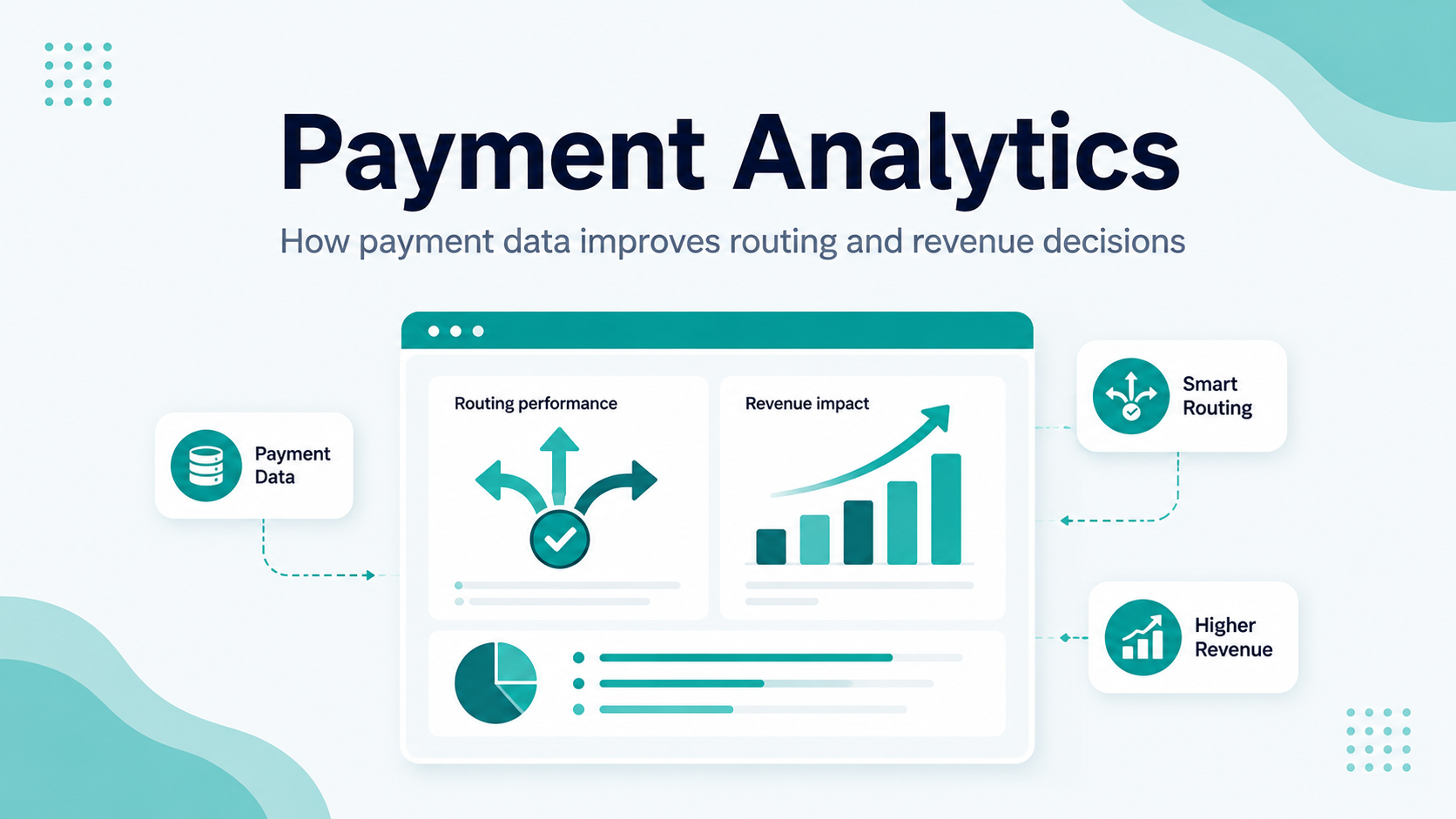
Payment analytics is not just a reporting function. For enterprise merchants, it is the decision layer that shows where payments succeed, where they fail, why performance changes, and which actions can improve revenue outcomes.
When a business processes payments across several PSPs, acquirers, currencies, regions, and payment methods, raw transaction data quickly becomes difficult to interpret. One dashboard may show sales volume, another may show declines, another may show settlement status, and another may hold fraud or chargeback data. Without a unified view, payment teams are often forced to make routing and provider decisions based on partial evidence.
This is where payment analytics becomes operationally important. It helps payment teams understand provider performance, approval trends, decline reasons, retry outcomes, cost differences, and customer payment behavior. More importantly, it helps turn those insights into better routing and revenue decisions.
For merchants using a payment orchestration platform, analytics is especially valuable because the data does not stay passive. It can inform smart routing, payment cascading, failover logic, fraud-rule tuning, reconciliation, and payment method strategy.
What is payment analytics?
Payment analytics is the process of collecting, structuring, and analyzing transaction data to understand payment performance and improve business decisions.
In practice, payment analytics brings together data from payment gateways, PSPs, acquirers, fraud tools, checkout systems, subscription platforms, settlement reports, and reconciliation workflows. The goal is not only to see how many transactions were processed, but to understand how effectively the payment stack supports revenue.
A strong payment analytics setup usually tracks:
- transaction volume and value;
- approval and decline rates;
- decline reasons;
- provider and acquirer performance;
- payment method performance;
- country, currency, and card-brand performance;
- retry and cascading outcomes;
- fraud, chargeback, and refund patterns;
- transaction latency;
- settlement and reconciliation status;
- payment costs by route or provider.
Basic payment reporting answers the question: “What happened?”
Payment analytics goes further and asks: “Why did it happen, what does it mean for revenue, and what should the payment team change next?”
That distinction matters. A monthly report may show that approval rates dropped in Germany. Payment analytics should help identify whether the issue came from a specific provider, issuer group, BIN range, authentication rule, currency setup, fraud filter, or checkout flow.
Why payment analytics matters for enterprise merchants
Payment analytics matters because enterprise payment performance is rarely determined by one provider or one metric. It is shaped by many operational variables working together.
A merchant processing payments in one country through one PSP may be able to manage performance with simple reports. But once the business expands across markets, adds local payment methods, introduces subscriptions, or works with several providers, payment decisions become more complex.
At that stage, payment teams need to understand not only whether revenue is growing, but whether the payment infrastructure is helping or limiting that growth.
Payment analytics helps answer questions such as:
- Which provider performs best for each region?
- Which payment methods convert best by market?
- Are declines concentrated around one acquirer, issuer, currency, card type, or transaction amount?
- Which failed payments are recoverable through cascading?
- Are fraud rules blocking too many legitimate customers?
- Are processing costs rising on routes that do not improve approval rates?
- Are settlement delays affecting finance operations?
- Which markets need additional local payment methods?
These are not just technical questions. They affect revenue, customer experience, cash flow, and market expansion.
For example, if a marketplace sees strong checkout demand in a new region but weak payment completion, the issue may not be product-market fit. It may be poor local payment coverage, weak acquirer performance, unsupported payment methods, or authentication friction. Payment analytics helps separate commercial problems from payment infrastructure problems.
What payment data should payment teams track?
Payment teams should track data that explains performance, not only data that describes volume.
The most useful payment analytics systems combine operational, commercial, risk, and financial data. A high transaction count is useful, but it does not tell the full story. A merchant also needs to know how many transactions were approved, how many failed, why they failed, what each route cost, and whether the money was settled correctly.
| Data category | What to track | Why it matters |
| Transaction performance | Approval rate, decline rate, authorization rate, failed payments | Shows whether customers can successfully complete payments |
| Provider performance | PSP, acquirer, MID, route, response codes, latency | Helps compare providers by real performance, not assumptions |
| Market performance | Country, currency, issuer country, card brand, local method usage | Shows where payment setup supports or limits expansion |
| Payment method data | Cards, wallets, APMs, bank transfers, BNPL, local methods | Helps adapt checkout and routing to customer preferences |
| Retry and cascading data | Retry success rate, soft declines, hard declines, fallback provider outcomes | Shows whether failed payments can be recovered |
| Risk and fraud data | Fraud flags, chargebacks, false positives, rule triggers | Helps balance fraud control with legitimate approval rates |
| Financial data | Fees, settlement status, reconciliation status, refunds | Connects payment performance to revenue and finance operations |
| Customer impact | Drop-off, repeat payment success, subscription renewal failure | Shows how payments affect conversion and retention |
The most important point is consistency. If decline reasons, provider names, payment methods, or currencies are classified differently across systems, the analysis becomes unreliable. Enterprise merchants need clean data definitions before they can make confident routing decisions.
How payment analytics improves routing
Payment analytics improves routing by showing which provider, acquirer, method, or route performs best for a specific transaction context.
Routing should not be static. A route that works well for domestic card payments may perform poorly for cross-border transactions. A PSP that delivers strong approval rates in one region may underperform for another currency, issuer group, or card type. A low-cost provider may not be the best choice if it creates more failed payments and lost revenue.
With payment analytics, routing can be based on real performance signals, such as:
- country;
- currency;
- card brand;
- BIN range;
- issuer country;
- transaction amount;
- customer segment;
- payment method;
- provider approval rate;
- provider latency;
- processing cost;
- fraud risk;
- historical decline behavior.
This makes payment routing more precise. Instead of sending all transactions to the same provider, payment teams can create routing logic based on what actually improves success rates and profitability.
For example, a travel company may discover that Provider A performs best for European Visa transactions, Provider B performs better for US Mastercard transactions, and Provider C is more cost-effective for selected wallet payments. Without analytics, this pattern may remain hidden. With analytics, it can become a routing rule.
Intelligent payment routing can be configured based on parameters such as BIN, card type, currency, transaction amount, country, and payment method. Businesses can also track approval rates, declines, latency, and route efficiency to continuously optimize payment performance.
How payment analytics supports cascading and retries
Payment analytics helps payment teams understand which failed transactions should be retried, when cascading makes sense, and which fallback route is most likely to recover revenue.
Not every failed payment should be retried. Some declines are hard declines, where another attempt is unlikely to help and may increase cost or risk. Others are soft declines, where a retry through another provider, acquirer, or route may be reasonable.
Analytics helps separate these cases.
| Decline pattern | What analytics should show | Possible action |
| Soft decline from one provider | The same transaction type succeeds through another provider | Add cascading rule |
| Issuer-specific decline spike | Declines concentrated around issuer country or BIN range | Adjust route for affected BINs |
| Authentication-related failures | Higher failure rate after 3DS or SCA step | Review authentication flow |
| Provider latency or timeout | Failed payments linked to technical response delays | Trigger failover route |
| High-risk rule rejection | Fraud rules reject many legitimate transactions | Tune risk thresholds |
| Repeated hard declines | Retries do not recover payment | Avoid unnecessary retry cost |
Cascading works best when it is selective. Retrying every failed transaction blindly can increase costs, create operational noise, and produce poor customer experience. Retrying the right transactions through the right alternative route can recover revenue that would otherwise be lost.
Payment analytics makes that distinction visible.
How payment analytics improves revenue decisions
Payment analytics improves revenue decisions by connecting payment performance to commercial outcomes.
For enterprise merchants, revenue leakage often hides inside payment operations. The business may see strong demand, high checkout intent, or recurring subscription value, but still lose revenue because payments fail unnecessarily or because payment routes are not optimized.
Payment analytics can support revenue decisions in several ways.
1. Identifying hidden approval-rate losses
A small approval-rate change can have a large financial impact for high-volume merchants. If a business processes millions in monthly payment volume, even a modest improvement in successful authorizations can produce meaningful recovered revenue.
Analytics helps identify where improvement is possible. For example, the issue may be concentrated in one country, one provider, one payment method, or one card brand.
2. Comparing cost against performance
The cheapest payment route is not always the most profitable route. If a low-cost provider produces more declines, higher retry costs, or weaker customer completion rates, the apparent savings may be misleading.
Payment analytics helps compare routes using a more complete view:
- approval rate;
- processing cost;
- retry cost;
- chargeback exposure;
- settlement timing;
- operational workload;
- customer impact.
This helps payment teams optimize for net revenue, not only transaction fees.
3. Improving payment method strategy
Payment analytics can show which payment methods are actually used, which convert best, and which create operational friction.
For example, a merchant may add a local payment method in a new market and then use analytics to compare it against cards, wallets, and bank transfers. If the local method increases completion rates without creating settlement or reconciliation complexity, it may deserve stronger placement at checkout.
4. Supporting subscription and recurring revenue
For subscription businesses, failed recurring payments directly affect retention. Analytics can show whether failures are linked to expired cards, issuer declines, authentication issues, insufficient funds, or provider-specific problems.
That insight can inform retry timing, account updater logic, payment method fallback, customer notifications, and route selection.
5. Making expansion decisions more realistic
Before entering a new market, payment teams can use existing transaction data to identify infrastructure gaps. After launch, they can monitor approval rates, method adoption, fraud patterns, and settlement performance by market.
This helps the business avoid treating payment expansion as a one-time integration project. Instead, it becomes an ongoing performance process.
Payment analytics and provider performance monitoring
Provider performance monitoring helps merchants compare PSPs and acquirers using consistent metrics.
In a multi-PSP environment, each provider may report data differently. One provider may classify a decline as issuer-related, another may use a different response structure, and another may provide limited detail. Without normalization, provider comparison becomes difficult.
A payment orchestration layer can help centralize and standardize this view.
Payment teams should compare providers by:
- approval rate by region;
- approval rate by payment method;
- decline reason distribution;
- technical failure rate;
- latency;
- retry success rate;
- settlement reliability;
- refund processing performance;
- chargeback patterns;
- cost per successful transaction.
This is where analytics becomes a management tool. It helps payment leaders move provider conversations from general complaints to specific evidence.
Instead of saying, “Provider B is underperforming,” the team can say, “Provider B has a 12% higher soft-decline rate on French Mastercard transactions above €150 compared with Provider A over the last 30 days.”
That level of detail makes optimization practical.
Payment analytics vs payment reporting
Payment reporting shows results. Payment analytics explains performance and supports decisions.
The distinction is important because many merchants already have reports but still lack insight. A report may show the number of transactions, total processed value, and monthly decline rate. Analytics should explain what caused changes and what action the business should take.
| Area | Payment reporting | Payment analytics |
| Main purpose | Show what happened | Explain why it happened and what to do next |
| Timeframe | Often periodic | Real-time, historical, and comparative |
| Typical users | Finance, operations | Payments, finance, risk, product, leadership |
| Main output | Reports, exports, summaries | Insights, patterns, decisions, routing actions |
| Data depth | Basic transaction and settlement data | Provider, market, method, risk, route, and customer-level data |
| Business value | Visibility | Optimization and control |
Payment analytics gives businesses real-time visibility into transaction statuses, financial data, payment trends, and provider performance. Teams can segment data by merchant or MID, build custom reports and dashboards, export data in CSV or XLS formats, and connect payment data to BI tools such as Tableau or Looker for deeper analysis.
How payment orchestration turns analytics into action
Payment orchestration turns analytics from a visibility layer into an execution layer.
This is the main difference between simply having payment data and being able to act on it. If analytics shows that a provider is underperforming, the payment team needs a way to change routing logic. If a region has poor approval rates, the team may need to add a local method, change the acquirer, tune fraud rules, or introduce cascading. If reconciliation is difficult, finance teams need cleaner data across providers.
A payment orchestration platform supports this by centralizing:
- PSP and acquirer connectivity;
- smart routing;
- payment cascading;
- provider performance monitoring;
- payment method management;
- transaction reporting;
- reconciliation;
- fraud and risk controls;
- payment data visibility.
Akurateco’s payment orchestration platform is positioned around connecting to 700+ providers, optimizing transactions, improving approval performance through smart routing and cascading, managing global payment coverage, and simplifying reconciliation with automated reporting.
For enterprise merchants, the value is not only in collecting better data. It is in using that data to adjust the payment stack without rebuilding every provider integration manually.
Practical framework: from payment data to routing decision
Payment teams can use a simple five-step framework to turn payment analytics into better routing decisions.
| Step | Question to answer | Example decision |
| 1. Segment the data | Where is performance changing? | Compare approval rates by country, provider, method, and card brand |
| 2. Identify the cause | Why is the issue happening? | Separate issuer declines from provider timeouts or fraud-rule blocks |
| 3. Estimate revenue impact | How much value is at risk? | Calculate lost revenue from avoidable failed payments |
| 4. Test routing changes | Which route performs better? | Send selected traffic to an alternative PSP or acquirer |
| 5. Monitor results | Did the change improve net performance? | Compare approval rate, cost, latency, and chargebacks after routing change |
This framework keeps analytics tied to action. It also prevents payment teams from making changes based on isolated metrics.
For example, a route may improve approval rates but increase chargebacks. Another route may reduce cost but increase latency. The best decision depends on the full performance picture.
Common mistakes in payment analytics
Payment analytics is only useful when the data is clean, contextual, and connected to decisions.
Many businesses invest in dashboards but still struggle to improve performance because the underlying analytics model is weak. The issue is rarely a lack of data. More often, it is fragmented data, inconsistent definitions, or unclear ownership.
Common mistakes include:
- tracking total payment volume without tracking success quality;
- comparing PSPs without normalizing response codes;
- treating all declines as the same;
- retrying failed transactions without understanding decline type;
- optimizing for cost without measuring lost revenue;
- ignoring settlement and reconciliation impact;
- separating fraud analytics from approval-rate analysis;
- reviewing payment data too late to act;
- using dashboards that do not connect to routing controls.
A useful analytics setup should help payment teams make decisions quickly and safely. If a dashboard only shows attractive charts but does not help improve routing, reduce failures, or explain revenue leakage, it is not enough.
Conclusion
Payment analytics is becoming a core capability for enterprise merchants that process payments across multiple providers, regions, currencies, and payment methods. It helps payment teams understand where revenue is lost, which routes perform best, how providers compare, and where payment operations need adjustment.
The strongest analytics setup does more than produce reports. It supports decisions about routing, cascading, fraud controls, reconciliation, payment method strategy, and market expansion.
For enterprise merchants managing complex payment operations, Akurateco can act as a payment orchestration partner that helps centralize payment data, improve provider visibility, optimize routing, monitor performance, and scale payment operations without rebuilding the entire payment stack from scratch.
FAQ
What is payment analytics?
Payment analytics is the process of collecting and analyzing transaction data to understand payment performance. It helps businesses track approval rates, declines, payment methods, provider performance, fraud patterns, settlement status, and revenue impact. For enterprise merchants, it supports better routing, reporting, reconciliation, and payment optimization decisions.
How does payment analytics improve payment routing?
Payment analytics improves routing by showing which PSP, acquirer, payment method, or route performs best for specific transaction types. Payment teams can use data such as country, currency, BIN, card brand, amount, provider latency, and decline reason to route transactions more effectively and reduce avoidable failures.
What payment metrics should enterprise merchants track?
Enterprise merchants should track approval rates, decline reasons, transaction volume, payment method performance, PSP performance, retry success, cascading outcomes, processing cost, fraud rates, chargebacks, refunds, settlement timing, and reconciliation status. These metrics help connect payment operations with revenue, customer experience, and finance outcomes.
What is the difference between payment analytics and payment reporting?
Payment reporting shows what happened, such as transaction volume, approval rate, or settlement totals. Payment analytics explains why it happened and what action should be taken. Analytics helps identify patterns, compare provider performance, tune routing rules, improve cascading, and support revenue decisions.
How does payment orchestration use payment analytics?
Payment orchestration uses payment analytics to inform smart routing, cascading, provider selection, fraud-rule tuning, payment method management, and reconciliation. Instead of keeping insights separate from execution, orchestration allows payment teams to act on data across multiple PSPs, acquirers, markets, and payment methods.
How can Akurateco help with payment analytics?
Akurateco helps merchants centralize payment data, monitor transaction performance, compare routes, track provider behavior, and manage routing decisions through its payment orchestration platform. Its analytics, dashboard, routing, cascading, and reporting capabilities support payment teams that need more control over complex payment operations.