

- What is multi-acquirer payment orchestration?
- Why is connecting several acquirers not enough?
- How does multi-acquirer payment orchestration work?
- What happens during payment authorization?
- How are unsuccessful transactions classified?
- What is payment cascading?
- What is the difference between routing, cascading, and failover?
- What happens after authorization?
- How does orchestration support payment reconciliation?
- How should merchants monitor acquirer performance?
- Direct integrations vs in-house routing vs orchestration
- When does multi-acquirer orchestration make sense?
- How should an enterprise implement multi-acquirer orchestration?
- Common multi-acquirer orchestration mistakes
- Building a manageable multi-acquirer payment stack
Working with multiple acquirers gives enterprise merchants more payment coverage, greater resilience, and more flexibility in how transactions are processed. It can also create a fragmented infrastructure in which every provider has its own API, transaction statuses, decline codes, reporting format, settlement schedule, and maintenance requirements.
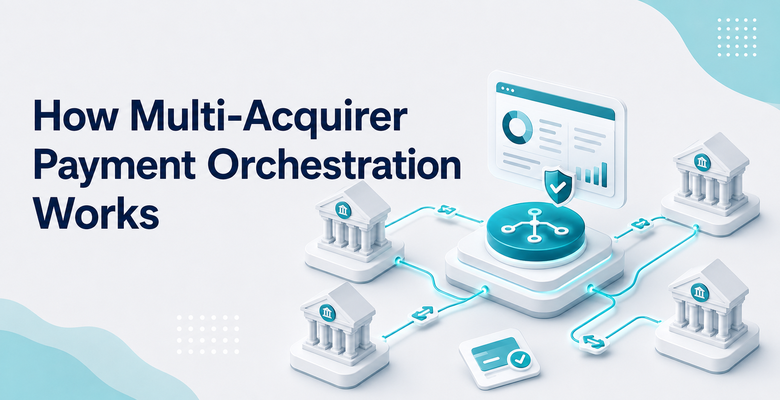
Multi-acquirer payment orchestration adds a centralized control layer between the merchant’s payment environment and its acquiring providers. Instead of sending every payment to a predetermined acquirer, the orchestration platform evaluates the transaction, identifies eligible routes, chooses a provider, handles recoverable failures, and records the result in a standardized format.
The objective is not simply to connect more acquirers. It is to make those connections work as one manageable payment stack.
What is multi-acquirer payment orchestration?
Multi-acquirer payment orchestration is the centralized routing and management of transactions across two or more acquirers. It combines provider connectivity with routing rules, cascading, failover, transaction monitoring, and reconciliation.
In a single-acquirer setup, most transactions follow one predefined processing path. The merchant depends on that provider’s geographical coverage, availability, payment methods, authorization performance, pricing structure, and reporting capabilities.
A multi-acquirer setup introduces alternative routes. For example, one acquirer may be used for domestic card payments, another for cross-border transactions, and a third as a backup during technical incidents.
However, simply integrating several acquirers does not automatically create an optimized payment flow. Without an orchestration layer, the merchant may still need to maintain separate provider logic, manually allocate traffic, combine reports, and respond to outages through internal engineering changes.
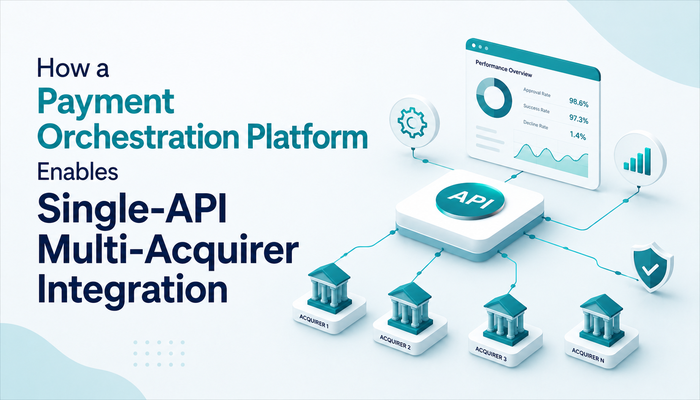
A payment orchestration platform centralizes these processes. The merchant sends a standardized payment request to one infrastructure layer, while the platform manages the differences between individual acquirers.
Why is connecting several acquirers not enough?
Several acquirer integrations provide more processing options, but orchestration determines how and when those options are used. Without centralized control, a multi-acquirer stack can increase complexity faster than it improves performance.
Every acquirer may use different:
- API structures and authentication methods
- Request and response fields
- Payment statuses
- Decline and error codes
- Merchant identifiers and terminal settings
- Capture and refund processes
- Reporting formats
- Settlement files
- Supported currencies and payment methods
- Recurring payment requirements
When these integrations are managed independently, adding a new acquirer becomes another engineering project. For businesses working with Mastercard Payment Gateway Services or similar acquiring connections, routing rules may be hard-coded into the merchant’s backend, and changing traffic allocation may require development work and a new release.
Operational teams also need to switch between provider dashboards to investigate failed payments, compare performance, or reconcile transactions with settlements.
Multi-acquirer payment orchestration separates the merchant’s payment logic from individual provider integrations. Provider-specific details remain within the orchestration layer, while the merchant operates through a common transaction model.
This makes it possible to change routing rules, introduce backup routes, add payment providers, and compare performance without rebuilding the entire checkout infrastructure.
How does multi-acquirer payment orchestration work?
A typical orchestration flow includes payment initiation, request normalization, route eligibility checks, acquirer selection, authorization, response classification, cascading or failover, and post-payment reporting. For a broader explanation of the mechanics of payment orchestration, see our dedicated guide.
The exact sequence depends on the payment method, merchant configuration, authentication requirements, and risk strategy. A card payment usually moves through the following stages.
| Stage | What happens | Main systems involved |
| Payment initiation | The customer confirms the purchase | Checkout and merchant backend |
| Request normalization | Payment data is converted into a standard internal format | Merchant API and orchestration layer |
| Eligibility filtering | Unsupported or unavailable routes are excluded | Routing engine and provider configuration |
| Risk and authentication | Fraud rules and 3D Secure are applied where required | Fraud tools, 3DS provider, orchestration platform |
| Acquirer selection | The primary processing route is chosen | Smart routing engine |
| Authorization | The payment is submitted to the acquirer and issuer | Acquirer, card network, issuing bank |
| Response evaluation | The result is classified and normalized | Orchestration platform |
| Cascading or failover | An eligible transaction is redirected when necessary | Routing engine and alternative acquirer |
| Post-payment operations | The transaction is captured, monitored, reported, and reconciled | Payment operations and finance systems |
1. The customer initiates the transaction
The flow begins when the customer chooses a payment method and confirms the purchase.
The merchant’s backend creates a payment request containing information such as:
- Transaction amount
- Currency
- Order identifier
- Payment method
- Card token or payment credentials
- Customer location
- Billing and shipping details
- Recurring payment indicator
- Merchant-defined parameters
Some of this information is required for authorization. Other fields may be used to determine which acquirers are eligible and which route should be prioritized.
For example, the platform may use the transaction currency, card BIN, issuer country, or customer region when selecting a provider.
2. The orchestration platform normalizes the request
Different acquirers may expect different request formats. One provider may require a specific currency code, another may use a different transaction-type field, and a third may have its own structure for authentication data.
The orchestration platform converts the merchant’s request into a standardized internal payment object. It then translates that object into the format required by the selected provider.
The same process works in reverse when an acquirer returns a response. Provider-specific codes and statuses are mapped to a consistent model that the merchant can use across its payment operations.
Without normalization, the merchant must build separate logic for every provider throughout its backend, monitoring tools, customer support workflows, and financial reports.
3. The platform determines which acquirers are eligible
Before choosing the preferred route, the orchestration layer excludes providers that cannot process the transaction.
Eligibility may depend on:
- Payment method support
- Transaction currency
- Issuer or customer country
- Card scheme
- Merchant category
- Transaction amount
- One-time or recurring payment type
- 3D Secure support
- Merchant account configuration
- Provider processing limits
- Risk restrictions
- Terminal availability
- Capture or refund requirements
This step is essential because the cheapest or historically best-performing provider may not support the specific transaction.
For example, an acquirer may have strong approval performance for domestic Visa transactions but may not support the required currency or recurring payment model. In that case, it should be removed from the eligible route list before routing logic is applied.
4. Fraud checks and authentication are performed
Risk management and authentication can happen before or during provider selection, depending on the merchant’s architecture.
The payment may be sent to a fraud prevention system that evaluates the transaction using customer data, device information, historical behavior, velocity rules, and merchant-defined risk criteria.
For card payments, the platform may also coordinate 3D Secure authentication. Authentication may be required by regulation, requested by the issuer, or triggered by the merchant’s risk strategy.
The authentication result must then be passed correctly to the selected acquirer. This means the alternative route must be able to process the same authentication data if the transaction is redirected.
Fraud, authentication, and routing should therefore be treated as connected parts of the payment flow rather than isolated systems.
5. The routing engine selects the primary acquirer
Once the platform identifies eligible routes, it applies the merchant’s routing strategy.
A route may be selected according to:
- Customer or issuer geography
- Transaction currency
- Card BIN or scheme
- Payment method
- Transaction amount
- Domestic or cross-border status
- Historical authorization performance
- Provider response time
- Processing cost
- Acquirer availability
- Merchant account limits
- Risk category
- Remaining provider capacity
- Contractual traffic commitments
A simple configuration may use fixed rules. For example:
- Route transactions in EUR issued in Germany to Acquirer A.
- Route transactions in PLN issued in Poland to Acquirer B.
- Send all transactions above a defined value to Acquirer C.
- Use Acquirer D only as a backup provider.
A more advanced configuration may consider current or historical performance. The routing engine can compare providers for a particular transaction segment and prioritize the route that best matches the merchant’s objective.
The objective must be clearly defined. A merchant may want to optimize for:
- Authorization performance
- Processing cost
- Provider resilience
- Domestic acquiring
- Transaction speed
- Market coverage
- A balance of several factors
The lowest-cost route is not always the most commercially efficient route. If a provider charges less but approves fewer transactions, the merchant may lose more revenue than it saves in processing fees.
What happens during payment authorization?
After selecting the route, the orchestration platform submits the payment to the chosen acquirer and records the response. The authorization result then determines whether the transaction is completed, rejected, authenticated again, or redirected.
For a card payment, the authorization request usually moves through the following chain:
- The orchestration platform sends the request to the acquirer.
- The acquirer forwards it through the card network.
- The card network directs it to the issuing bank.
- The issuer approves or declines the payment.
- The response returns through the network and acquirer.
- The orchestration platform normalizes the result and returns it to the merchant.
The platform records information such as:
- Selected provider
- Provider transaction identifier
- Authorization status
- Decline or error code
- Response time
- Authentication result
- Routing rule used
- Processing attempts
- Final transaction state
If the payment is approved, the platform returns a successful result and continues with capture or another required post-authorization step.
If the payment fails, the orchestration platform must determine what kind of failure occurred.
How are unsuccessful transactions classified?
Not every failed payment should be sent to another acquirer. The platform must distinguish between definitive issuer declines, potentially recoverable declines, technical errors, and uncertain transaction states.
Common categories include:
Hard declines
A hard decline usually indicates that another immediate authorization attempt is unlikely to succeed or should not be made.
Examples may include:
- Invalid account details
- Stolen or blocked card
- Closed account
- Transaction not permitted
- Definitive issuer rejection
The exact interpretation depends on the provider response and card-network rules.
Soft declines
A soft decline may indicate a temporary or recoverable issue.
The payment may require:
- 3D Secure authentication
- Updated transaction data
- A different route
- A customer action
- A later retry
Soft declines must still be handled carefully. Repeatedly submitting the same transaction without a controlled policy can increase fees and create a poor customer experience.
Technical errors
Technical failures include:
- Provider timeout
- Connection error
- Unavailable API endpoint
- Internal acquirer error
- Temporary service disruption
These failures are usually the main candidates for provider failover.
Unknown or pending results
A timeout does not always mean that the authorization failed. The acquirer may have processed the transaction but failed to return the response in time.
Before submitting the payment elsewhere, the orchestration platform must confirm the transaction state where possible.
Idempotency controls and status checks are important here. Without them, the merchant could send a second authorization even though the first provider ultimately approved the payment.
What is payment cascading?
Payment cascading redirects an eligible unsuccessful transaction to another provider. It is used after the first authorization attempt and should follow predefined retry and transaction-state rules.
When cascading is triggered, the orchestration platform selects another compatible route.
The alternative provider must support the same:
- Currency
- Payment method
- Transaction type
- Authentication model
- Stored credential framework
- Merchant configuration
- Regional requirements
The platform may use a predefined cascade sequence, such as:
- Acquirer A as the primary route
- Acquirer B after an eligible soft decline
- Acquirer C after a technical failure
Alternatively, the routing engine may recalculate the best available route after the first attempt.
Cascading should not be treated as a way to retry every declined payment. The platform must evaluate the response code, transaction status, previous attempts, retry limits, and duplicate-payment risk.
A strong initial routing strategy should reduce the need for cascading. The cascade acts as a recovery mechanism rather than a replacement for accurate route selection.
What is the difference between routing, cascading, and failover?
Smart routing selects the initial provider. Cascading responds to an eligible unsuccessful authorization, while failover protects processing continuity when a provider is unavailable.
| Mechanism | When it happens | Typical trigger | Main purpose |
| Smart routing | Before authorization | Transaction and provider data | Select the most suitable initial route |
| Cascading | After an unsuccessful attempt | Recoverable decline or provider response | Recover a potentially payable transaction |
| Failover | During provider disruption | Timeout, outage, or technical unavailability | Maintain payment continuity |
| Load balancing | Before authorization | Traffic or capacity policy | Distribute transaction volume |
These mechanisms may use some of the same provider connections, but they serve different operational objectives.
For example, a routing rule may send a French-issued card to a local acquirer because it has historically performed well for that segment. If the acquirer returns a recoverable decline, cascading may send the transaction to a second eligible route. If the first provider is completely unavailable, failover may bypass it before or during the authorization attempt.
What happens after authorization?
Payment orchestration continues after the initial approval. The platform must support capture, refunds, recurring transactions, reporting, settlement visibility, and reconciliation while preserving the original provider relationship.
Depending on the merchant’s business model, an approved authorization may later require:
- Full or partial capture
- Authorization void
- Full or partial refund
- Recurring payment
- Subscription renewal
- Dispute investigation
- Chargeback processing
- Settlement matching
- Fee calculation
These operations usually need to be sent back to the acquirer that processed the original transaction.
The orchestration platform must therefore maintain the relationship between:
- Merchant order identifier
- Internal payment identifier
- Acquirer transaction identifier
- Merchant account or MID
- Authorization
- Capture
- Refund
- Settlement record
This transaction history gives payment teams a centralized view of the lifecycle even when different payments are processed by different providers.
How does orchestration support payment reconciliation?
A centralized orchestration layer can standardize transaction data across providers and make it easier to match payments, refunds, fees, and settlements with merchant records.
Multi-acquirer reconciliation is difficult because providers may use different:
- File structures
- Settlement periods
- Time zones
- Fee formats
- Transaction identifiers
- Status definitions
- Currency conversion methods
A payment may be approved on one date, captured on another, and included in a later settlement after provider fees have been deducted.
The finance team must match the settlement record with the corresponding order, authorization, capture, and refund events.
Without centralized data, this process may involve manually exporting reports from several provider portals and converting them into a common format.
A payment orchestration platform can consolidate provider-side transaction data and connect it with merchant references. This does not remove every reconciliation exception, but it gives finance and payment teams a consistent dataset for identifying discrepancies.
How should merchants monitor acquirer performance?
Provider performance should be evaluated by transaction segment, not only through one overall approval-rate figure. An acquirer may perform well in one country or card segment and poorly in another.
Useful performance metrics include:
- Authorization rate by acquirer
- Approval rate by issuer country
- Approval rate by card BIN
- Performance by card scheme
- Domestic versus cross-border approvals
- Recurring payment success rate
- Technical error rate
- Timeout rate
- Average response time
- Cascading recovery rate
- Cost per successful transaction
- Decline distribution
- Reconciliation discrepancy rate
For example, Acquirer A may have the strongest overall approval rate but perform poorly for cards issued in a specific country. Acquirer B may be more expensive but produce more successful transactions for high-value purchases.
The payment team can use this information to update route priorities, adjust traffic allocation, change cascade sequences, or remove underperforming providers from specific segments.
Routing changes should be measurable. Each adjustment should have a defined objective and be compared with a baseline rather than introduced without controlled analysis.
Direct integrations vs in-house routing vs orchestration
Direct integrations may work for a small and stable provider setup. An in-house routing layer provides control but creates long-term development obligations, while a payment orchestration platform provides a ready-made management layer.
| Approach | Advantages | Limitations | Best suited to |
| Direct integrations | Direct provider control and no additional platform layer | Separate maintenance, reporting, and routing logic | Merchants with very few stable providers |
| In-house payment switch | Custom routing and complete infrastructure ownership | High development and maintenance requirements | Large companies treating payments as a core internal product |
| Payment orchestration platform | Centralized integrations, routing, failover, monitoring, and reporting | Requires platform evaluation and implementation | Enterprise merchants scaling across providers and markets |
Direct acquirer integrations are not necessarily inefficient. They become difficult when the merchant needs to manage many providers, business units, currencies, methods, and routing scenarios.
An internal payment switch can give the company deep control, but it also requires the merchant to own:
- Acquirer integrations
- API updates
- Certifications
- Routing infrastructure
- Retry and state-management logic
- Provider monitoring
- Payment analytics
- Reconciliation data
- Security and compliance processes
A payment orchestration platform provides these capabilities as a centralized infrastructure layer while allowing the merchant to define its own payment strategy.
When does multi-acquirer orchestration make sense?
Multi-acquirer orchestration is most useful when provider diversity is necessary but managing separate integrations is slowing down payment operations.
International e-commerce
An international retailer may use local acquirers for domestic transactions and alternative providers for cross-border payments. Routing can account for currency, issuer location, cost, and regional performance.
Subscription businesses
Subscription companies need to manage recurring transactions, stored credentials, token references, and retry policies. A multi-acquirer setup can provide alternative routes when the primary provider cannot process an eligible renewal.
Travel companies
Travel businesses often process high-value and cross-border transactions. Different acquirers may perform differently depending on the customer’s location, card issuer, transaction currency, or risk profile.
Marketplaces
A marketplace operating across several countries may need different acquiring relationships for different legal entities, currencies, or business models. Orchestration gives the central payment team one control layer across these routes.
Large retailers and digital platforms
High-volume businesses can use multiple acquirers to reduce dependency on one provider, distribute transaction volume, maintain backup capacity, and compare processing performance.
How should an enterprise implement multi-acquirer orchestration?
Implementation should begin with clear payment objectives and existing transaction data. Routing rules should solve a defined business problem rather than simply distribute traffic between available providers.
A practical implementation process includes the following steps.
1. Establish a performance baseline
Measure the current:
- Approval rate
- Decline distribution
- Provider latency
- Technical error rate
- Processing cost
- Reconciliation workload
- Outage frequency
- Payment-method coverage
Without a baseline, the merchant cannot determine whether orchestration improves the payment operation.
2. Define the primary objective
The initial project should focus on a clear priority, such as:
- Reducing dependency on one acquirer
- Improving payment continuity
- Expanding into a new market
- Increasing authorization performance
- Centralizing payment reporting
- Reducing integration maintenance
- Improving reconciliation
Trying to optimize every KPI at once can make the routing model difficult to evaluate.
3. Map provider capabilities
Document which acquirers support each:
- Country
- Currency
- Payment method
- Card scheme
- Transaction type
- Authentication flow
- Capture model
- Refund operation
- Recurring payment scenario
This information forms the basis of route eligibility.
4. Connect providers gradually
The merchant can begin with its current primary provider and then add an alternative route for a specific market, payment method, or backup scenario.
Gradual implementation makes it easier to compare results and isolate operational issues.
5. Define routing and retry policies
The payment team should document:
- Primary route rules
- Provider exclusions
- Traffic allocation
- Failover conditions
- Cascade order
- Eligible decline categories
- Maximum retry count
- Timeout handling
- Unknown-status handling
These policies should be controlled and auditable.
6. Monitor and refine
Compare performance with the original baseline and change one routing variable at a time.
Payment operations, engineering, finance, fraud, and compliance teams should agree on ownership. Routing changes affect more than authorization rates; they may also affect costs, reporting, settlements, and customer support.
Common multi-acquirer orchestration mistakes
The most common mistakes come from treating orchestration as a connectivity project rather than an operating model. More providers do not automatically produce better payment outcomes.
Adding acquirers without a specific purpose
Every new provider adds configuration, reporting, commercial, and operational work. Each acquirer should serve a defined market, performance, cost, or resilience objective.
Routing only by processing cost
A lower provider fee does not necessarily produce a lower cost per successful transaction. Approval performance, customer abandonment, cross-border fees, and operational workload must also be considered.
Retrying every decline
Uncontrolled retries can create additional fees, duplicate-payment risk, and a poor customer experience. Cascading should only be triggered for eligible responses.
Ignoring authentication compatibility
The alternative provider must be able to process the authentication result and transaction data produced earlier in the flow.
Optimizing approvals but ignoring reconciliation
A routing strategy may improve authorization performance while increasing financial complexity. Payment optimization should consider the full transaction lifecycle.
Using one global provider ranking
Acquirer performance varies across countries, issuers, currencies, payment methods, and transaction types. Routing should reflect these differences.
Building a manageable multi-acquirer payment stack
A multi-acquirer strategy gives enterprise merchants more payment options, but those options only create value when they can be managed as one coordinated infrastructure.
The orchestration layer must do more than forward API requests. It must determine which providers can process a transaction, select the appropriate route, preserve an accurate transaction state, control retries, normalize provider responses, and make transaction data usable for payment operations and finance teams.
For merchants that have outgrown static provider integrations, a payment orchestration platform such as Akurateco can centralize acquirer connectivity, smart routing, cascading, transaction monitoring, reporting, and reconciliation without requiring the company to rebuild every part of its payment infrastructure internally.
FAQ
What is multi-acquirer payment orchestration?
Multi-acquirer payment orchestration is the centralized management of transactions across two or more acquiring providers. An orchestration platform identifies eligible routes, selects an acquirer, handles recoverable failures, and consolidates transaction data for monitoring, reporting, and reconciliation.
How does a payment orchestrator select an acquirer?
A payment orchestrator first removes providers that cannot process the transaction. It then applies routing logic based on factors such as country, currency, card scheme, issuer, payment method, transaction type, provider availability, historical performance, processing cost, and merchant-defined priorities.
What is the difference between smart routing and cascading?
Smart routing takes place before the first authorization and selects the preferred acquirer. Cascading happens after an eligible unsuccessful attempt and redirects the payment to another compatible provider. Cascading should only occur when the response type and transaction state allow another authorization attempt.
Can payment orchestration prevent acquirer downtime?
Payment orchestration cannot prevent a provider from experiencing an outage, but it can reduce the merchant’s dependency on that provider. Failover logic can redirect eligible transactions to an alternative acquirer when the primary route is unavailable or returns a technical error.
Does multi-acquirer orchestration improve approval rates?
It can improve approval performance when providers have different strengths across issuers, countries, payment methods, and transaction types. The result depends on provider coverage, routing logic, authentication strategy, decline handling, and the quality of the transaction data used for optimization.
How can Akurateco support multi-acquirer payment processing?
Akurateco provides a payment orchestration platform that helps enterprise merchants connect and manage multiple acquirers, PSPs, and payment methods. Payment teams can centralize transaction routing, cascading, failover, provider monitoring, reporting, and reconciliation without maintaining every provider workflow separately.