


- What Does a Payment Gateway Company Do?
- How Payment Gateways Make Money
- Inside the Merchant Discount Rate
- Pricing Models Providers Use
- Revenue Streams of a Gateway Business
- Unit Economics of a Gateway Business
- Business Models for Gateway Companies
- How to Start a Payment Processing Company or PSP: Step-by-Step
- Market Research: Your Ideal Merchant Base
- Compliance & Licensing Requirements
- Essential Departments & Teams
- Partnerships Required to Launch a Payment Gateway Company
- Technology Options: Build, White-Label, or Hybrid
- Go-to-Market Strategy
- Scaling Your Payment Gateway Company
- Common Mistakes New Gateway Companies Make
- Conclusion
A payment gateway business model allows PSPs to provide merchants with the infrastructure needed to accept and manage online payments. It securely transfers payment data between the parties involved and supports transaction authorization. Revenue can come from transaction fees, setup charges, subscriptions, value-added services, and, where the company’s role permits, a share of the Merchant Discount Rate.
The guide below describes a full roadmap for launching and scaling a payment gateway company, covering revenue streams, pricing, unit economics, business models, compliance, partnerships, technology, go-to-market strategy, and operations.
What Does a Payment Gateway Company Do?
A payment gateway company is a technology provider that enables merchants to accept and manage online payments securely. A gateway is a central component of the payment processing workflow. It’s a secure digital bridge that captures, encrypts, and moves payment data between customers, merchants, acquiring banks, and processors.
In addition to handling transactions, payment gateway companies also provide various tools that help their merchant clients work more efficiently. Such tools typically involve connections with providers, dashboards for settlement reporting featuring real-time analytics, payment routing rules that can increase approval rates and lower fees, billing and reconciliation tools, and built-in compliance and risk controls relating to dispute management and settlement visibility.
In this context, another related term may come up: payment aggregator. A payment gateway and a payment aggregator are similar but distinct terms.
A payment aggregator is a type of PSP that acts as a financial intermediary between merchants and the banking network. It transfers data between the major players involved in transaction processing: the customer, the merchant, the acquiring bank, the issuing bank, and the card network.
Instead of requiring each merchant to open its own merchant account with an acquiring bank, the aggregator onboards multiple sub-merchants under a shared master merchant account, which can shorten the time needed to start accepting payments. See our payment aggregator explainer for a clearer breakdown of this model.
A payment gateway company is also distinct from a payment processing company, which handles the actual movement of funds rather than just the payment data. The launch steps are the same for both, and the step-by-step section below shows where the processing route adds licensing and settlement obligations.
For these companies, revenue can come from several sources, including transaction fees, subscriptions, setup charges, and value-added services. We explain these income streams in more detail below.
How Payment Gateways Make Money
A significant portion of a payment gateway service provider’s revenue comes from the markups applied to transactions processed through its platform. In simple terms, a payment gateway earns income from each transaction by charging a percentage fee, a fixed fee, or both as part of the Merchant Discount Rate (MDR). After the underlying transaction costs are covered, the remaining markup becomes your margin.
To understand what an MDR includes, you need to start with the card network business model, since card networks are major players in online payments.
When we talk about card networks, we usually mean Visa or Mastercard. Banks and other payment participants pay these networks fees for access to their infrastructure and for transactions processed through it. Acquirers, processors, and other parties involved in the payment flow may also charge their own fees.
Payment service providers similarly charge merchants. To accept payments online, a merchant may rely on an acquiring bank, card network, payment processor, and online payment gateway. Each participant may charge a percentage fee, a fixed amount per transaction, or both. The total amount charged to the merchant is the MDR. Meanwhile, the difference between your merchant pricing and the underlying costs determines your margin.
Payment gateways also generate income through setup charges, subscriptions, and other service fees that their customers pay regularly. Read the full financial model of a payment processor for a broader breakdown of payment costs, pricing, and margins.
Inside the Merchant Discount Rate
MDR refers to the rate that a merchant pays when accepting a card payment, generally consisting of a percentage of the transaction value together with a fixed amount for each transaction. It’s not a single fee but a combination of several fees, each owned by a different party.
There’s an important commercial distinction for a payment provider. Interchange and scheme fees are pass-through costs you cannot compress, while the processing and gateway layers are where your margin actually lives.
| Component | Paid to | Controlled by | Typical share |
|---|---|---|---|
| Interchange | Issuing bank | Card network / regulator | 50–70% of MDR |
| Scheme fees | Visa, Mastercard, etc. | Card network | 5–15% |
| Acquiring markup | Acquiring bank | Commercial negotiation | 10–25% |
| Processing & gateway | PSP / processor | You | 10–30% |
Interchange fee. Paid by the acquirer to the issuer for authorizing and settling the transaction. Rates vary by card type (consumer vs. commercial), presence (card-present vs. e-commerce), merchant category, and, most significantly, geography. Under the EU Interchange Fee Regulation, consumer debit is capped at 0.20% and consumer credit at 0.30% for EEA domestic and intra-EEA transactions. Commercial cards and inter-regional transactions carry no such cap and routinely run several times higher.
Scheme fees. Charged by the card network for use of its rails and billed to both the acquiring and issuing sides. Unlike interchange, these are made up of dozens of individual line items, like authorization, settlement, cross-border, currency conversion, fraud, and data services, which is why scheme fee reconciliation is one of the harder problems in acquiring.
Acquiring markup. The acquirer’s own margin for holding the merchant relationship, carrying settlement risk, and managing chargeback exposure. If your company holds an acquiring license, this converts from cost to revenue.
Processing and gateway fees. The technology layer: authorization routing, tokenization, 3DS, retries and cascading, reporting. This is the component a white-label provider serves, and the only one where infrastructure quality translates directly into unit economics.
What MDR does not include. Chargeback and representment fees, refund fees, FX markup, monthly minimums, PCI compliance charges, and settlement or payout fees are all billed separately. Merchants comparing providers on headline MDR alone frequently misjudge total cost by 20–40%.
Pricing Models Providers Use
A payment gateway pricing model determines how the provider combines underlying processing costs with its markup. Payment gateway providers charge merchants using one of two models: blended pricing or interchange++. Each offers a different balance between price stability and margin visibility.
Blended Fee
Payment service providers using a blended fee structure charge merchants a flat rate. It combines the average transaction processing cost with a fixed markup. This means the merchant pays a fixed fee per transaction, regardless of factors such as card type or the customer’s location. For example, a blended fee might be set at 2.5% per transaction, with no breakdown of how costs vary by different variables.
This pricing strategy gives merchants a stable and predictable rate, but the underlying costs remain less visible. For the provider, the margin may vary between transactions because interchange and card network fees can change while the merchant rate stays fixed.
Interchange++ Fee
Interchange++ is typically used by PSPs in the USA or large acquirers in Europe. This model provides a detailed breakdown of the three main costs associated with card payments: the acquirer’s markup, the card network’s fee, and the interchange fee. This way, the rate for each transaction will vary depending on the specific payment method used.
Unlike blended pricing, interchange++ makes the provider’s markup and underlying payment costs more transparent. But the final rate is less predictable because interchange and card network fees vary between transactions.
On average, the merchant is charged 1–3% under interchange++ pricing for each transaction. For example, if the total interchange++ rate is 2.0%, the fees may be divided as follows:
- 1% – interchange fee
- 0.5% – acquirer markup
- 0.5% – card scheme
In addition, the merchant will also pay a fixed PSP fee. Let’s assume the PSP fee is 0.5% of the transaction amount, a common markup charged by many PSPs.
For example, a customer makes a $1,000 purchase at the online store with a card issued outside the EEA. From this amount, the merchant will pay a $10 Interchange fee to the issuing bank, $5 to the acquiring bank, $5 to the card scheme, and $5 to the PSP. Accordingly, a merchant would receive $975 out of the $1,000 paid by the customer.
The same split on a $100 payment: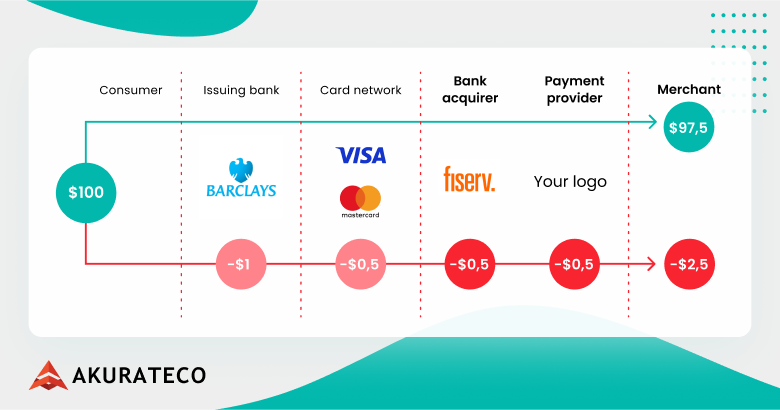
Revenue Streams of a Gateway Business
A payment gateway revenue model usually combines transaction-based income with recurring platform fees and paid services. Revenue grows through higher processing volume, a larger merchant base, and additional services sold alongside the core gateway infrastructure.
| Revenue stream | Who pays | Pricing form | Recurrence | Margin character |
|---|---|---|---|---|
| Transaction fees | Merchant | Percentage markup, fixed fee per transaction, or both; rates may also vary by processing volume | Recurs with every transaction | Volume-driven. Your margin is the difference between the merchant rate and the underlying processing costs. |
| Setup fees | Merchant | One-time charge for onboarding, configuration, integrations, or white-label deployment | One-time | Covers implementation work and may generate additional margin when onboarding is standardized. |
| Recurring fees | Merchant | Monthly or annual subscription for access to the gateway, updates, support, and platform tools | Monthly or yearly | Predictable recurring revenue with margins that depend on infrastructure and support costs. |
| Chargeback and fraud fees | Merchant | Fixed fee per chargeback, fraud case, dispute, or screened transaction | Event-based or usage-based | Often covers operational and third-party costs. Any remaining markup contributes to margin. |
| Cross-border fees | Merchant | Percentage surcharge, fixed transaction fee, currency-conversion markup, or a combination | Per eligible transaction | Variable margin because acquiring, card network, and foreign-exchange costs may differ by market and currency. |
| Value-added services | Merchant | Subscription, usage fee, feature-based tier, or per-transaction charge | Recurring or usage-based | Can provide additional margin through fraud tools, smart routing, tokenization, recurring billing, analytics, multi-currency support, and premium support. |
| Custom development | Merchant or business partner | Fixed project fee, milestone billing, or hourly rate | Usually one-time | Project-based margin that depends on development time, technical complexity, and ongoing maintenance requirements. |
| Partnerships and integrations | Processor, acquirer, fraud provider, or other partner | Referral fee, revenue share, integration fee, or commercial commission | One-time or recurring | Can add revenue without charging the merchant directly, but income depends on partner terms and referred volume. |
Unit Economics of a Gateway Business
Unit economics show what a gateway company can earn from each active merchant after covering the costs of serving that merchant.
When calculating startup costs for a fintech payment gateway company, count both the one-time expenses required to launch and the ongoing monthly costs of running the business. Akurateco and Dwayne Gefferie’s ebook explains in detail what exactly requires significant investment when building a payment infrastructure. Licensing an existing platform can reduce the initial investment, although it adds recurring license and service fees.
The figures below are illustrative. Actual results depend on transaction volume, merchant pricing, infrastructure costs, staffing, and commercial agreements.
Assumptions for the Worked Example
Suppose a gateway company serves 100 active merchants, each processing an average of $100,000 per month. This gives the company a total monthly payment volume of $10 million.
The gateway retains 0.30% of this volume as transaction revenue. It also charges each merchant a $250 monthly platform fee and earns an average of $50 per merchant from additional services.
The retained take rate is the part of the transaction fee that remains with the gateway after pass-through payment costs have been deducted.
Revenue Build-Up
A 0.30% retained take rate on $10 million in monthly volume generates:
$10,000,000 × 0.30% = $30,000
Monthly platform fees generate:
100 merchants × $250 = $25,000
Additional services generate:
100 merchants × $50 = $5,000
Total monthly revenue is:
$30,000 + $25,000 + $5,000 = $60,000
The gateway therefore earns an average of $600 in monthly revenue per merchant.
Monthly Cost Lines
Suppose the company’s monthly operating costs include:
- $15,000 for the platform and infrastructure
- $3,000 for fraud checks and transaction monitoring
- $4,000 for merchant support and dispute handling
- $18,000 for technical and payment teams
- $5,000 for compliance and legal work
- $6,000 for sales, administration, and other expenses
In that case, these cost lines total $51,000 per month.
They cover the technology, staff, security, compliance, integrations, and merchant support required to operate the gateway.
Net Profit per Merchant per Month
The company’s monthly operating profit is:
$60,000 in revenue − $51,000 in costs = $9,000
Dividing this result by 100 active merchants gives:
$9,000 ÷ 100 = $90
In this example, each merchant generates an average of $600 in revenue, costs $510 to serve, and contributes $90 in operating profit per month.
One-time launch costs also affect the result. For example, if the company spends $120,000 before launch and spreads that amount over 24 months, it adds $5,000 to monthly expenses. Monthly profit then falls to $4,000, or $40 per merchant.
A gateway company can improve its unit economics by increasing retained revenue per merchant, controlling operating costs, and spreading fixed expenses across a larger merchant base.
Business Models for Gateway Companies
Depending on its approach to monetization, the range of its operations, and how deeply it takes part in the payment process, a startup that provides a payment gateway can choose from a number of different business models, each of which has its own advantages and disadvantages.
Model 1: Full PSP / Payment Gateway Company
You build both gateway technology and the PSP layer for payment processing and settlement.
Pros:
- Full ownership of the payment stack
- Highest revenue potential across processing fees, FX margins, value-added services, and settlements
- Strong competitive positioning with full control over performance and merchant experience
- End-to-end merchant management, including onboarding, risk, authorization flows, and payouts
Cons:
- High development and maintenance costs if built internally
- Requires licensing, depending on the country of operation
- Heavier compliance burden, including PCI DSS
- Higher operational complexity, requiring multiple specialized teams
- Longer time-to-market owing to the prolonged development timelines
This is also the route to becoming a payment processor. Processing in the card-network sense additionally requires an acquiring or sponsor bank, registration with the card schemes, and enough capital to carry settlement, reserves, and chargeback liability.
A company generally only decides to set up its own gateway when it has very high transaction volumes and a specific, substantial requirement for full control over all aspects of the payment process. This means that it has to accept the high cost and risk involved in handling PCI compliance.
Model 2: Gateway-as-a-Service Company
You provide gateway infrastructure only. Merchants connect through you to their own acquirers, and you never hold or move their funds.
Pros:
- Faster time-to-market thanks to software already built by an expert team
- Usually no financial licensing required, since you never hold funds
- Immediate access to multiple integrations and connections
- White-label branding and customization options
- Lower operational overhead compared to full PSPs
Cons:
- Revenue potential may be lower, as monetization is focused on software rather than processing fees
- Payment performance depends on the merchant’s PSP partners, not the gateway
- Less control over settlement and payout experience
This model is ideal for financial entrepreneurs who want to quickly tap into the market and open a new payment revenue stream but don’t have the expertise or resources to build and maintain a complex, regulated payment infrastructure.
As for licensing, one point to note: the exemption varies according to your jurisdiction and depending on how the money actually flows through your arrangement, not on how you describe your role. Generally, passing on payment instructions between merchants and their providers keeps you outside the licensing requirements, while merely holding funds or having control of a settlement account generally does not.
Model 3: Vertical-Specific Payment Gateway
This model focuses on specialized industries and their unique payment needs, including travel, betting, marketplaces, and subscriptions.
Pros:
- Clear product-market fit, with a solution addressing the exact needs of one domain
- Targeted compliance and risk management
- Stronger differentiation with industry-specific features
- Stronger readiness to invest in specialized capabilities that solve unique business challenges
Cons:
- Requires deep domain expertise to maintain a competitive edge
- Regulatory obligations vary greatly across different countries, depending on the industry
- Market size is narrower, limiting growth potential
If your focus is on a particular niche with unique payment needs, a vertical-specific payment gateway helps to target a specific customer base and solve their challenges.
Model 4: SaaS or Platform Adding Its Own Gateway Layer
The platform becomes a payments provider, gaining additional revenue while delivering a more integrated experience by extending its core offering with a payment gateway layer.
Pros:
- Improved margins as payments become a new source of revenue
- Higher customer retention, since merchants rely on the platform for both payments and software
- Full control over the user experience, from checkout to reporting
- Stronger differentiation with an all-in-one solution
Cons:
- More operational responsibilities, including risk, compliance, and support
- Additional technical complexity, requiring engineering resources
- Financial licensing may be required if the platform holds the funds
- Significant competition with global payment giants
This model allows existing SaaS and platforms to introduce new payment revenue, increase customer retention, and gain greater control over the user experience without becoming a full PSP.
How These Compare to PayFac and Aggregator Models
The gateway models above describe how a company builds, operates, or licenses payment infrastructure. There are also PayFac and payment aggregator models. They define how a provider onboards merchants and gives them access to payment processing.
Under a PayFac-as-a-Service model, merchants are onboarded through a registered payment facilitator and its acquiring relationship. A payment aggregator model also groups multiple merchants under a shared acquiring setup, although the exact structure and responsibilities vary by market.
Does Your Model Require a License?
The licensing outcome is driven by one question — how money moves through your setup:
| Your architecture | Typical licensing position |
|---|---|
| You pass data only; funds move between the merchant’s own PSP and acquirer | Usually exempt from licensing as a technical service provider |
| You pass data and instruct settlement, but never hold funds | Usually exempt, but architecture-dependent — verify |
| You hold funds even momentarily, or control a settlement account | Licensing generally required |
| You onboard sub-merchants under your own acquiring relationship | Payment facilitator licensing generally required |
Take the table as your starting point, since your compliance obligations will vary according to your jurisdiction, your particular setup, and the specific fund flows.
How to Start a Payment Processing Company or PSP: Step-by-Step
Whether you are starting a payment gateway company, a PSP, or a payment processing company, the launch follows the same sequence. The processing route adds the licensing and settlement obligations described in the models above, and the sections that follow cover each step in more depth.
- Research the market and choose your niche. Pick the regions, merchant segments, and industries you will serve, such as e-commerce, high-risk verticals, SaaS platforms, marketplaces, or cross-border sellers.
- Define your business model. Decide which revenue streams you will charge for: transaction markups, setup and platform fees, and value-added services such as fraud prevention, routing, and merchant management tools.
- Choose your operating model. Your licensing requirements, partners, risk responsibility, and technical setup will be different depending on whether you operate as a gateway, PSP, PayFac, ISO/MSP, or full processor.
- Prepare your legal and compliance framework. Set up the legal entity, confirm the licensing each target market requires, and plan PCI DSS, AML/KYC, data protection, and risk policies.
- Build acquiring, banking, and provider relationships. Your acquirers, PSPs, payment-method providers, and fraud vendors decide which payment methods, currencies, regions, and merchant categories you can support.
- Choose your payment infrastructure. Build in-house, license a white-label platform, or combine the two. The platform has to cover transaction processing, merchant onboarding, routing and cascading, reporting, fraud prevention, and reconciliation. If you build, our technical guide to building a gateway covers the architecture, API, security, and certification work.
- Set up merchant onboarding and risk management. Before the first merchant agrees to sign, determine the application process, the documents that need to be collected, the KYC/KYB checks, the AML screening, the underwriting, the risk scoring, and the website review.
- Test the system before launch. Run successful and failed payments, refunds, chargebacks, routing rules, fraud rules, settlement reports, dashboards, and provider downtime end-to-end.
- Launch, monitor, and scale. Go live with a first group of merchants, then track approval rates, failed transactions, processing costs, chargebacks, and system performance as volume grows.
Market Research: Your Ideal Merchant Base
Merchant segments handle payments in distinct ways. Their risks, transaction flows, and day-to-day needs vary, so they rely on payment gateways for different reasons. As a payment gateway company, you need to understand these differences to decide which features and integrations to prioritize in your platform architecture.
Digital Banks / Fintech Apps
Since digital banks and fintech apps have to deal with sensitive financial and identity information every day, it is essential that their payment operations be secure and stable. Payment gateways are therefore vital components that support transaction processing, identity verification, and authorization within various payment rails.
They might also require account-to-account payments, digital wallets, connections to card issuing services, multi-currency support, and integrations with banking or compliance systems. When fintech products grow in scope, the gateway has to accommodate new providers and payment processes without disrupting the current operations.
Subscription Businesses
Since subscription businesses place great emphasis on retaining their customers, they require technology that enables recurring billing, tokenization, and reliable retry procedures. In order to securely store payment details, recover failed renewals, handle subscription updates, and keep the daily billing tasks under control, many companies make use of payment gateways.
SaaS companies might also require support for monthly and annual plans, free trials, upgrades, downgrades, usage-based billing, and prorated charges; payment reporting should assist them in keeping track of recurring revenue, failed payments, churn, refunds, and renewals for different plans and markets.
Ecommerce
Smooth checkout experiences and a variety of payment options are important for ecommerce merchants. They also care about approval performance and being able to accept international shoppers. Payment gateways help them address these areas by improving conversion, reducing drop-offs, managing fraud risk, and ensuring the system can handle high-volume periods.
Travel and Airlines
Travel payments are generally of a high value, frequently involve transactions between countries, and, as a result, cause a greater number of disputes. Given this complexity, together with the additional requirements related to 3DS and Strong Customer Authentication, merchants in this sector place great trust in gateways that enable them to reduce international declined transactions, manage their fraud exposure, support multiple currencies, and diversify their processing across various PSPs.
High-risk Verticals
As a rule, high-risk industries experience higher rates of fraud and chargebacks, have to go through more rigorous underwriting processes, and attract fewer willing acquirers since the character of these industries introduces extra operational, financial, and compliance risks for banks and PSPs. To deal with these difficulties, many operators use payment gateways that are designed for high-risk merchants to link up with specialized PSPs, manage the risk more effectively, settle disputes more quickly, remain compliant, and, at the same time, keep their approval rates at a reasonable level.
Marketplaces and Platforms
Since marketplaces work with a large number of sellers, divide up payments, and arrange scheduled payouts, they depend on payment gateways to carry out Know Your Business checks when onboarding sellers, to manage multi-party transactions, to handle payout distributions, and to provide both buyers and sellers with clear and consolidated reporting.
Compliance & Licensing Requirements
For any gateway startup, compliance and licensing form the basic foundations. In reality, they establish the regulatory framework in which your company can operate and are essential if you are to launch and keep a gateway functioning in the market you want to enter.
Let’s look at the basic licensing requirements for setting up and running a gateway business.
PCI DSS
PCI DSS compliance applies to organizations that store, process, or transmit cardholder data, as well as systems that can affect the security of the cardholder data environment. The level of responsibility and the scope of validation depend heavily on the gateway architecture.
Working with a certified provider can reduce your PCI DSS scope. But it does not remove your responsibilities or the need to validate compliance at the level your setup requires. The PCI Security Standards Council provides the official PCI DSS requirements and guidance that determine what remains in scope and how compliance must be validated.
You also need to ensure cardholder data stays outside your environment if reduced scope is the goal. An integration that routes card data through your own servers, even briefly, brings those systems under PCI DSS.
Depending on your setup, the cost can include security controls, evidence collection, vulnerability management, penetration testing, segmentation controls where segmentation is used, and recurring compliance work. That makes PCI DSS compliance an ongoing obligation rather than a one-off expenditure. The total cost depends on your architecture and the requirements of your acquirer or payment brands, and in some cases, on transaction volume. Confirm it with a Qualified Security Assessor before budgeting for compliance.
Local Regulations
Whether you’re operating in the EU, GCC, LATAM, or Africa, each has its own local regulations that a payment business must adhere to. If you hold or transmit merchant funds, that typically means state money transmitter licenses and registration with FinCEN as a money services business in the US, or an electronic money institution (EMI) or payment institution (PI) license in the EU and UK. Depending on the target region, you’ll need to understand how government officials define payment services and what requirements apply. Getting this right early helps you choose the fastest way into the market, shape your commercial approach, pick the right tech setup, and avoid unnecessary risks or costs.
Contracts with Acquiring Banks and PSPs
You can’t operate as a payment gateway without establishing legal partnerships with your acquiring banks and PSPs. These contracts are what let you process transactions, support multiple payment methods, and give merchants access to the providers they need.
AML/KYC Expectations
When you are onboarding merchants, you must carry out AML/KYC checks to verify who the merchant is and to ensure that their activities are legitimate. Such checks are usually required by banking partners and serve to prevent fraud, chargebacks, and future regulatory problems.
Because of these licensing and compliance challenges, many new gateway companies choose a shorter path.
To accelerate time-to-market and reduce regulatory complexity, many startups rely on support models such as:
- White-label payment gateway platforms that let PSPs avoid building the entire infrastructure from scratch. PCI DSS scope becomes much narrower because cardholder data is handled inside the vendor’s certified environment instead of yours, but it does not disappear, and your acquiring partners will ask for evidence of your compliance.
- Outsourced PCI or compliance certification, where a specialized firm manages your PCI DSS audit and documentation if your business model requires certification.
- Compliance-as-a-service providers that take over ongoing operational tasks, such as merchant onboarding, AML checks, transaction monitoring, and regulatory reporting.
Each approach simplifies the launch of a payment gateway for founders. As a result, founders can focus on going live and merchant acquisition.
Essential Departments & Teams
Every gateway launch also depends on the people behind it. In most early-stage setups, this means building a small but capable team that can cover the fundamental processes.
The number of people in a typical starting team varies between 15 and 36 and is based on the company’s technology model, the extent of its market scope, and the level of outsourced support.
Compliance & Risk (2–4 people)
This group manages your regulatory obligations and keeps merchant activity under control. They handle licensing matters, review AML and KYC documents, and monitor risk on an ongoing basis.
Technology & Product (6–12 people)
This team drives the development and evolution of your payment gateway. They coordinate product updates, support new integrations, and ensure the platform remains reliable as transaction volume increases.
Customer Support & Merchant Operations (2–5 people)
These are the people who stay close to your merchants day-to-day. They answer questions, solve operational issues, and help keep transaction flows running smoothly.
Sales & Partnerships (2–6 people)
This function focuses on bringing new merchants on board and building relationships with PSPs, acquirers, and alternative payment method providers. Their work shapes your commercial pipeline and partner network.
Finance & Settlement Operations (1–3 people)
The finance team oversees reconciliation, invoicing, and settlement-related checks. They help ensure that money movement and reporting remain accurate and timely.
Account Management (1–3 people)
Once merchants go live, this team looks after them. They help improve payment performance, support feature adoption, and maintain long-term relationships and retention.
Marketing (1–3 people)
This team represents your brand in the market. Through thought leadership, targeted campaigns, and search-focused content, they build awareness and attract qualified prospects looking for payment infrastructure.
Partnerships Required to Launch a Payment Gateway Company
A payment gateway depends on a network of financial, technology, and risk partners. The broader this network, the more payment methods, processing routes, and markets the gateway can support. To operate effectively, you need to secure relationships with several key players in payments:
- Acquiring banks, which provide merchant acceptance and support transaction authorization, clearing, and settlement.
- PSPs, which give your merchants access to additional processing routes and geographies.
- Local APMs and digital wallets needed to support region-specific payment habits.
- Fraud prevention providers, which strengthen security and reduce operational risk.
- KYC/KYB vendors who help you verify merchants during onboarding.
- BIN sponsors, if required by your business model, which enable card issuing or tokenization.
- Infrastructure providers such as AWS, Azure, or Oracle Cloud, which host your platform and support uptime.
It is this wider ecosystem of partners that makes a payment gateway work. No single provider can realistically build every payment method, integration, or fraud tool in-house without slowing growth or increasing costs.
A modern gateway creates value by giving merchants more options across payment routes, methods, and performance optimization. Over time, this allows you to expand coverage, support different merchant segments, control costs, and remain competitive.
Technology Options: Build, White-Label, or Hybrid
When starting a gateway company, you choose among three technology paths: building in-house, using white-label payment gateway solutions, or adopting a hybrid model. Each comes with different levels of control, cost, and speed to market.
One thing to state upfront: Akurateco develops and provides white-label payment gateway infrastructure, so we have a commercial interest in one of the three options below. The trade-offs listed for each path are the ones we would want a buyer to weigh before choosing any vendor, including us.
Option 1 — Build a Custom Gateway
Building in-house has several business implications. The most important are the cost of gateway development and the time and resources a build from scratch requires.ScienceSoft’s 2025 research estimates that building a custom gateway costs $100,000–$300,000+ and takes approximately 6–11 months.
That is why this option is typically chosen only by companies with very high transaction volumes, unique requirements, or a strong need for control and proprietary processing logic. For most early-stage PSPs and startups, the time-to-market and cost barriers are difficult to justify.
Option 2 — White-Label Payment Gateway
With a white-label payment gateway, startups can take the shortest path to launch: typically a few weeks rather than the months or years required for in-house development. The infrastructure, security layers, and hundreds of integrations are already built and maintained by the vendor. Because the vendor’s environment is PCI DSS-certified, the compliance scope you have to cover yourself becomes much narrower.
This allows founders to focus immediately on merchant acquisition, partnerships, support, pricing, and operations. A white-label gateway is often chosen over in-house development by PSP startups, SaaS platforms adding payments, regional providers, and entrepreneurs who want to launch a gateway business with lower upfront costs.
The trade-offs are real. You depend on the vendor’s roadmap for new connectors and features. That means some requests may not align with its priorities or delivery capacity. Recurring license or revenue-share fees replace the upfront development spend, so buyers should compare total long-term costs rather than launch costs alone.
You also give up some ownership of the underlying technology. Differentiation can still come from your commercial offer, service, and market focus rather than from proprietary technology, but competitors can access similar core infrastructure. Switching vendors later takes planning, which is why the selection criteria below matter more than the launch timeline.
Option 3 — Hybrid Model
Many modern PSPs adopt a hybrid strategy: they launch using a white-label solution, validate demand, build revenue, and then gradually extend the platform with proprietary modules where differentiation is needed.
This model combines rapid market entry with the option to develop a more customized or partially in-house stack over time. It also reduces risk by allowing the company to validate its business model before making major engineering investments. For a deeper comparison of these paths by cost, risk, and timeline, read our full build-vs-buy analysis for PSPs.
The same build-or-license choice for a new PSP is covered in this short video:
White-Label Gateway Economics
The white-label payment gateway business model replaces most in-house development costs with platform licensing fees. Instead of funding years of engineering, integrations, security work, and maintenance, you pay to use infrastructure that is already built and supported.
White-label providers usually structure their commercial agreements in one of two ways:
- Upfront license. A PSP pays a larger initial fee, followed by recurring charges for hosting, support, maintenance, or transaction volume. This requires more capital at launch but can leave the provider with a larger share of future revenue.
- Revenue share. The initial cost is lower, but the platform vendor receives an agreed percentage of transaction or service revenue. This reduces the barrier to entry while lowering the margin retained as volume grows.
Some vendors combine both through a setup fee, monthly platform charge, and transaction-based pricing.
The most valuable benefit is faster time to revenue. A licensed platform significantly shortens the period between the initial investment and the first merchant income. Compared with custom development, which takes 6–11 months or longer by the estimate above, this option allows you to launch within weeks. You can start onboarding merchants and charging transaction fees, subscriptions, setup fees, and value-added service fees without waiting for the full gateway stack to be developed.
Your retained margin is the revenue collected from merchants after deducting license fees, revenue share, processing costs, payment method charges, fraud tools, compliance, support, and other operating expenses. Merchant pricing and commercial strategy remain under your control, subject to the platform agreement.
Akurateco’s PCI DSS-certified white-label payment gateway combines branded payment infrastructure, integrations, merchant management, billing, and reporting into a single platform. Akurateco provides the gateway and orchestration layer on top of your acquirers; it does not process transactions itself.
How to Choose a White-Label Gateway Vendor
Most white-label gateways can deliver the main promises at the start, such as a faster launch and lower upfront costs. But whether the platform can keep up as your volumes grow and you enter new markets is harder to judge. Much of that depends on the vendor’s architecture, roadmap, and support model, so check the following before choosing one:
- The depth of the connector. Even if there are a lot of providers listed, this amounts to little if the key integrations are out of date or restricted. You should look for current coverage in the markets you’re interested in, for supported payment flows, and for clear responsibility regarding connector maintenance.
- Whether you can manage merchants from one interface. You should be able to assess the onboarding process, multi-MID support, permissions, billing, limits, and reporting all from a single interface. If they sit in separate tools, much of the work falls back on your team.
- How much you can change without the vendor. If you have to contact the vendor every time you need to change a routing rule, update a merchant’s fees, or raise a transaction limit, routine changes slow down. Identify which of these settings, along with workflows and branding, your team can manage without development support.
- How quickly the vendor responds and delivers. A merchant loses sales if the platform goes down during peak sales hours, which affects your processing revenue. Compare service level agreement (SLA) commitments, incident response times, support coverage, and delivery times for new integrations.
- How freely you can access and export your data. To find out why approval rates drop or to prepare a migration, you need the raw transaction records. Check whether the platform offers API access and bulk export, how detailed the data is, and whether the contract states that the records are yours.
- What happens if you decide to leave. A difficult exit can create technical and commercial lock-in. Check notice periods, data portability, migration assistance, and access after the contract ends.
Select a vendor who is able to provide support during both the launch and the scaling phases. Defining clear lines of ownership, specifying the service terms, and setting out exit conditions will avoid expensive surprises down the line.
Go-to-Market Strategy
Launching a payment gateway is only half the story. You also need a sustainable flow of clients. Winning merchants requires a targeted strategy, especially in the early stages when your positioning, partnerships, and sales focus are still taking shape.
Here are recommendations on how a new payment gateway company should shape an effective go-to-market strategy.
Define Your ICP (Ideal Customer Profile)
Start by identifying the type of merchant your gateway is built to serve. In payments, an ICP is defined by how a merchant processes, not by company size or industry label alone. Four variables do most of the work.
Processing volume. There is a floor below which a merchant may not justify your onboarding and support costs, and a point above which a merchant is more likely to expect customized pricing, direct acquiring relationships, and greater control over their payment setup. Your initial target usually sits between the two, but you may be able to serve a wider range of merchants as your onboarding and support processes become more efficient.
Card mix and geography. The types of cards a merchant accepts and where those cards are issued affect its payment costs. EEA consumer debit and credit cards are generally subject to capped interchange. Commercial and inter-regional cards can carry different, often higher costs. Card mix can, therefore, have a significant impact on the economics of an account. This understanding helps you determine what pricing and acquiring setup may be viable.
Risk classification. A merchant’s category code is an important part of determining which acquirers may support the business and under what conditions. Know which merchant categories, geographies, and risk profiles your acquiring partners accept before you build a pipeline around merchants they are unlikely to approve.
Existing setup. A merchant already using one or more payment providers may have established integrations, contracts, and internal processes. In this case, switching is more complex. Merchants dealing with fragmented payment setups, limited provider coverage, or operational inefficiencies may have a stronger reason to consider a new PSP. Understanding the merchant’s current setup helps you assess both the sales effort required and the problems your offer needs to solve.
The sharpest early ICP is often a merchant that has outgrown a simple single-PSP setup and needs broader payment capabilities but does not want to build and manage complex payment infrastructure. This type of merchant has a clear operational problem, a reason to consider a new PSP, and a stronger need for capabilities such as multiple acquiring connections, routing, broader payment-method coverage, reporting, and reconciliation.
Target High-Value Verticals First
Prioritize verticals with high processing volumes and complex payment operations.
These merchants often manage multi-PSP setups, cross-border flows, recurring billing, or elevated dispute rates. A new gateway can serve digital goods, marketplaces, subscription businesses, travel companies, and financial apps. These sectors move quickly and are often more willing to consider a new provider when it can remove clear payment friction.
Choose Local-First or Global-First Expansion
Your target geography determines which integrations, licenses, and partners you need first.
A local-first strategy works well when you specialize in one geography or regulatory zone, such as the EU, GCC, or LATAM. A global-first strategy better suits gateways focused on cross-border commerce, currency coverage, and PSP aggregation.
The decision should be based on how fast you want to go live and which partners you can secure.
Design a Commercial Routing Strategy
Your routing strategy should reflect merchant needs, processing costs, and provider performance.
Commercial routing defines why transactions are sent through specific PSPs or acquirers. It should account for processing patterns, geography, currencies, approval rates, cost, and provider availability.
When designed well, it can support higher approvals, cost savings, PSP failover, broader coverage, and new payment methods. In many cases, this can also become a core part of your commercial offer, especially for merchants that have outgrown a single-PSP setup.
Focus on the Features Merchants Expect in Year One
Your first release should cover the core capabilities merchants need to operate confidently.
These usually include:
- Fast KYC, KYB, and technical onboarding
- Clear dashboards and reporting
- Smart routing and multiple PSP options
- Reliable settlement visibility and transaction monitoring
Missing any of these capabilities can make sales cycles longer and merchant onboarding more difficult.
Differentiate Where It Matters
Positioning should be based on tangible operational value rather than on general assertions.
Although the market is very competitive, the current providers tend to be less flexible when merchants require faster adjustments or more customized payment arrangements, for example, by adding a new connector, onboarding a non-standard merchant profile, or altering the routing rules for a single account. A new gateway can differentiate itself by adapting more quickly to customers’ needs rather than just providing more features.
A new gateway can stand out through:
- Faster onboarding, integration, and deployment
- Wider PSP, APM, currency, and regional coverage
- Greater automation across risk, monitoring, and alerts
- Clear pricing that merchants can understand
- Better visibility into transactions, reconciliation, settlements, and disputes
Scaling Your Payment Gateway Company
Once your payment gateway is live and supporting its first merchants, the next step is scaling. As your clients grow, their expectations evolve. Over time, they will need stronger performance, faster transactions, broader coverage, and more sophisticated tools.
Focusing on these core areas will help your gateway meet growing payment demands, strengthen performance, and scale more efficiently.
Operational Bottlenecks That Make a Gateway Break
A payment gateway must support a growing merchant base and increasingly complex operational needs. As the merchant base grows, any manual processes become the main barrier to scale:
- Merchant onboarding. Repeating KYC/KYB reviews, pricing setup, credentials, permissions, and account configuration slow activation.
- Reconciliation. More PSPs, currencies, and settlement schedules create reporting gaps and manual matching work.
- Provider incidents. Fragmented monitoring makes outages, failed transactions, and merchant communication harder to manage.
- Configuration duplication. Copying routing rules, fees, limits, and settings across accounts increases errors and inconsistencies.
A centralized merchant management system reduces these bottlenecks by keeping merchant data, configurations, permissions, and operational workflows in one place.
Expand Geographic Coverage (PSPs / Acquirers / APMs)
Broader payment coverage allows you to support merchants in more markets.
Scaling starts with expanding your processing network. Adding new PSPs, local acquirers, and APMs helps you enter new markets, increase approval rates, and support merchants with region-specific payment habits.
Add A2A and Open Banking Rails
A2A and open banking payments can expand coverage while reducing transaction costs.
Account-to-account and open banking payments are becoming more widely used. Introducing these rails strengthens your offer with lower-cost transactions, faster settlements, and support for regulatory requirements across European, GCC, and APAC markets.
Add Tokenization and Network Tokenization
Tokenization helps merchants protect payment data and improve recurring payment performance.
As merchants grow, so does their need for advanced retention tools. Tokenization and network tokenization help reduce payment friction, improve recurring acceptance rates, and strengthen security for subscription-heavy verticals.
Introduce Risk Scoring and Automation
Automated risk controls allow the gateway to manage higher transaction volumes without increasing manual work at the same rate.
A scalable gateway must handle risk without adding unnecessary operational workload. Automated decisioning, transaction scoring, and real-time monitoring reduce fraud exposure and streamline operations, which can be an important differentiator for enterprise merchants.
Grow Your Merchant Base
A larger merchant portfolio spreads fixed operating costs and creates more recurring revenue. Once you have a healthy sales pipeline, portfolio growth can become constrained by onboarding throughput. Each new merchant you add must complete required business verification, like KYB, and underwriting for your acquiring setup, and be configured before it can start processing. In an early-stage setup, it’s natural that some of these steps may still involve a lot of manual work, but it often creates onboarding bottlenecks.
For that reason, time-to-first-transaction is an important metric to manage. A long onboarding process leaves signed merchants waiting to start processing, which may cause drop-offs. If you manage to shorten that path, that can help turn signed accounts into active, transacting merchants faster.
As the portfolio grows, track two key metrics: the share of onboardings that require manual intervention and the time from signed contract to first live transaction.
For similar types of merchants, onboarding should become faster and require less manual work over time. If it starts taking longer or needs more manual effort, identify which steps are slowing the process down.
Move to Multi-PSP Routing to Increase Approval Rates
Multi-PSP routing improves resilience by giving transactions more than one processing path.
As volume increases, merchants expect stronger payment performance. Multi-PSP routing helps optimize costs, reduce declines, and provide redundancy. This makes your gateway more resilient and commercially attractive.
Common Mistakes New Gateway Companies Make
When starting a payment gateway company, the most common mistakes involve launching before the business has the right partnerships, compliance resources, product direction, and operational controls in place. The main pitfalls that early-stage teams should avoid are:
- Starting with technology instead of partnerships. Securing acquirers, PSPs, or APMs should be a priority. Without these partners, even the best gateway cannot process a single transaction.
- Underestimating the cost of compliance. The time and budget required by PCI DSS, licensing, AML/KYC, and banking regulations are usually greater than expected, which can significantly postpone the launch and use up resources.
- Poor merchant onboarding flows. Long KYC/KYB checks, unclear instructions, or slow integrations can lead to early churn and lost deals.
- Failing to differentiate in a saturated market. New gateways often launch with a generic offer and no clear go-to-market strategy. As a result, they struggle to stand out from established PSPs.
- Hiring developers before product managers. Building without a product roadmap leads to unnecessary features, slow releases, and misalignment with merchant needs.
- No monitoring or visibility tools. Gateways that do not provide clear reporting, alerts, and real-time transaction statuses can quickly lose merchant trust.
- Scaling infrastructure too late. Traffic spikes or expansion into new verticals can expose gaps when the infrastructure was not designed for growth from the beginning.
Many of these mistakes happen because early teams try to manage too much too soon. A strong foundation can reduce this overhead and allow founders to focus on partnerships, merchant acquisition, and growth.
Conclusion
A payment gateway company can combine several revenue streams in its pricing, including per-transaction fees or markups, monthly subscriptions, value-added services, and one-time setup fees. To stay profitable, merchant pricing must cover technology, compliance, and support costs, plus processing and risk costs if the company bundles acquiring, while leaving enough margin for growth.
It also needs a clear target segment, acquirers and PSPs willing to work with it, a compliance plan, and infrastructure that grows with volume. Companies with big budgets, their own payments engineers, and unusual requirements can build all of this in-house. For most others, a licensed platform means less development risk and earlier revenue.
Akurateco’s white-label payment gateway provides PCI DSS-compliant infrastructure with pre-built 700+ connectors, merchant management, reporting, analytics, and customization tools in one platform. This lets new gateway companies focus on merchant acquisition, partnerships, pricing, and payment performance instead of building the core technology from scratch.
FAQs about Payment Gateway Business Model
How do payment gateways make money?
Payment gateways earn most of their revenue from the Merchant Discount Rate (MDR) charged on each transaction, complemented by setup fees, recurring fees, value-added services, and other charges.
What are the main revenue streams in a payment gateway business model?
Beyond transaction fees, revenue comes from setup fees, recurring fees, chargeback and fraud fees, cross-border fees, value-added services, custom development, and partnership referrals.
What does the Merchant Discount Rate (MDR) include?
MDR is the total per-transaction fee a merchant pays that consists of the interchange fee, the card network fee, the acquiring bank fee, and the payment service provider’s margin.
What is the difference between blended and interchange++ pricing?
Blended pricing charges a single flat rate per transaction regardless of card type or location, while interchange++ breaks the cost into interchange fee, acquirer markup, and card scheme fee, so the rate varies by payment method.
How much does it cost to start a payment gateway company?
The cost varies widely based on the approach. According to ScienceSoft’s 2025 figures, developing a custom payment gateway can cost $100,000–$300,000+. A white-label payment gateway can reduce initial costs by at least half, allowing startups to launch quickly and with a narrower compliance scope.
How long does it take to launch a payment gateway company?
It usually takes about 6–11 months to start a payment gateway business, depending on the complexity of routing, reporting, and integrations. With a white-label solution, companies typically launch within weeks, depending on the integrations and setup they want.
Can a startup launch a payment gateway using a white-label solution?
Yes, for most startups, it is the fastest route to market. A white-label platform gives you ready infrastructure and integrations. It keeps cardholder data inside the vendor’s certified environment, so your own PCI DSS scope is much smaller but is not eliminated entirely. The trade-off is dependency since your roadmap and connector coverage partly follow the vendor’s delivery capacity and priorities.
Do payment gateway companies need their own acquiring bank?
Not necessarily. Many gateways operate via merchant-provided PSPs and acquirers, simply facilitating transactions between them. However, gateways that act as full PSPs or provide settlements must secure acquiring partnerships and, in many regions, licensing.
How do you start a payment processing company?
Choose a niche and an operating model first. It’s either gateway, PSP, PayFac, ISO/MSP, or full processor. Then set up the legal entity and licensing your model requires, and sign acquiring and provider partners. Decide between building in-house and white-label infrastructure, define merchant onboarding and risk rules, test end-to-end, and launch with a first group of merchants before scaling.
What is the difference between a payment processor, a PSP, a PayFac, and an ISO?
A payment processor carries authorization and settlement messages between acquirers, card networks, and issuers. A PSP bundles a gateway, processing connections, risk tools, and payment methods for merchants. A PayFac onboards sub-merchants under its own master merchant account. An ISO resells an acquiring bank’s merchant accounts and services, while the merchant account itself stays with the acquirer.