

- What are payment orchestration platforms?
- Why payment orchestration matters for payment businesses
- How payment orchestration platforms work
- Core benefits of payment orchestration platforms
- Payment orchestration ROI: what to measure
- ROI framework by merchant business model
- Payment orchestration vs payment gateway vs PSP integration
- Build vs buy vs white-label payment orchestration
- How to choose a payment orchestration platform
- Common mistakes to avoid
- Where Akurateco fits
- Conclusion
Payment orchestration platforms help businesses manage multiple PSPs, acquirers, payment methods, routing rules, fraud tools, settlement flows, and reporting layers from one infrastructure environment. For companies that process payments across markets, providers, currencies, or merchant portfolios, orchestration is no longer only a checkout optimization tool. It is a way to control payment performance, infrastructure cost, and operational complexity.
The problem usually starts when payment growth outpaces the existing stack. A merchant adds a second PSP, expands into a new region, introduces local acquirers, or adds more payment methods. Each new provider may improve coverage, but it also adds integration work, reporting gaps, reconciliation effort, routing complexity, and support overhead.
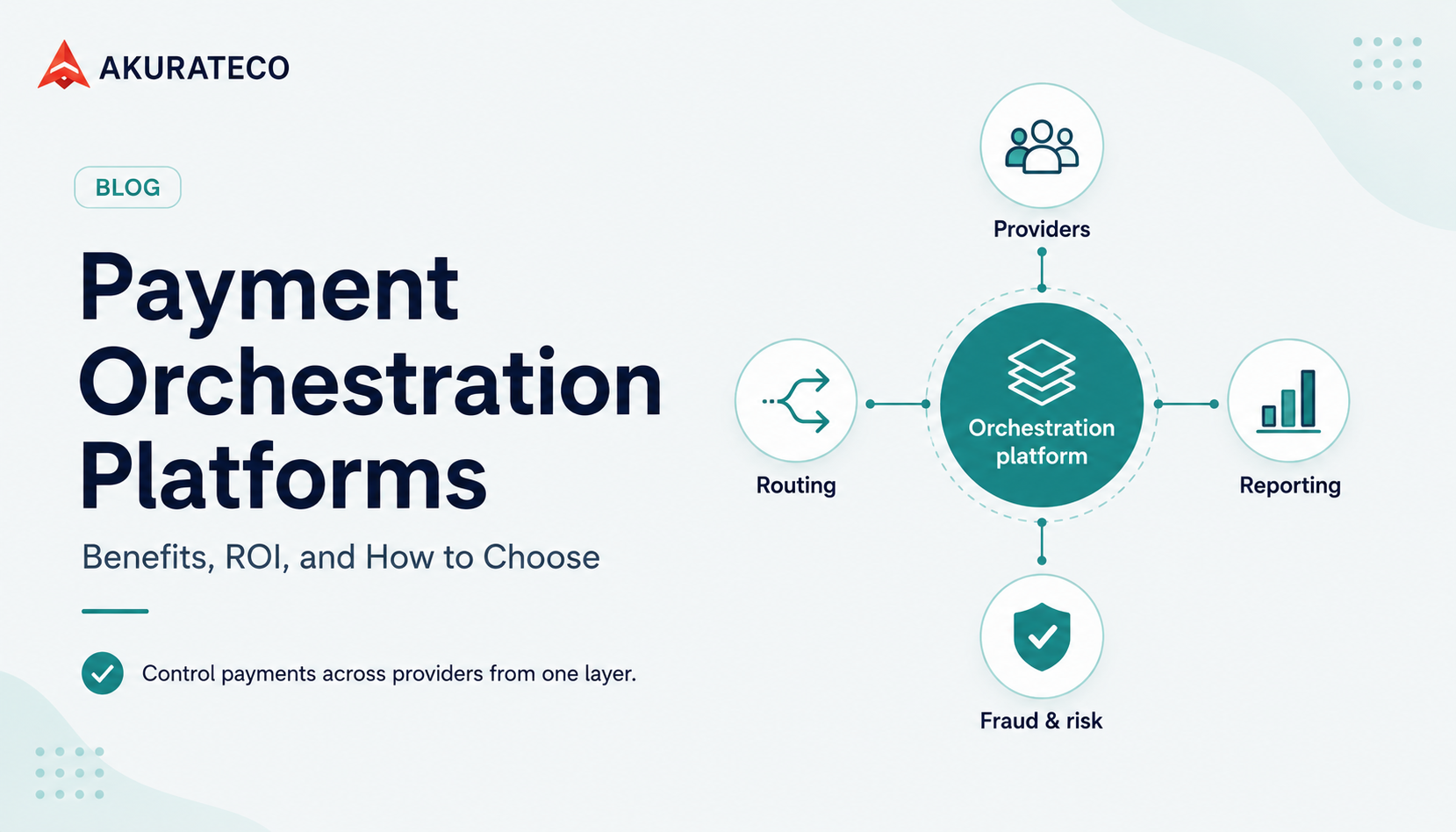
Payment orchestration solves this by creating a central layer between the business and the payment ecosystem. Instead of managing every provider separately, teams can manage connectivity, routing, cascading, data, fraud controls, merchant configuration, and reporting through a unified platform.
For payment teams managing multiple providers, markets, and checkout flows, the real question is not only “What is payment orchestration?” The more useful question is: “When does orchestration create measurable ROI, and how do we choose the right platform without adding another expensive layer of complexity?”
What are payment orchestration platforms?
Payment orchestration platforms are infrastructure layers that connect, manage, and optimize payment flows across multiple providers, payment methods, acquirers, fraud tools, and reporting systems. They give payment teams one control layer for routing, cascading, transaction monitoring, reconciliation, and provider management.
In a simple setup, a business may connect directly to one payment gateway or PSP. This works when the business is small, processes in one market, and has limited payment complexity. But once the business needs several PSPs, multiple acquirers, local payment methods, regional routing rules, and consolidated reporting, direct integrations become harder to maintain.
A payment orchestration platform sits between the checkout or merchant-facing layer and the broader payment ecosystem. It can help the business decide where each transaction should go, what fallback route should be used after a decline, how transaction data should be normalized, and how payment performance should be monitored.
For businesses with complex payment operations, orchestration is especially useful because it does not only support payment acceptance. It can also support provider management, payment configuration, fraud controls, reporting, settlement workflows, and operational scaling.
Definition in practical terms
A payment orchestration platform helps you answer questions such as:
- Which PSP or acquirer should process this transaction?
- What should happen if the first provider declines or times out?
- Which payment methods should be shown to a customer in a specific region?
- How can transaction data from several providers be reported consistently?
- How can finance teams reconcile payments across providers and currencies?
- How can a payment team add, compare, or switch providers without rebuilding the checkout or back-office setup each time?
- How can a business reduce dependency on a single provider?
That is why orchestration should be treated as payment infrastructure, not only a checkout feature.
Why payment orchestration matters for payment businesses
Payment orchestration matters because payment stacks become more fragile as they grow. More providers can create better coverage and resilience, but without a central orchestration layer, they can also create fragmented data, duplicate technical work, inconsistent reporting, and slow operational decision-making.
For many companies, the first PSP integration feels simple. The second integration is manageable. The third integration exposes the real cost of fragmentation.
Each provider may have its own API logic, transaction statuses, error codes, reporting format, settlement timelines, refund rules, dashboard, fraud settings, and reconciliation files. Without orchestration, teams often compensate with manual work, spreadsheets, custom scripts, and internal engineering tickets.
The result is a payment stack that looks diversified but is not truly optimized.
Payment complexity increases across several dimensions
| Complexity driver | What changes | Operational impact |
| More PSPs and acquirers | Transactions can be processed through more routes | Routing logic, monitoring, and provider management become harder |
| More regions | Local rules, methods, currencies, and settlement flows differ | Expansion requires more configuration and compliance awareness |
| More payment methods | Cards, wallets, APMs, bank payments, and local schemes behave differently | Checkout, reporting, and reconciliation become less consistent |
| More merchants | Each merchant may need different limits, pricing, routing, and risk settings | Merchant management becomes a platform-level requirement |
| More transaction volume | Small inefficiencies become financially meaningful | Approval rate, latency, cost, and downtime affect revenue directly |
| More compliance and fraud pressure | Risk controls must be applied consistently | Manual reviews and fragmented tools increase operational risk |
Payment orchestration is valuable when it reduces this complexity without forcing the business to give up flexibility.
How payment orchestration platforms work
A payment orchestration platform works by centralizing provider connectivity, transaction routing, cascading, data normalization, fraud controls, and reporting into one payment layer. The business connects to the orchestration platform, while the platform manages connections to PSPs, acquirers, payment methods, and operational tools.
The technical workflow depends on the platform, but the logic usually follows a similar path.
| Stage | What happens | Systems involved | Operational risk without orchestration |
| Payment initiation | Customer or merchant initiates a transaction | Checkout, hosted page, API, mobile SDK | Inconsistent user experience across methods |
| Transaction enrichment | Payment data is prepared for processing | Token vault, customer data, risk rules | Poor data quality can reduce approvals |
| Fraud and risk checks | Transaction is assessed against risk logic | Internal fraud tools, third-party fraud providers | Fraud decisions may be inconsistent across providers |
| Routing decision | Platform selects PSP, acquirer, MID, or method | Routing engine, provider performance data | Transactions may go through expensive or weak-performing routes |
| Authorization | Transaction is sent to the selected provider | PSP, acquirer, issuer, card network, APM provider | Declines may not be recoverable |
| Cascading or retry | Soft declines or technical failures may be rerouted | Backup PSPs, retry logic, cascading rules | Failed transactions become dead ends |
| Reporting | Transaction status is normalized | Dashboard, analytics, exports, BI tools | Teams see fragmented and unreliable performance data |
| Settlement and reconciliation | Payment data is matched against provider settlement files | Finance, accounting, reconciliation tools | Manual reconciliation consumes finance resources |
The best orchestration setups do not simply send payments to many providers. They create a controlled payment operating model where routing, reporting, risk, and reconciliation can be managed consistently.
Core benefits of payment orchestration platforms
Payment orchestration platforms create value by improving payment performance, reducing operational overhead, and giving teams more control over provider strategy. The most important benefits are usually higher approval rates, lower processing costs, faster expansion, better resilience, and clearer payment reporting.
Different stakeholders care about different benefits. A Head of Payments may care about approval rates and routing logic. A CFO may care about costs, reconciliation, and settlement visibility. A CTO may care about API complexity and maintenance. Operations teams may care about fewer provider tickets and cleaner reporting.
Higher approval rates through smarter routing
Payment routing sends each transaction through the provider, acquirer, MID, or payment method most likely to process it successfully under the current rules.
Routing logic can be based on:
- Country or region.
- Currency.
- Card brand.
- BIN range.
- Transaction amount.
- Merchant category.
- Customer type.
- Provider performance.
- Provider availability.
- Cost rules.
- Risk rules.
- Historical approval data.
This matters because not all providers perform equally across all regions, card types, transaction values, or merchant categories. A route that performs well for one merchant or country may be weaker for another.
Revenue recovery through cascading
Payment cascading gives transactions another path after a soft decline, timeout, or provider failure. Instead of ending the payment attempt immediately, the platform can retry the transaction through another configured provider or route.
Cascading is most useful when the decline is recoverable. For example, a technical timeout, temporary provider issue, issuer communication problem, or soft decline may be worth retrying. Hard declines should usually not be retried blindly because they may increase cost, risk, or customer friction.
A good orchestration platform should let teams define when cascading is allowed, which fallback routes are acceptable, and how retries should be controlled.
Lower processing costs
Payment orchestration can reduce costs by sending transactions through lower-cost routes where performance remains acceptable. This does not mean always choosing the cheapest provider. It means balancing cost, approval probability, settlement speed, reliability, and risk.
Cost optimization can include:
- Routing local transactions to local acquirers.
- Selecting providers based on card type or region.
- Reducing unnecessary retries.
- Avoiding high-cost fallback routes unless needed.
- Improving authorization data quality.
- Reducing engineering time spent on provider maintenance.
- Consolidating reporting and reconciliation work.
For CFOs and finance teams, the cost benefit often appears in both direct processing costs and indirect operational costs.
Faster market expansion
When a company enters new markets, payment complexity increases quickly. Local payment methods, acquiring relationships, currencies, fraud patterns, and regulatory requirements may differ by region.
With direct integrations, each expansion can require new technical work. With orchestration, the business can use a more repeatable model: add or activate providers, configure routing rules, adapt checkout methods, and monitor performance through the same control layer.
This is especially valuable for businesses that need to support multiple markets without rebuilding payment integrations, checkout logic, reporting, and reconciliation workflows for each one.
Better resilience and provider redundancy
A single-provider setup creates a single point of failure. If that provider has downtime, latency issues, regional degradation, or unexpected restrictions, the business has limited options.
Payment orchestration supports provider redundancy. When one route is unavailable or underperforming, traffic can be shifted to another route. For high-volume businesses, this resilience can protect revenue and reduce operational firefighting.
Unified reporting and payment visibility
Fragmented payment data makes decision-making harder. If each provider uses different transaction statuses, reports, dashboards, and settlement files, teams struggle to compare performance accurately.
A payment orchestration platform can normalize transaction data across providers, giving teams a clearer view of:
- Approval rates.
- Decline reasons.
- Provider performance.
- Routing efficiency.
- Processing costs.
- Refunds and chargebacks.
- Settlement status.
- Merchant-level performance.
- Market-level performance.
- Payment method performance.
This visibility helps teams improve routing decisions, negotiate with providers, and identify operational issues faster.
Stronger operational control
For merchant-side payment teams, orchestration is not only about transaction routing. It can also support internal operations across provider management, reconciliation, refunds, fraud control, reporting, and payment performance monitoring.
Useful operational capabilities include:
- Merchant onboarding.
- Merchant configuration.
- Merchant-level routing rules.
- Role-based access.
- Billing and fee configuration.
- Fraud rule management.
- Settlement reporting.
- Payment analytics.
- Admin dashboards.
- Tokenization.
- Connector management.
This is where payment orchestration starts to overlap with day-to-day payment operations: checkout control, provider management, reporting, reconciliation, and risk workflows.
Payment orchestration ROI: what to measure
The ROI of payment orchestration should be measured across revenue recovery, cost optimization, operational efficiency, engineering savings, resilience, and expansion speed. A narrow ROI model that only looks at provider fees will miss much of the value.
Payment orchestration ROI is rarely one single number. It is usually a combination of several improvements that compound over time.
Main ROI drivers
| ROI driver | What to measure | Why it matters |
| Approval rate improvement | Approved transactions before vs after orchestration | Small percentage changes can create large revenue impact at scale |
| Recovered soft declines | Transactions recovered through cascading or retries | Shows direct revenue recovery from fallback logic |
| Processing cost reduction | Average cost per transaction by route | Helps finance teams measure routing efficiency |
| Provider downtime reduction | Failed or delayed payments caused by outages | Shows resilience value |
| Engineering time saved | Hours spent building and maintaining integrations | Shows technical ROI |
| Finance operations saved | Hours spent on reporting and reconciliation | Shows back-office ROI |
| Speed to market | Time required to add a provider, method, or region | Shows growth enablement |
| Merchant operations efficiency | Time to configure, onboard, and support merchants | Important for PSPs, PayFacs, and platforms |
| Fraud and risk optimization | Fraud losses, false positives, manual review workload | Shows risk-adjusted ROI |
Simple ROI formula
A practical payment orchestration ROI model can start with:
Incremental gross benefit = recovered revenue + processing cost savings + operational savings + engineering savings + avoided downtime losses
Then subtract:
Total orchestration cost = platform fees + implementation cost + internal team time + provider costs + ongoing maintenance
The result is:
Payment orchestration ROI = net benefit / total orchestration cost
The calculation should be based on the company’s actual transaction volume, average order value, provider cost structure, decline rate, team cost, and expansion plans.
Example ROI model
| Input | Example value | How to use it |
| Monthly transaction volume | 500,000 transactions | Determines scale of impact |
| Average transaction value | £40 | Used to estimate revenue exposure |
| Current approval rate | 88% | Baseline performance |
| Approval rate after orchestration | 90% | Improvement from routing and cascading |
| Incremental approved transactions | 10,000 | 2 percentage point improvement |
| Gross recovered volume | £400,000 | Incremental approved transactions × average transaction value |
| Gross margin on recovered volume | 15% | Should use business-specific margin |
| Gross revenue contribution | £60,000 | Recovered volume × margin |
| Monthly orchestration cost | £15,000 | Platform and operational cost |
| Estimated monthly net benefit | £45,000 | Gross revenue contribution minus orchestration cost |
This example is simplified. A more complete model should also include cost savings, engineering effort, reconciliation time, fraud risk, and downtime avoidance.
The key point is that orchestration ROI becomes easier to justify when the business has enough transaction volume, payment complexity, or expansion pressure for small improvements to become financially meaningful.
ROI framework by merchant business model
Payment orchestration ROI differs by merchant model. E-commerce brands, marketplaces, iGaming operators, subscription businesses, travel companies, and SaaS platforms all evaluate orchestration differently because their payment operations create value in different ways.
Marketplaces and platform businesses
For marketplaces and platform businesses, payment orchestration can improve payment performance, participant experience, settlement visibility, and provider control.
Key ROI areas include:
- Faster launch of new connectors.
- Better merchant approval rates.
- Merchant-level routing configuration.
- More competitive payment offering.
- Reduced dependency on manual technical work.
- Centralized merchant management.
- Improved reporting and settlement operations.
- Ability to support more payment methods and regions.
For a marketplace or platform business, orchestration can become part of the operating model. The payment team can support smarter routing, cascading, analytics, and payment method coverage across regions, sellers, or business units without building every component internally.
Fintech companies
For fintech companies, orchestration ROI often comes from flexibility and speed. Wallets, neobanks, BNPL providers, crypto platforms, remittance products, and embedded finance companies may need payment infrastructure that adapts quickly.
Key ROI areas include:
- Faster experimentation with providers and payment methods.
- Reduced engineering load.
- Better control over payment flows.
- Easier regional expansion.
- Better transaction analytics.
- More resilient payment operations.
- Ability to add payment capabilities without rebuilding core product infrastructure.
For fintech teams, orchestration is often a way to avoid locking the business into a single provider strategy too early.
Enterprise merchants
For enterprise merchants, payment orchestration ROI is usually tied to approval rates, processing cost, customer experience, and finance operations.
Key ROI areas include:
- Higher authorization rates.
- Lower failed payment volume.
- Reduced checkout friction.
- Multi-provider resilience.
- Better provider negotiation power.
- Improved settlement visibility.
- Less manual reconciliation.
- Faster market expansion.
Enterprise merchants should evaluate orchestration as both a revenue tool and an operational control layer.
Regulated and multi-entity merchants
For regulated and multi-entity merchants, orchestration can support payment modernization, provider control, settlement visibility, and infrastructure flexibility.
Key ROI areas include:
- Better merchant management.
- Faster support for new payment methods.
- More flexible payment routing.
- White-label merchant-facing tools.
- Improved reporting and settlement workflows.
- Lower internal development burden.
- Ability to compete with modern PSPs and payment platforms.
Regulated businesses usually need strong control, compliance, and deployment flexibility. For them, orchestration is often part of a broader payment operations upgrade.
SaaS platforms and marketplaces
SaaS platforms and marketplaces often evaluate orchestration through the lens of embedded payments.
Key ROI areas include:
- New payment revenue streams.
- Better merchant or seller onboarding.
- More control over payment experience.
- Unified reporting for platform participants.
- Payment method localization.
- Reduced reliance on a single embedded payments provider.
- Better scalability across regions.
For platforms, orchestration can support the shift from “accepting payments” to “operating payments as part of the product.”
Payment orchestration vs payment gateway vs PSP integration
A payment gateway processes payment data between the checkout and the payment ecosystem. A PSP usually provides payment acceptance services, often including gateway functionality, acquiring connectivity, settlement, and merchant services. A payment orchestration platform manages multiple gateways, PSPs, acquirers, and payment methods through one control layer.
These terms are often used loosely, but they are not interchangeable.
| Capability | Payment gateway | PSP | Payment orchestration platform |
| Processes online payment data | Yes | Usually yes | Usually through connected providers |
| Provides merchant account or acquiring access | Sometimes | Often yes | Usually no, unless bundled with provider services |
| Connects multiple PSPs | Usually no | Sometimes limited | Yes |
| Supports smart routing | Limited or provider-specific | Sometimes | Core capability |
| Supports cascading across providers | Limited | Sometimes | Core capability |
| Normalizes multi-provider data | No | Limited | Yes |
| Centralizes reporting across providers | Limited | Limited | Yes |
| Helps manage provider redundancy | No | Limited | Yes |
| Supports merchant-level configuration | Limited | Often | Often, depending on platform |
| Best for | Simple payment acceptance | Payment processing and merchant services | Complex, multi-provider payment environments |
A business does not always need all three separately. Some PSPs include orchestration-like capabilities. Some orchestration providers include gateway tools. Some white-label payment platforms combine gateway, orchestration, merchant management, reporting, and risk functionality.
The right choice depends on how much control, flexibility, and provider independence the business needs.
Build vs buy vs white-label payment orchestration
Merchant-side payment teams can build orchestration internally, use a third-party orchestration provider, or extend their existing stack through a configurable orchestration layer. The right option depends on technical resources, time to market, compliance responsibilities, budget, control requirements, and long-term payment strategy.
| Approach | Pros | Cons | Best for |
| Build in-house | Maximum control, custom logic, full ownership | High engineering cost, long timeline, connector maintenance, compliance burden, ongoing support needs | Very large enterprises with mature payment engineering teams |
| Use a third-party orchestration provider | Faster than building, multi-provider access, routing tools, reporting layer | May add another vendor layer, platform fees, limits on customization, dependency on provider roadmap | Merchants and platforms needing faster multi-PSP optimization |
| Use white-label payment software | Faster time to market, brand control, gateway and orchestration capabilities, merchant management, reporting, support | Requires vendor evaluation, may need configuration and integration work | PSPs, PayFacs, fintechs, banks, and platforms building payment infrastructure |
| Stay with one PSP | Simple setup, lower initial complexity | Provider dependency, limited routing, weak redundancy, less control over performance | Smaller businesses with simple payment needs |
The most expensive option is not always building. Sometimes the hidden cost is maintaining direct integrations that were never designed to scale. Teams may spend months managing connector updates, fixing provider-specific issues, reconciling fragmented data, and building internal dashboards instead of improving the core product.
That is where using an orchestration-first or white-label model can make sense.
How to choose a payment orchestration platform
Choose a payment orchestration platform by evaluating provider coverage, routing flexibility, cascading logic, reporting, reconciliation, fraud controls, merchant management, integration quality, deployment options, support model, and total cost of ownership. Connector count matters, but it should not be the only decision factor.
A platform with hundreds of connectors is not automatically the best choice if it cannot support the routing logic, reporting model, compliance needs, or merchant workflows your business requires.
1. Provider and payment method coverage
Start by checking whether the platform supports the PSPs, acquirers, banks, payment methods, wallets, and local schemes you need today and may need later.
Ask:
- Which PSPs and acquirers are already available?
- Can existing providers be connected?
- How long does a new connector take?
- Are local payment methods supported in target markets?
- Are Apple Pay, Google Pay, PayPal, BNPL, APMs, bank payments, or crypto options relevant to your business?
- Can provider access be configured per merchant, region, or business unit?
Coverage should match your market strategy, not just look impressive on a connector list.
2. Routing and cascading flexibility
Routing is one of the main reasons to use orchestration. The platform should support flexible routing rules that reflect real business logic.
Evaluate whether routing can be based on:
- Country.
- Currency.
- Card brand.
- BIN.
- Issuer.
- Merchant.
- Transaction amount.
- Customer segment.
- Payment method.
- Provider availability.
- Provider cost.
- Approval performance.
- Risk score.
- Custom business rules.
For cascading, check whether the platform can distinguish between soft declines, hard declines, technical failures, timeouts, and provider downtime. Poorly controlled retries can increase cost and risk.
3. Reporting, reconciliation, and data quality
Payment orchestration should improve visibility, not create another reporting gap.
Check whether the platform provides:
- Unified transaction reporting.
- Normalized transaction statuses.
- Provider-level performance dashboards.
- Merchant-level analytics.
- Exportable reports.
- Settlement reports.
- Reconciliation support.
- Fee and billing data.
- Decline reason analysis.
- Route performance reporting.
Finance and operations teams should be involved in platform evaluation. If they cannot trust the data, the orchestration layer will create operational friction.
4. Merchant management capabilities
For marketplaces, platforms, multi-brand businesses, and other complex merchant groups, merchant configuration is critical.
Evaluate whether the platform supports:
- Merchant onboarding.
- Merchant profiles.
- Merchant-level limits.
- Merchant-level routing rules.
- Merchant billing.
- Role-based access.
- Sub-merchant reporting.
- Settlement configuration.
- Risk settings.
- Custom payment pages.
- White-label branding.
A merchant management system becomes especially important when the company is not only processing its own transactions, but also serving many merchants or platform users.
5. Fraud, risk, and compliance support
Payment orchestration should support fraud and risk workflows without making compliance harder.
Check for:
- PCI DSS alignment.
- Tokenization.
- Role-based access.
- Audit trails.
- Fraud rule configuration.
- Third-party fraud provider integrations.
- Risk-based routing.
- Chargeback monitoring.
- Secure data handling.
- Deployment options that match compliance requirements.
A platform does not remove all compliance responsibility, but it can reduce the operational burden if designed correctly.
6. Integration quality and developer experience
A strong orchestration platform should reduce technical complexity.
Evaluate:
- API documentation.
- Sandbox quality.
- Webhook reliability.
- SDK availability.
- Testing tools.
- Error handling.
- Status code normalization.
- Implementation support.
- Time required to go live.
- Quality of technical support.
For CTOs and engineering leaders, the key question is whether the platform reduces long-term integration maintenance or simply shifts complexity to a new vendor.
7. Deployment model and infrastructure control
Some businesses are comfortable with SaaS. Others need dedicated infrastructure, private cloud, regional hosting, or on-premises deployment.
Consider:
- SaaS availability.
- Dedicated cloud deployment.
- On-premises deployment.
- Data residency.
- Scalability under peak load.
- Disaster recovery.
- SLA commitments.
- Monitoring and support.
Regulated online businesses, marketplaces, and high-volume merchants may need more control over deployment than a standard SaaS model provides.
8. Commercial model and total cost
Do not evaluate pricing only by the monthly platform fee.
Include:
- Setup fees.
- Monthly platform fees.
- Per-transaction fees.
- Connector costs.
- Custom integration costs.
- Support costs.
- Internal engineering time.
- Finance operations time.
- Cost of failed payments.
- Cost of provider downtime.
- Cost of slower expansion.
A cheaper platform can become expensive if it requires heavy engineering support or cannot handle key operational workflows.
Common mistakes to avoid
The most common mistake is choosing a payment orchestration platform based only on connector count. A large connector list is useful, but it does not guarantee routing quality, reporting accuracy, operational control, or ROI.
Mistake 1: Treating orchestration as only a technical integration
Payment orchestration affects finance, operations, risk, product, customer experience, and commercial strategy. If only engineering evaluates the platform, important business requirements may be missed.
Include stakeholders from:
- Payments.
- Product.
- Engineering.
- Finance.
- Risk.
- Compliance.
- Operations.
- Merchant support.
Mistake 2: Ignoring reconciliation
A platform may improve routing but still leave finance teams with fragmented settlement data. This weakens ROI.
Reconciliation should be evaluated early, not after go-live.
Mistake 3: Overusing cascading
Cascading is valuable when used carefully. But retrying every decline can increase costs, trigger risk issues, or create poor customer experiences.
The platform should support controlled cascading logic, not blind retries.
Mistake 4: Assuming all payment methods behave the same
Cards, wallets, bank payments, BNPL, local APMs, and crypto payments may have different authorization flows, settlement timelines, refund rules, and reporting structures.
The orchestration layer should account for these differences.
Mistake 5: Choosing a platform that cannot scale operationally
A platform may work for a few providers but fail once the business adds more merchants, markets, payment methods, and routing rules.
Scalability should include technical performance and operational manageability.
Mistake 6: Underestimating internal ownership
Even with a strong vendor, the business still needs ownership of routing strategy, performance monitoring, provider relationships, risk logic, and ROI measurement.
The platform provides the control layer. The payment team still needs to manage the strategy.
Where Akurateco fits
A payment orchestration platform such as Akurateco can help businesses manage complex payment operations without building every integration, routing rule, reporting layer, and reconciliation workflow from scratch. Akurateco is especially relevant when a payment team needs orchestration, multi-provider connectivity, routing, cascading, analytics, fraud controls, and reporting in one operating environment.
For enterprise merchants, Akurateco can support multi-PSP orchestration, routing, cascading, analytics, and reporting when direct provider integrations become too fragmented.
For regulated and high-volume businesses, Akurateco can support payment technology modernization with routing control, settlement visibility, provider management, and deployment flexibility.
The most natural fit is for companies that need more than a basic payment gateway. Akurateco is relevant when the payment stack requires:
- Multi-PSP infrastructure.
- Smart routing.
- Cascading.
- Merchant management.
- Payment analytics.
- Payment fraud prevention.
- Tokenization.
- Billing and invoicing logic.
- Settlement and reconciliation support.
- White-label branding.
- Flexible deployment.
- Scalable payment infrastructure.
Conclusion
Payment orchestration platforms are becoming important because payment complexity is no longer limited to the largest global businesses. E-commerce brands, marketplaces, iGaming operators, SaaS platforms, travel companies, and subscription businesses all face pressure to support more providers, methods, markets, and operational workflows without creating an unmanageable payment stack.
The best way to evaluate orchestration is through practical ROI. Look at approval improvement, recovered declines, cost optimization, provider redundancy, engineering savings, reconciliation efficiency, and expansion speed. Then compare those benefits with the full cost of implementation and ongoing ownership.
For businesses managing complex payment operations, Akurateco can act as a technology partner that helps simplify orchestration, routing, provider connectivity, reporting, reconciliation, and scalability without requiring a full infrastructure rebuild.
FAQ
What are payment orchestration platforms?
Payment orchestration platforms are systems that connect and manage multiple PSPs, acquirers, payment gateways, payment methods, fraud tools, and reporting flows through one central layer. They help businesses route transactions, recover soft declines, improve visibility, reduce provider dependency, and manage payment operations more efficiently.
How does a payment orchestration platform work?
A payment orchestration platform receives transaction data, applies risk and routing logic, sends the payment to the selected provider, manages fallback routes when needed, and normalizes reporting data. It acts as a control layer between checkout, PSPs, acquirers, fraud tools, and finance systems.
What is the difference between a payment gateway and payment orchestration?
A payment gateway helps process payment data between the customer, merchant, and payment network. Payment orchestration manages multiple gateways, PSPs, acquirers, and payment methods through one layer. A gateway enables payment acceptance, while orchestration optimizes provider choice, routing, reporting, and resilience.
How do payment orchestration platforms improve ROI?
Payment orchestration platforms improve ROI by increasing approval rates, recovering soft declines, reducing processing costs, lowering engineering maintenance, improving reconciliation, and reducing downtime risk. The strongest ROI usually appears when a company has high transaction volume, multiple providers, or plans to expand into new markets.
When do businesses need payment orchestration platforms?
Businesses may need payment orchestration platforms when they work with multiple providers, payment methods, markets, routing rules, reporting workflows, or reconciliation processes. Orchestration can help payment teams improve authorization performance, reduce provider dependency, and manage payment operations through one control layer.
Is it better to build orchestration in-house or use a payment orchestration platform?
Building in-house gives maximum control but requires significant engineering, compliance, support, and maintenance resources. A payment orchestration platform can reduce time to value by providing ready-made infrastructure for routing, reporting, fraud controls, reconciliation, and provider connectivity within one payment operations layer.