

- What Akurateco Does
- What Makes Akurateco Different
- Who Needs Akurateco
- How Smart Routing Impacts Margins
- Hidden Costs and Pricing Transparency
- Integration Timelines and Connector Development
- When to Build Versus Use a White-Label Solution
- Expensive Mistakes Founders Make in Payments
- Trust, Clarity, and the Human Side of Business
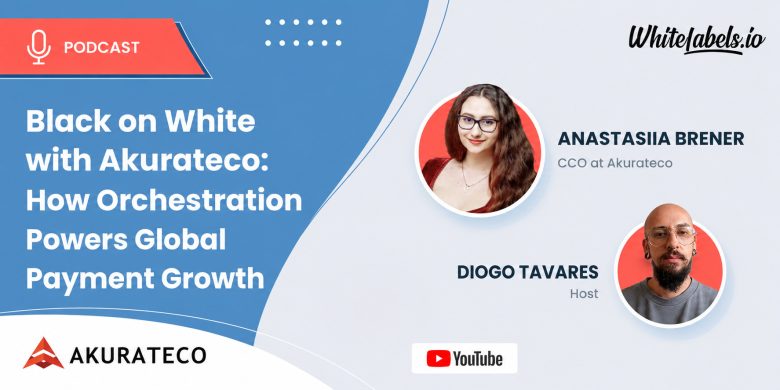
On 4 of March, 2025, Anastasiia Brener, CCO at Akurateco, joined Diogo Tavares, Digital Marketing Manager at Whitelabels.io, to discuss how white-label payment infrastructure and payment orchestration help PSPs, acquiring banks, and enterprise merchants build, scale, and optimize their payment operations.
Video: https://www.youtube.com/watch?v=wEjoU9ixfiw&t=7s
Find the full conversation below.
What Akurateco Does
Host: Hello everyone, and welcome to the first episode of this series of interviews. This one is called Black on White, where white labels will speak with clarity about their solutions and what they have to offer. Today, we are presenting Akurateco, and we have with us Anastasiia Brenner, CCO at Akurateco.
Hello, how are you?
Anastasiia: I am good, thank you. And you?
Host: I’m good, thanks. Okay, so can you tell us briefly about Akurateco?
Anastasiia: Sure. Akurateco is a global payment infrastructure. It’s a white-label payment gateway with a payment orchestration layer included.
It’s built for PSPs, acquiring banks, and enterprise merchants, and we cover all the technical aspects of payment processing so that clients can focus on the business side.
Essentially, imagine that you have a payment gateway, but it’s already built by a team of experienced people in the payment processing field. We put your name, your URLs, your logos, and your colors everywhere, so your clients see you and not us in any way, but you have this brand-new technology that you run as your own.
We help companies launch and scale payment infrastructure fast without spending years and millions on developing technology in-house.
This platform includes a lot of functionality like routing, cascading, balancing, billing, anti-fraud plans, different tools to track transaction analytics, tokenization, and 650+ integrations with different acquirers, PSPs, APMs, wallets, and open banking. Essentially, we are your in-house technical development team.
Payment Chaos Akurateco Usually Walks Into
Host: Cool, thank you very much for your introduction.
And so you mentioned orchestration, and you mentioned how you enter into these businesses, but Akurateco often comes in after there’s already some complexity in payments, right? What chaos do you usually walk into?
Anastasiia: Yeah, I can say so. Definitely chaos. Most of the time, we come in when payments are already complicated. There are different scenarios and different ways it can happen.
I can just share a couple of examples. It can be a legacy system that was built years ago. It still works fine, but it cannot keep up with the market anymore.
New integrations take forever, routing is limited, and many things are still manual. So emotionally, it is quite hard to let go of this in-house system. A lot of time and effort were spent building it in-house and maintaining it, and there is also a psychological part to it.
Some people just think that owning technology is the key to success and that this is the only way to run the business. But once they let it go, it turns out that they can cut costs on maintaining an old dinosaur system and channel their resources into the business direction. They can provide better solutions to their merchants and also offer more payment options and more channels by focusing on this specific direction instead of spreading themselves across many different activities.
The other case is when we enter, and there is already a circle of different connections in place. It can be with a PSP or with a merchant. They have already integrated some providers.
They might even have some basic orchestration they developed, but it’s all very dispersed. There is no logic behind it. There is no system that can work as one organism.
Routing is basic, failover is messy, and performance is not managed. On the payment page, you can see that there are multiple payment options for the same method, let’s say cards. Payers have to manually choose those providers, so they cannot even use cascading in these cases, which means they are losing a lot of transactions this way.
So the flow is basically random, and sometimes approvals don’t go up; they go down instead because traffic is sent the wrong way by mistake, and there is no safety net to protect it with backup cascading.
And sometimes, there is a more emotional aspect. After a breakup with another white label, clients come tired, frustrated, and scared.
They had weak support, limited control, and they felt locked in. In those cases, our job is more supportive than technical. We have to help them take control back and start trusting the world again.
With such clients, sometimes they try to rewrite whole agreements completely just to add as many clauses as possible that can protect them from unwanted outcomes, or so that they can leave this relationship as quickly and easily as possible, because they have experienced it before.
So, with this chaos, there can be different scenarios: technical, operational, or emotional. But the goal is always the same: build structure, create clear rules, and bring control back to payments.
What Makes Akurateco Different
Host: Cool. That’s a nice overview. Thank you for that.
And you mentioned, obviously, that clients sometimes come from other platforms. How do you differentiate from other orchestration platforms that are in the market?
Anastasiia: In general, if I’m honest, all of the platforms are about the same. It’s the same routing, cascading, and the same logic behind it.
What differentiates us is, first of all, focus. We decided that we have to be focused on something, because this way, we can be the best, at least in what we’re doing. Our focus is providing our solutions mainly to PSPs, acquiring banks, and large enterprises that run payments seriously.
The platform is for high volumes, complex routing, and real control, not just accepting payments, and that’s it. Because of that, our system is quite complex, but it can also cover completely different directions our clients can take. It can cover different logic for routing.
If they want to work with schedules and recurring payments, they can. If they’re missing some parts, they can be added. So, I’m slowly getting to the second part, which is flexibility.
We are, in general, quite flexible. We’re not limiting our clients to the strict basics of the platform.
We have functionality that we call user management, which allows you to give any type of access to your users, and you define what kind of access they will have. So, if you want to build complex logic for your different employees, merchants, sub-merchants, and master merchants, you can do that.
If you’re missing some functionality, or if you’re missing any rules or criteria in routing or anti-fraud, they can be added. So, we’re not limiting any of these things, as long as they are helping our clients grow. We’re very supportive in that direction.
And the other thing is that we’re also quite flexible in terms of deployment choices. Our system can be provided as SaaS and on-premise. In terms of on-premise, it can be a cloud or bare-metal setup, which is essential for specific regions where data has to be stored internally in the country. Around the US and Asia, countries are very dispersed, and every country has its own rules.
So, we cater to those markets, and it’s the only way to cater to those markets. You have to be flexible in terms of the setup. And with acquiring channels and acquiring banks, it is also important to do bare-metal, which is, of course, complicated. It takes a lot of time and effort, but we can still do it. And we already have quite a lot of experience doing it.
After that, we support them from a technical point of view. We still help them with all the centers, how many of them they need, how much setup they need, and we also help with PCI data.
And the fourth thing that I think is quite important to mention, which differentiates us, is support: the level of it and the quality. Our clients always mention that to us, especially every time we’re at conferences and meeting a lot of our clients. This is my favorite thing, to get that feedback. I mean, of course, good feedback is better, but honestly, all feedback is valuable.
Our support is very client-oriented. It sometimes comes with babysitting, because our clients really need us, and we’re there for them.
But it is important because, in this payment ecosystem, time is money, and it’s directly connected. So when performance drops or a new opportunity appears, you cannot wait in line, in a queue with your ticket. You have to get support. And we provide support in chats and through the service desk, so you can use both.
We truly love what we do, and the platform shows it. It keeps improving based on real client feedback and real market problems.
Who Needs Akurateco
Host: That’s amazing. You really touched on all the points: flexibility, support, everything that’s needed and important in a good white-label solution. You also mentioned different types of clients: merchants, PSPs, and clients in emotional chaos as well.
So, basically, who is the ideal customer for Akurateco?
Anastasiia: There is no one ideal customer. I would say there are different types of ideal customers. I would say there are around four profiles.
We work with PSPs on legacy systems, or those that are using a white label but are maybe not happy with whatever they currently have. They want to grow, but the system is slowing them down. Integrations take too long, reporting is weak, routing is basic, and every new rule and every new request from a merchant becomes a pain.
So, they often feel that they cannot provide proper support and cannot compete, because merchants compare them to more modern PSPs on the market. They expect speed, flexibility, and good analytics. So, I would say this is one case.
The other case is ISOs or referral partners.
At some point, they become too big and too confident. They have enough acquiring channels, they have merchants, they have partnerships, and they’re ready to go to the next level, where they get the payment platform under their brand, under their own information. They connect their merchants and their channels, and they offer added value in terms of payment orchestration.
So, they are offering their expertise and their unique relationships with providers. By having those volumes for merchants, they can influence different, better prices and better solutions from those providers, and they can play this way so that they can provide their competitiveness and their expertise, plus their consultations to merchants so that they can get the best out of it.
The third case is acquiring banks. Acquiring banks are trying to stay competitive in this very aggressive PSP world, where PSPs are, in general, becoming more and more flexible and faster. Of course, PSPs are getting solutions from acquiring banks, so they cannot be as good. But from the technology point of view, acquiring banks are very outdated.
They’re using some core banking systems, like a BGSI resource or anything else, and this is fine for being an acquiring provider. But in order to compete with PSPs, you need to have a payment gateway, a modern payment gateway, a payment gateway that merchants expect to see, with all this functionality, not just one channel they are providing, but also maybe added orchestration with different channels like APMs, wallets, crypto, or open banking, so that it’s one place, a one-stop shop, where merchants can integrate and then get access to all of it.
So, in order not to lose this market share, and in order to maybe get a bit more in terms of merchant verticals and quantities, banks have to make some changes. Abandoning their core banking system is a huge step, and I don’t think acquiring banks can take it anytime soon. But there is a solution. They basically get us, put us on top of their core banking system, and that way they can become modern.
They can maintain all of their legacy infrastructure that they are used to and comfortable with, and then they get this layer, which is merchant-facing. They can run their payment pages. I mean, merchants can run their payment pages in the back office.
They can have the user experience. They can have their reports. They can set up different dashboards.
So, it’s easier and more modern for them, and I can see more and more requests like that from acquiring banks, because it is currently a very competitive environment.
The fourth case is enterprise merchants. Enterprise merchants that are big enough to have huge volumes, but whose internal processing system is not at the level needed to cover their payment processing.
It’s not optimized. It’s not well developed. Even if they have some basic orchestration layer, I doubt it’s as good as what payment orchestrators are providing, because this is what their focus is on.
For them, payments are not just a checkout. It’s a huge part of revenue and customer experience. They want to improve approval rates, control routing logic, reduce costs, manage risk, and avoid being dependent on just one provider. One provider is, in any case, a liability. So, having as many as possible is the direction.
So, they’re trying to integrate everything in-house. They’re trying to develop everything in-house, but then it gets to the point where they don’t have enough expertise. They’re very good at what they’re doing in terms of their services, but payment processing is different.
So, they are looking into providers that can cover that for them, and we like working with such clients because they are ready to take responsibility for their own payment solutions and payment acquirers. And from us, they only expect the technology part, which we are more than eager to provide.
And by getting orchestration, they are getting more control, more stability, and smart optimization.
So, in short, I would say that our ICP is any company that is serious or becoming serious about payment processing. And they specifically need to be covered from the technology point of view.
How Smart Routing Impacts Margins
Host: That’s interesting. You mentioned two points. I mean, you mentioned routing logic twice, and clients that have basic routing and end up seeking you out because you have smart routing, right? How do smart routing rules impact real margins for these clients?
Anastasiia: Smart routing and routing in general are just technology. Everyone provides it, and it cannot solve all the issues.
The main aspect here is that you need to understand what you’re working with. If you know everything about your acquiring channels, your acquiring providers, banks, APMs, wallets, what markets you’re in, what your limitations are, and approval rates on different channels, then you can use smart routing in a very logical, very directional way.
If you know that one provider is cheaper, but they have a bit higher conversion, while the other is more expensive but can, for example, cover more transactions in the region you’re in, then having this knowledge allows you to set up smart routing the way you need.
In general, routing is not just one thing. It’s pre-routing, routing, and then cascading.
When you define different rules and set up settings in a smart way, this creates a very user-friendly experience for payers. If I’m coming from Poland, I will see my payment method on the payment page, and if I’m choosing cards and something happens, like my transaction is not processed for some reason, there are follow-up options in cascading.
This transaction can try again and again. This is how you can set it up, and then you can get an improvement in your approval ratio of up to 40% in some cases. I know it may sound like a lot, because 40 percent depends on what exactly they had before, but it’s important to understand what we’re working with.
If the merchant has one channel or two channels, with no idea what is happening there, and the plan is just to send transactions wherever they reach and then see how it goes, then by understanding what we’re working with and how it can be created, we can reach those levels. It’s quite possible.
And after that, it’s not random sending to wherever. It’s a drastic improvement with real logic behind it. High approval rates mean immediate revenue, but it’s not only about revenue.
Smart routing also helps with costs, because you can send transactions to the right provider with better fees when it makes sense, of course, avoid pointless retries, reduce declines, and avoid pushing customers away.
In the case of declines, you, of course, have cascading for a different set of criteria. You can also limit unwanted transactions with anti-fraud and link it with your routing logic.
With our guidance, clients can not just turn on routing; they can actually build a real performance plan and keep moving and improving it over time.
Hidden Costs and Pricing Transparency
Host: That’s really important to keep the margins in place, right? Speaking about costs, with your expertise, what are the common hidden costs and misconceptions that you see people have?
Anastasiia: Well, some providers can market their prices as cheap, so the entry price is very low. But if you go deeper and analyze what this price actually includes, you might be surprised that it’s not even covering the basic technology or basic onboarding structure.
So later, these costs pile up, and if you add them together, you understand that they are market prices or even higher. In the end, you might just be unhappy with what you’re receiving because you signed up for something cheap, and you expected that you would get this whole world changed, but you’re ultimately getting a small piece of functionality that is not influencing anything for you.
With us at Akurateco, we prefer a bit of a different approach. Our pricing is transparent and minimalistic. We prefer it to be clear from the beginning rather than surprise clients later.
I don’t like it when you have to jump through hoops in order to get prices from providers. You have to go on one call, then another, then submit some forms, then promise that you’re really, really interested in them, and after that, you might be able to receive some offers.
With us, and this is the feedback we’re getting, every time we have a new potential lead asking about our services and our pricing, we just give them all the information they might potentially need in order to understand if that is the solution they want, if that is what they’re expecting or looking for.
And I believe that it is the better way, because you don’t have to wait weeks in order to receive information, and then you can just make a choice if that’s something that you want or not, and basically go in different directions or go with this provider.
If you’re trying to be dishonest in this industry, it’s a very small environment. Even though FinTech is huge, if you go to any conference, like with me, for example, it takes me one minute to meet people I know: colleagues, ex-colleagues, friends, and partners from different companies. And if you misbehave in this environment, ultimately, people will know. So, my advice is: don’t do that. Be open in communication, direct, with clear pricing and a clear structure, and clients really appreciate that.
Host: As always, right. Transparency upfront is always best. At least you know exactly what to count on.
Anastasiia: Honestly, yeah. As a client, I was evaluating CRM systems for us, and I was a client. I was being chased by different providers, and it took me at least two weeks to get prices from them. I was so frustrated. Every time, it was, okay, see you on the next call. We’ll give you a bit more of the system, a bit more information, a bit more of the next step. Like, come on, I just want to have all this information. Why do I have to struggle?
Integration Timelines and Connector Development
Host: Exactly. Well, let’s say that I’m a client, I’m a merchant, and I want to integrate Akurateco. What is the realistic timeline that I should expect for the integration to be complete?
Anastasiia: So, there are different types of integrations. If we’re talking about merchants integrating with us, we support different types of integration.
There is host-to-host, which is a more complex one for PCI-compliant partners or clients. We have HPP or a checkout page. This is very easy and user-friendly. Merchants can integrate it in one or two days. We also have plugins. We have payment-link types of integration, and our system is integrated with a lot of cashiers and merchant platforms.
So, if merchants are using them, it’s easier for them. This is one type of integration.
The other type of integration that we do is when our clients, merchants, or PSPs request that we integrate more channels, like acquiring partners, APMs, wallets, crypto, or anything else.
In this case, we have a form that they have to fill out with information. It contains all the information needed, like API documentation, what kind of flows they need, what kind of methods, currencies, tasks, and live credentials.
After that, once we have all of this information, it takes around two weeks for us to implement one flow, of course, or one sprint.
And we can take this integration in the current or next sprint. We usually schedule the task depending on the workload. So, if we can take it in the current sprint, we’ll take it.
If we have too many already ordered integrations, we have to move it to the next one. Around 15 integrations are released every month, and we have different teams for connectors, which we call integrations, and features. That’s why even if we have a workload filled with features, it will not in any way influence the connectors.
Technically, it can be faster, as some APIs are clear and easy to integrate. But sometimes APIs are not working, or we’re getting random errors. Or, which happens quite often, we integrate everything and test it in the test environment, everything works, and then we switch to live, and nothing works. Then we have to redo it, communicate with the provider, check why it’s not working, and then they are trying on the go to rebuild their own API to show us how we can do it.
This especially happens with different APMs in LATAM or African markets. Even if it’s a well-developed APM, such things can happen, but especially with a new APM that’s just appearing, they don’t really have a described API flow that we can integrate, so it can be a struggle.
But in general, we’re trying to be realistic in terms of expectations, and we’re always trying to be open in terms of saying, this is taking time, help us with this, we will push it as much as we can, but from the business point of view, we need your side to reply to us.
Host: Rather than speed and being fast, it’s more important that it’s well done, right?
Anastasiia: Yeah. You can do it fast, you can do it cheap, or you can do it with quality. So you can choose two of those. It cannot be three. Choose two.
When to Build Versus Use a White-Label Solution
Host: Yeah, exactly. Okay, and in your opinion, when should a PSP build instead of going with a white-label solution?
Anastasiia: I think the times when people were developing their own solutions in-house from the very beginning have already passed. Currently, the most important thing is time to market.
Realistically, developing infrastructure in-house from scratch is a huge investment. It takes at least one and a half years to get to an MVP and at least three years in total to get to the level of platform that merchants expect, and you will spend millions on it. It will not happen fast, and it will not happen easily.
And the problem is that payments move fast. New payment methods appear, rules change, fraud patterns evolve, and what was modern yesterday is already outdated today. Things move so quickly that if you are stuck developing your in-house platform for some time, your competitors are already selling the solutions you wanted to sell, already learning their hard lessons, already experimenting, providing, testing, and getting much further than you while you’re developing something in-house.
Time is everything currently, and my recommendation is usually quite simple. Start with a white label, go live fast, test your model, start making some revenue, build relationships, and learn what your clients really need.
Later, if you have strong reasons, you can build your own technology step by step, or even buy source code. But losing momentum early because you’re stuck in long development is just too big of a risk.
I see a lot of clients coming to us, and they’re like, okay, we know that we are professionals in what we’re doing. We have tons of connections. We have tons of acquiring channels. We have merchants that trust us. And we understand that if we start now developing the system, we will go live and pass back in two years, maybe. But all this time, what are we going to do? Just wait with those connections? Those connections will become outdated. Merchants will forget about them.
So get into the market as soon as you can, test the waters, go live, and see how it goes. You might find that you don’t like it at all, and ultimately, you don’t want to proceed in this direction. Maybe you want to do IBaaS or something else, but you already have this technology developed, and what will you do with it?
Expensive Mistakes Founders Make in Payments
Host: That’s insightful, for sure.
Usually, mistakes can be costly. What’s the most expensive mistake that you see founders make?
Anastasiia: There are a number of mistakes founders can make in general in the payment field.
And the first one, I would say, is that some founders, especially when they come from outside the payment processing ecosystem, think that payment processing is so lucrative. They just want to jump in, but they have no idea or background about it. And what they’re trying to find is a one-stop solution.
So they want to have a technology platform with acquiring channels, with licenses, and preferably even people who handle everything for them. They’ll just pay and say, go do my business for me. I will put my brand on it, and now I have my business.
This is the biggest mistake you can make, honestly, from my point of view. Never trust solutions you know nothing about. You don’t know these people.
You cannot trust them, because by trusting your money and your clients’ money to providers you know nothing about, you’re risking your brand and your face, because you are representing your brand and things can go wrong. Things might not be as easy as you think, especially in the beginning, and you’re risking your reputation.
After that, you will still have to do something: either just run away or start again with just software and then try to build and find providers that you can trust, that you can trust your merchants’ money with, that have good approval rates, and that have stable settlement plans. So this is, I would say, the first thing you should focus on.
The other kind of mistake or misconception people have is thinking that technology will be the answer to all of your questions. Basically, this comes from the previous question.
Just owning technology doesn’t mean anything. The most valuable asset you have is your trusted acquiring channels. If you don’t have them, don’t start a business.
Wait until you have those connections, because otherwise having just technology will not cover it for you. Or, of course, if you are providing payment orchestration services on our platform, this might work, but still, you need to understand what your target audience is, what your verticals are, what solutions they can work with, and provide this expertise. So that would be my second piece of advice.
Another thing a lot of new founders get into is that they’re trying to be everything to everyone, especially in the very beginning. That’s a very bad idea, because you cannot be professional everywhere, across all verticals and all types of merchants. You need to understand what your target audience is.
Let’s say what kinds of industries or merchant verticals you want to work with. You need to understand that you have connections there, and it’s best to start with someone you already had some experience working with before.
So maybe you’re coming out of the telecom industry. Start with telecoms. Or maybe you used to work with marketplaces. Start there because you already have connections there. You already have friends and ex-colleagues that you can onboard in the very beginning. Find the best provider. Understand their pain points, understand what they’re struggling with, understand what you can offer them, and get those solutions onboarded for specific markets. Then you can get more and more solutions within the same vertical for those kinds of clients.
After that, you can add more verticals, because you will have those volumes that you will be able to influence with your acquiring channels. You’ll be able to get better prices, better conditions, faster settlements, and lower rolling reserves. And in general, your solutions will be competitive this way.
If you try to cover it all in the very beginning, for starters, your technology platform might not be able to do that because you want to cover all countries, but it takes time to integrate everything that you might potentially want, and you will not be able to sign all those providers at the same time. It takes a lot of time and effort. So be methodical. Do it step by step.
And another thing is thinking that you have a unique solution or unique feature. Nothing is unique anymore.
Maybe 10 years ago, a unique thing or a unique solution could be your unique solution for at least a year. Currently, with technology, the way it’s growing, and with how everyone can get into contact with basically everyone in this field, you have these unique solutions or unique features for a maximum of three months.
So move fast with those features and unique solutions, offer them to your clients, and don’t get obsessed with them.
Keep adding more and more, and keep finding new additional options, directions, top-ups, or maybe consult on how this should be set up or that should be set up. So this should be your main asset: your expertise, essentially.
And always, always trust your money only to those you trust.
So for me, the key is simple. You have to build trust first. Technology supports your business, but without trusted relationships and operations, it works only this way.
Host: That’s very insightful. I think you broke up for a split second just when you said trust your money too.
Anastasiia: Trust your money only to trusted providers, those that you know, those that you can easily go to, and those that you can influence in any way. Only to them.
Trust, Clarity, and the Human Side of Business
Host: Okay. That is clear. There’s a lot of knowledge being passed on from this interview, and thank you for that.
As you know, white labels value transparency. We value clarity. We like things to be as clear as possible so that people know exactly what they are getting, exactly what they are getting into, and what they can count on. It’s very important to rely on a partner and to trust a partner when we go with a white-label solution, right?
A level deeper. So tell us a habit that you have that would surprise your team.
Anastasiia: A habit? Well, I’m not sure if it’s surprising, but I have different hobbies, and those hobbies are mostly about creating decor, I would say.
So I paint, I create statues from clay. I like really bright and colorful creations that I then use to decorate my apartment or give to my friends. That’s inspiring for me.
Host: That’s awesome.
It’s wonderful to have a full interview talking about very technical and very deep knowledge about technology and everything, and then suddenly to discover another part of the person who was talking the whole time. It is relatable or not, but it should be relatable to you.
Anastasiia: Ultimately, we’re all humans.
Host: Exactly. That’s it.
Well, thank you very much, Anastasiia, for being with us today and for your interview.
Anastasiia: Thank you for inviting me.
Host: Always a pleasure. And for everyone listening, thank you for being here.
I hope you at least have more clarity about Akurateco, the technology, and the white-label solution that Akurateco provides, and we will see you in the next episode. Thank you very much.
Anastasiia: Thank you.
And if you have any questions, you can contact me on LinkedIn. I’ll be more than happy to help.
Host: Awesome. Thank you very much.
Anastasiia: Bye. Have a nice day!