

The Middle East has seen significant e-commerce growth in the last couple of years, becoming a breeding ground for new payment ventures. Thanks to high internet penetration, the region is now a gold mine for online commerce, and PSPs, acquiring banks, and enterprise merchants are investing in payment infrastructure to serve it.
However, these companies don’t just cater to buyers within their region, no matter how rewarding this move is. They take a step further and sell to international consumers across the globe. Such a diverse audience calls for expert hand-tuned payment processing, and in the Middle East it comes with a condition: payment data has to stay in the country where it was generated. In this article, we explain why that pushes payment gateways in the region toward on-premises deployment, what else to look for in a gateway, and three solutions that fit.
If you only accept payments as a merchant, a licensed local gateway usually handles data residency for you. This article is for PSPs, acquiring banks, and enterprise merchants that run their own payment gateway.
Why Do Payment Gateways in the Middle East Need to Run On-Premises?
Because regulators across the Gulf require payment data to stay inside the country. Classic white-label solutions are usually deployed on servers owned and maintained by the technology vendor, often outside the region. And while that is much cheaper and easier for the client, it doesn’t comply with the regulations of the region. The most direct way to meet them is to run the gateway on your own infrastructure inside the country, so you can show the regulator exactly where every transaction record lives.
The rules differ from country to country:
United Arab Emirates
The Central Bank of the UAE’s Retail Payment Services and Card Schemes Regulation requires licensed payment service providers to store user and transaction data within the UAE, not outside it.
Saudi Arabia
The Saudi Central Bank (SAMA) requires regulated financial institutions to keep customer and payment data inside the Kingdom. Cloud hosting is allowed, but only in certified data center regions located in Saudi Arabia and under contracts that give SAMA audit rights. For banks and PSPs that want residency without depending on a cloud provider’s in-Kingdom region, on-premises deployment is the straightforward route.
Qatar
Qatar Central Bank requires licensed payment service providers to process and store payment data within Qatar, with no allowance for offshore cloud arrangements. That makes in-country infrastructure a requirement, not a preference.
Therefore, before choosing a system, check the requirements in your jurisdiction and, if necessary, opt for a provider that can deploy the gateway inside the country, whether on-premises or in the cloud.
Why Operate Your Own Branded Gateway Instead of Relying on a Regional PSP?
It strengthens loyalty
A white-label gateway allows payment service providers to fully brand the system and legally sell it as their own. Thus, when a customer clicks “Buy now” on your website, the system doesn’t transfer them to a different page. Instead, it keeps them on a payment page that has the logo, colors, and other company style attributes.
It grows your conversion rate
Visitors that are sure they can trust you are most likely to buy once and then return over and over again. Therefore, a white-label payment solution can boost your revenue and skyrocket your business.
It boosts your reputation
Offering your customers solid payment technology and an uninterrupted checkout experience will give you a chance to establish a reputation as an expert. And considering that you save significantly by licensing this technology instead of developing it yourself from scratch, it’s a win-win.
It opens up new markets for your business
Typically, such payment systems come with a wide range of available payment integrations. These give you a chance to penetrate new markets and sell your goods and services to new audiences. And even if the required integration isn’t available yet, WL providers have vast experience in adding new methods. So, implementing your request won’t take much time for them.
Knowing what a branded gateway gives you helps you stay focused on what’s really important when you compare vendors.
What to Look For in a Payment Gateway for the Middle East
In-Country Deployment: On-Premises or Cloud
As covered above, payment data in much of the region has to stay in the country where it was generated. That doesn’t lock you into a single setup. Look for a provider that supports three deployment options: dedicated infrastructure (on-premises), a private cloud hosted in your own environment, or your preferred cloud provider, such as Oracle, AWS, Azure, or Google Cloud. Whichever you choose, the data has to stay in the country, so a public cloud works only where the provider runs a local region your regulator accepts, while a vendor-hosted service outside the region won’t.
Local Payment Methods
The most popular payment methods in the region are credit and debit cards (specifically Visa and Mastercard), national debit schemes such as Mada in Saudi Arabia, KNET in Kuwait, and BenefitPay in Bahrain, as well as Apple Pay, PayPal, bank transfers, and cash.
Preferably choose a provider that already has these payment options integrated. If not, discuss the possibility and conditions of their integration before committing.Pay-Link Functionality
Among popular expectations of online buyers in the MENA region is an available payment link feature. This functionality allows you to generate a payment link inside the system and send it directly to the customer. Then, the client can easily pay for goods and services in one click. This feature is vital to small and medium merchants, as they can accept payments without even having a website.
Arabic Localization
System localization is of great importance, too. Even though English is widely used in business here, Arabic still dominates. Thus, to enter the market, it’s better to find a system with an available localization to cater better services to your clients.
Authorize-and-Capture Support
This one is also crucial to the overall success of your processing business.
The mechanics behind it are simple:
This transaction aims to make sure that the customer has sufficient funds on their account to complete the transaction. If so, then the bank will place a hold on the amount in question for authorization purposes. Finally, the money will be transferred to the merchant account.
Three Payment Gateway Solutions for Middle East PSPs and Banks
Not every gateway can meet these requirements. The three solutions below differ mainly in how they are deployed: Akurateco can run on dedicated infrastructure, in a private cloud, or with your preferred cloud provider, Mastercard Payment Gateway Services is hosted by Mastercard, and ACI Worldwide offers on-premises, cloud, and SaaS options. They are chosen for regional fit; for vendors beyond the Middle East, see our global vendor ranking.
Akurateco
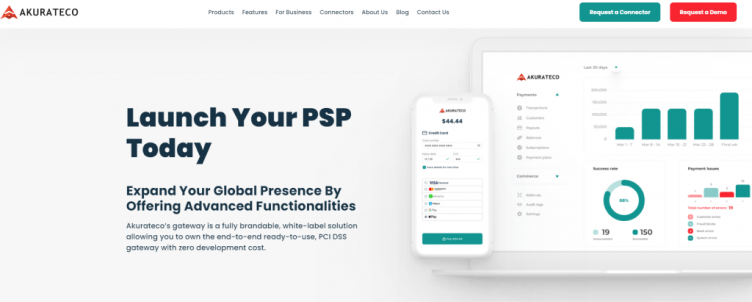
We might be biased, but Akurateco checks all the boxes on the list of essentials for payment gateways in the Middle East: it can be deployed inside the country on your own servers, in a private cloud, or with your preferred cloud provider, and it comes with the payment methods and tools regional PSPs and banks need. On top of that, the company has been one of the pioneers of the payment industry, and so understands the biggest pains of PSPs around the world and offers fine-tuned solutions for them.
Among the benefits the company offers are:- Three deployment options: dedicated infrastructure (on-premises), a private cloud in your own environment, or your preferred cloud provider (Oracle, AWS, Azure, Google Cloud, and others);
- 700+ integrations, including a ready connector to MPGS;
- Smart routing – to increase transaction approval rates;
- Smart Invoicing – to simplify invoice management and help PSPs charge more with flexible fee structures;
- Tokenization – to ensure fast and safe one-click payments;
- No in-house development needed, and fast onboarding;
- Fully customizable admin panel.
The company also offers a free demo so that potential customers can see what the platform has to offer before getting their feet wet.
Mastercard Payment Gateway Services (MPGS)

Mastercard needs no introduction. They’ve been paving the road for payment technology and innovation for decades. Supporting numerous industries, Mastercard Payment Gateway Services (MPGS) offers fast, safe, and cutting-edge technologies to meet the needs of the most demanding merchants.
Among the benefits of the system are:- 170+ currencies supported;
- 200+ acquiring solutions available;
- Tokenization – to simplify payments without compromising security;
- Anti-fraud solutions – to protect customers’ sensitive data;
- Simplified guest checkout to reduce cart abandonment;
- Popular card brand support as well as alternative payment methods;
- PCI DSS compliance.
MPGS allows its clients to get access to multiple payment methods, cut operational costs, and fully protect their transaction flow with a single integration. It is a gateway hosted by Mastercard rather than deployed on your own servers, so banks that need in-country control can keep MPGS as an acquiring connection behind a gateway deployed in the country.
ACI Worldwide

ACI Worldwide is another strong option for banks and PSPs. They offer a solution that allows their clients to easily build and scale payment gateways with both popular and alternative payment methods.
Other great features they offer include:- Risk management – to protect transactions in high-risk industries from scams and fraud;
- Multiple deployment options – ACI Worldwide offers on-premises, cloud, and SaaS deployments to all its clients;
- Unified payments consolidated in a single innovative platform;
- Cheaper compliance with top industry security standards;
- 100+ integrations available;
- Expert customer support.
The company aims to drive its clients’ businesses and change the landscape of payments with their latest developments.
Conclusion
The Middle East is one of the most active payment markets right now, and its regulators expect payment data to stay at home. For PSPs, acquiring banks, and enterprise merchants, that makes the deployment model the first filter when choosing a payment gateway: a system you can deploy inside the country, on-premises or in a cloud environment you choose, meets residency rules without relying on a vendor’s hosting. In this article, we’ve listed the other features to look for and three solutions that fit the region. Use these notes for future reference and stay tuned for more useful content coming your way!
FAQ
Why is On-Premises deployment important for payment gateways in the Middle East?
Several regulators require payment data to stay in the country. The UAE Central Bank requires licensed PSPs to store user and transaction data inside the UAE, and Qatar Central Bank requires payment data to be processed and stored in Qatar. Running the gateway On-Premises, on servers you control inside the country, is the most direct way to meet these rules and show the regulator where every transaction record lives.
Is an in-country cloud enough, or must a payment gateway run On-Premises?
It depends on the regulator. Saudi Arabia’s SAMA permits cloud providers that operate certified data center regions inside the Kingdom, while Qatar allows no offshore cloud arrangements. In practice, a gateway can meet residency rules on dedicated on-premises infrastructure, in a private cloud, or with a public cloud provider that has an accepted in-country region. On-premises deployment is the option that removes any dependency on a cloud provider’s local presence.
Do data residency rules apply to merchants or to payment providers?
They apply mainly to licensed PSPs and banks. A merchant accepting payments through a licensed local gateway usually relies on that provider’s compliance. A PSP, acquiring bank or enterprise merchant running its own gateway has to meet the rules itself.
What should PSPs and banks look for in a payment gateway for the Middle East?
In-country or On-Premises deployment where regulations require it, locally relevant payment methods, pay-link functionality, Arabic localization, and support for authorize-and-capture transactions.
What are the most popular payment methods in the MENA region?
Visa and Mastercard credit and debit cards, national debit schemes such as mada in Saudi Arabia, KNET in Kuwait and BenefitPay in Bahrain, plus Apple Pay, PayPal, bank transfers and cash.