

- What Is a Payment Infrastructure Platform for Large Enterprises?
- How We Evaluated Enterprise Payment Infrastructure Platforms
- Best Enterprise Payment Infrastructure Platforms by Category
- Best Payment Orchestration Platforms for Enterprise Multi-PSP Control
- RFP Checklist for Choosing an Enterprise Payment Infrastructure Platform
- Where Akurateco Fits for Large Enterprises
- Conclusion
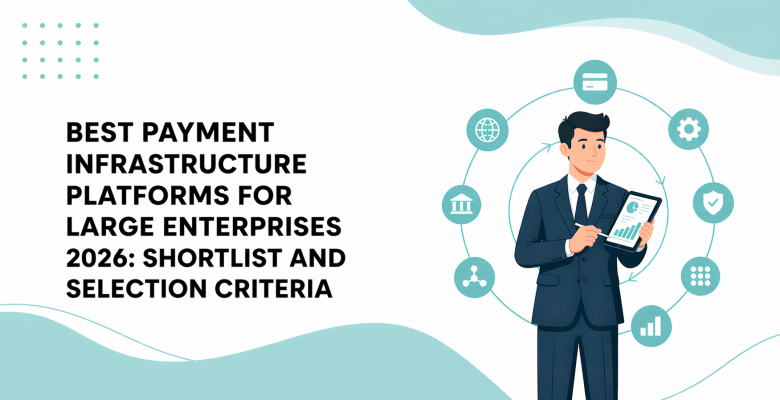
Large enterprises do not evaluate payment infrastructure the same way smaller e-commerce businesses do. At the enterprise level, payments become more complex. Teams need to manage multiple entities, cross-border operations, provider redundancy, finance visibility, governance, and uptime. This is why the best payment infrastructure platforms for large enterprises 2026 need to support control, scale, governance, and operations.
Different business models require different layers of the payment stack and different levels of control. Some organizations need a primary enterprise PSP with strong processing depth. Others need an orchestration layer above multiple providers to improve resilience, routing flexibility, and reporting consistency. Others need a white-label or modular setup, which gives more ownership without the cost and time of building everything in-house.
Akurateco is especially relevant for enterprises that want more centralized routing, reporting, and multi-PSP control in one platform. It combines white-label payment infrastructure and a payment orchestration solution with a broad integration ecosystem, PCI DSS Level 1 certification, and both SaaS and on-premise deployment.
This article gives a category-based shortlist of the best payment infrastructure platforms for large enterprises 2026, an evaluation rubric, and an RFP-ready checklist. Together, they help enterprise teams choose the right payment infrastructure.
What Is a Payment Infrastructure Platform for Large Enterprises?
For large enterprises, a payment infrastructure platform may refer to different layers of the stack. That distinction matters because many buying decisions go wrong when companies compare platforms that solve different problems:
- Processing and acquiring layer: PSPs, acquirers, and enterprise processors that handle payment acceptance, authorization, and settlement.
- Orchestration and control layer: the layer above one or more providers that manages routing, retries, and failover logic.
- Risk, compliance, and reporting layer: the controls and visibility layer that supports audit trails, governance, analytics, and reconciliation.
Large enterprises often need more than one of these layers at the same time. A company may use a major PSP for processing depth, then add orchestration above it. As a result, it reduces concentration risk, centralizes control, and normalizes reporting across providers.
How We Evaluated Enterprise Payment Infrastructure Platforms
For large enterprises, payment infrastructure should be evaluated as an operating model, not just a product feature list. A platform may look strong in demos, but still be a weak fit if PCI scope is unclear, routing logic is hard to govern, reporting is fragmented, or incident support does not match enterprise uptime expectations. That is why our shortlist focuses on the factors that shape long-term control, resilience, and operational efficiency.
Security and compliance readiness
In this shortlist, PCI posture, evidence readiness, and clarity around what remains in vendor scope versus client scope carried significant weight. Enterprise teams usually need more than a certification claim. They need a clear understanding of shared responsibility, especially since validation expectations are commonly shaped by payment-brand and acquirer compliance programs.
Resilience and operations
We treated SLAs, uptime transparency, incident handling, multi-region resilience, and support escalation models as core evaluation points. At enterprise scale, payment disruption affects not only transaction flow but also revenue continuity, customer trust, and internal operations across entities and markets.
Enterprise controls
RBAC, approvals, audit logs, change management, segregation of duties, and data-residency options were included because payment operations in large organizations usually involve multiple teams. In that environment, payment logic needs to be governed through traceable and accountable processes rather than informal access.
Payment performance
We assessed routing flexibility, routing optimization, retries, stop conditions, and cascading or failover design as indicators of operational maturity. Enterprise environments often require payment logic that can adapt across providers, regions, issuers, and payment methods without creating instability or excessive manual oversight.
Financial operations
Settlement reporting, reconciliation support, dispute visibility, and multi-PSP normalization were included because fragmented finance data often becomes a serious operational burden long after the initial integration is complete.
Integration and extensibility
We also considered essentials like API quality, connector ecosystem, sandbox maturity, implementation timelines, and compatibility with broader enterprise systems. Platform fit depends not only on capability, but also on how realistically the platform can be implemented, extended, and maintained inside a complex stack.
Taken together, these criteria help separate platforms that look compelling at the feature level from platforms that are more likely to hold up under enterprise complexity. That distinction is especially important in large-scale payment environments, where the long-term cost of weak governance, fragmented reporting, or limited control usually becomes visible only after rollout.
Best Enterprise Payment Infrastructure Platforms by Category
Enterprise payment infrastructure is not a single market with one clear winner. Large organizations usually choose between different platform models depending on what they need most. This can mean direct processing depth, centralized control across multiple providers, or greater ownership through white-label infrastructure. For that reason, we organized this shortlist by category rather than rank. Each category solves a different enterprise problem, and each becomes more relevant at a different stage of payment-stack maturity.
Best enterprise PSPs and acquirers in 2026
For large enterprises that prioritize high-volume payment acceptance, broad geographic coverage, unified reporting, and one primary provider, a payment setup centered on one provider remains the best fit. In that model, a primary provider must be able to handle large transaction volumes, support broad market coverage, and keep payment operations more centralized.
The shortlist below includes enterprise payment providers that are most relevant for companies looking for one payment partner for payment acceptance, compliance support, and operational scale.
| Provider | Best For | Strengths | Trade-Offs | Questions to Ask in RFP |
| Adyen | Enterprises that want a processor-led model with broad coverage and strong cross-channel operations | Unified commerce positioning, enterprise-scale processing, PCI guidance, and strong documentation for different integration models | Better fit when you want a strong primary processor than when you want neutral orchestration across many PSPs | How much reporting is exportable across entities? What flexibility remains if we later expand to more external processors? |
| Stripe | Enterprises that want strong APIs, broad product coverage, and mature developer tooling | Enterprise product breadth, strong documentation, Level 1 service-provider certification, and clear shared-responsibility guidance | Strong processor-led platform, but more complex multi-processor governance may still require orchestration above Stripe | Which controls can operations teams manage without engineering? How much reporting is available across brands and regions? |
| Checkout.com | Digital enterprises focused on processor-led performance and compliance support | PCI DSS Level 1 service-provider status, merchant compliance documentation, and a strong fit for performance-oriented digital payment operations | Still primarily a processing platform, not a neutral orchestration layer or white-label infrastructure route | How are settlement and reconciliation outputs structured? Which models reduce merchant PCI burden most effectively? |
Best fit for this category: large enterprises that want one primary payment partner for payment acceptance, compliance support, operational scale, and more centralized reporting.
Less suitable: enterprises that need centralized control across multiple PSPs, more advanced routing governance, or a payment setup built around orchestration rather than one main provider.
Best Payment Orchestration Platforms for Enterprise Multi-PSP Control
When an enterprise adds more than one PSP or acquirer, payment operations become harder to coordinate. Different providers bring different routing rules, reporting formats, settlement views, and failure points. At that stage, orchestration becomes more relevant because it helps bring that complexity under one control layer.
For enterprise scale, orchestration matters for resilience, routing governance, and unified reporting. It helps reduce dependence on one provider, supports safer failover, and keeps routing rules more consistent across entities, regions, payment methods, issuers, and risk conditions. It also gives finance and operations teams a clearer view across multiple providers.
Use the 2026 orchestration shortlist as a market map, not as a universal ranking. The platforms below address different enterprise priorities, including white-label control, routing governance, reconciliation depth, token portability, and workflow flexibility:
- Akurateco stands out for enterprises seeking white-label control, flexible deployment, and orchestration on a single platform.
- IXOPAY emphasizes enterprise orchestration, agnostic tokenization, smart routing, and reconciliation depth.
- Primer stands out for configurable payment logic, observability, and faster changes to payment flows.
- ACI Worldwide brings enterprise-grade orchestration, centralized payment flows, broad connectivity, and scale.
- Spreedly fits enterprises that prioritize tokenization, portable vaulting, and provider abstraction.
- Gr4vy brings a cloud-native orchestration model with flexibility around routing, retries, and workflow design.
Best fit for this category: enterprises that already work with multiple providers, or plan to, and need more centralized control over routing, failover, reporting, and provider governance.
Less suitable: enterprises that only need one primary payment provider and have limited need for multi-PSP control or orchestration-level reporting.
Best white-label and modular payment infrastructure software for enterprise build-or-buy decisions
Some enterprises need more control than a standard PSP model offers, but do not want to build payment infrastructure from scratch. White-label and modular platforms become more relevant when a standard PSP setup no longer gives enough control, while building payment infrastructure internally still feels too heavy. For enterprises in that position, the appeal usually comes from having more influence over routing, reporting, provider management, and the way payment operations are structured overall.
Akurateco is a strong fit in this category for enterprises, PSPs, and payment businesses that want branded infrastructure with built-in orchestration. It combines white-label payment infrastructure, centralized payment operations, and flexible deployment models, which makes it especially relevant for businesses that want more control over how payment operations are managed and scaled.
At the enterprise level, Akurateco is most relevant for use cases such as:
- Launching a branded payment infrastructure model faster without building the full payment stack from scratch
- Moving from a single-PSP setup to multi-PSP operations with centralized routing, retries, failover, and reporting
- Adding more operational control to a complex payment setup through tokenization, anti-fraud, provider management, and flexible deployment models
- Centralizing payment operations across multiple entities, regions, or business units under one orchestration layer
- Reducing dependence on a single processor while keeping payment logic, reporting, and governance more consistent across the enterprise.
White-label infrastructure serves a different enterprise need than direct acquiring. Akurateco is most relevant where the priorities are faster launch, stronger ownership of the payment layer, built-in orchestration, and more centralized payment control.
Best fit for this category: enterprises, PSPs, and payment businesses that want branded payment infrastructure, control over routing and reporting, and the flexibility to choose a deployment model that fits internal governance requirements.
Less suitable: businesses whose main priority is selecting one primary acquirer or processor for direct acquiring depth, rather than building a more controlled and branded payment operating model.
RFP Checklist for Choosing an Enterprise Payment Infrastructure Platform
An enterprise payment platform rarely affects only the payments team. Procurement, architecture, security, finance, and operations usually all need confidence that the setup will hold up under real business conditions. A well-structured RFP helps uncover issues that often stay hidden during product demos, such as unclear responsibility boundaries, weak governance over payment logic, fragmented reporting, or limited support for multi-entity operations.
Use this checklist during procurement, architecture, and security calls:
- What remains in scope for us versus the vendor under the shared-responsibility model?
- Can the platform support multi-entity structures across regions, brands, and business units?
- Do we get an exportable audit trail, admin change logs, and approval history?
- What is the failover strategy across providers, and how are retry caps and stop conditions governed?
- How are settlements, reconciliation, and disputes normalized across providers?
- What data-residency, retention, and access-control options exist?
- What does incident response look like in practice, including escalation path and notification expectations?
- Which payment-logic changes require engineering, and which can be handled safely by operations teams?
- If our processor mix changes later, how portable are tokens, routing rules, and reporting outputs?
A checklist like this helps expose how well a platform can support enterprise complexity once multiple entities, multiple providers, and stricter internal controls come into play.
Where Akurateco Fits for Large Enterprises
Akurateco fits best as an orchestration and white-label infrastructure option for enterprises that need more centralized routing, reporting, and multi-PSP control without turning the whole stack into a fully internal build.
For enterprises, Akurateco’s value comes from combining white-label infrastructure with orchestration control, routing, retries, reporting, and multi-provider operations in one platform, together with deployment options (SaaS, on-premises, and cloud-agnostic setups) that can match different governance and business model requirements.
Conclusion
Large enterprises do not need one universal winner. They need the platform model that best matches their payment complexity, governance requirements, and operating structure.
For some, that means a primary provider with the scale to support high transaction volumes and broad market coverage. For others, it means orchestration that brings more control over routing, failover, and reporting across multiple providers. In cases where ownership and flexibility matter more, white-label or modular infrastructure can be the more practical path. That is why a category-based shortlist works better.
Akurateco is especially relevant for enterprises that want centralized routing, reporting, and multi-PSP control, combined with white-label flexibility and flexible deployment models.