

- What a Payment Infrastructure Provider Means in Regulated Industries
- How We Evaluated Payment Infrastructure Providers
- Best Payment Infrastructure Provider Categories for Regulated Industries
- Payment Infrastructure Selection Checklist for Regulated Industries
- Where Akurateco Fits in the Payment Infrastructure Landscape
- Conclusion
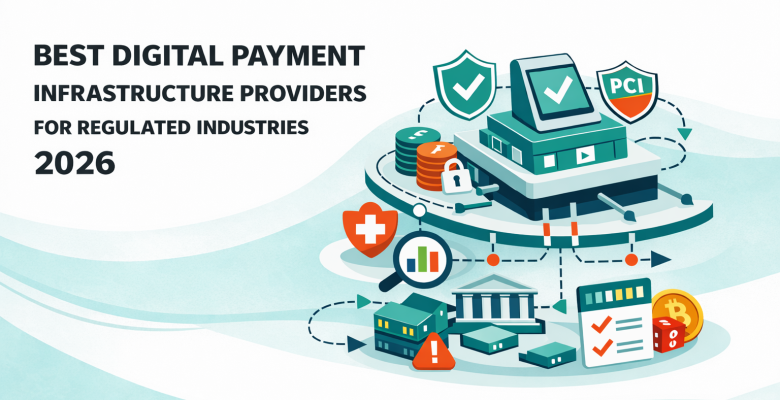
Best digital payment infrastructure providers for regulated industries 2026 are not judged by the same criteria as payment platforms for standard e-commerce or SaaS, where speed of integration, checkout performance, and ease of use often drive the decision. For regulated industries, those things still matter, but they are not enough, and overlooking distinct requirements can be costly.
Regulated industries are businesses that require strict government oversight because they handle sensitive data, financial activity, consumer funds, health information, or other high-risk operations. Financial services, iGaming, healthcare, crypto and virtual assets, and lending are common regulated industries expected to meet strict compliance requirements.
Given the higher level of risk and obligations, these businesses must protect consumers, ensure economic stability, manage public safety risks, and meet a list of legal and safety standards. It requires ongoing audit readiness, strong data controls, effective risk tooling, reliable uptime SLAs, and clear reporting. In this context, infrastructure carries more weight. PCI DSS Level 1 service provider, Stripe Radar provides real-time fraud protection and custom rules, while Stripe also offers features that can help automate parts of PCI compliance.
This article compares the best digital payment infrastructure providers for regulated industries in 2026. To pick the most suitable vendor for your business model, use our key selection criteria of compliance support, risk controls, reporting, and uptime.
What a Payment Infrastructure Provider Means in Regulated Industries
Before reviewing the best digital payment infrastructure providers 2026 for regulated industries, it is worth clarifying what “payment infrastructure provider” actually means in this context. In regulated payments, the term is broader than a PSP alone. Different businesses buy different layers of the stack depending on their operational model, regulatory burden, and growth plans.
For example, iGaming businesses usually care more about approval rates, regional provider coverage, fraud pressure, and chargeback exposure. Healthcare businesses tend to focus more on data handling, auditability, and operational reliability. Crypto businesses often place more emphasis on banking sensitivity, risk controls, and partner readiness. Lending businesses usually give more weight to reporting, traceability, and compliance workflows.
That is why a payment infrastructure provider can refer to several layers:
- Core payment processing and acquiring provide businesses with direct processing scale, broad payment acceptance, and a primary payment partner.
- Orchestration and multi-provider control support businesses that already use, or plan to use, multiple providers and need routing, retries, failover, and centralized management across them.
- Risk, compliance, and reporting infrastructure help businesses that need stronger visibility, auditability, and operational control, especially when launching a payment product without building the full stack from scratch.
Some vendors focus mostly on one layer, while others combine several. For regulated businesses, the most suitable provider is often the one that gives the right mix of processing access, operational control, and compliance-oriented visibility.
How We Evaluated Payment Infrastructure Providers
In regulated payment environments, provider selection usually involves more than a payments team. Security, legal, compliance, operations, and finance often all need to evaluate the setup.
A provider may look strong on integrations or conversion performance, but still be a weak fit if PCI scope is unclear, audit artifacts are hard to obtain, reporting is fragmented, or deployment options do not match internal policy or data residency requirements.
So, to make this shortlist useful, we shifted our evaluation approach from brand recognition and integrations toward the operational fundamentals that determine provider fit in regulated payment environments.
Just as important, PCI scope and compliance should not be treated as a box-ticking exercise. In regulated setups, businesses need to understand what stays in vendor scope, what stays in their own scope, and what audit evidence can actually be produced when needed. That matters as much as product capability.
Our evaluation focuses on the following principles that define the best fit and reliability of payment infrastructure providers in regulated environments:
- Compliance posture: PCI DSS level, audit readiness, AOC availability, and SDLC controls.
- Risk controls: fraud tooling, rule engines, velocity controls, and chargeback workflows.
- Data controls: tokenization, data residency, access controls, and audit trails.
- Operational resilience: SLAs, incident processes, redundancy, and multi-region support.
- Payment performance: approval optimization, smart retries, failover, cascading, and routing flexibility.
- Financial operations: settlement reporting, reconciliation tooling, and dispute visibility.
- Deployment fit: SaaS and on-premise options, depending on regulatory and operational requirements.
Note that PCI DSS responsibility is shared. A vendor’s certification can reduce scope and simplify parts of compliance, but it does not automatically remove the client’s own obligations.
These criteria help separate general payment vendors from providers better suited to different regulated business models. With this in mind, you can evaluate how well each provider supports compliance, control, resilience, and day-to-day payment operations for your case.
Best Payment Infrastructure Provider Categories for Regulated Industries
There is no single “best” payment infrastructure provider for all regulated industries. Different business models require different levels of control, compliance support, and operational flexibility.
A healthcare platform, an iGaming operator, a crypto business, and a lending company may all need strong compliance and risk controls, but they do not buy infrastructure for the same reason. That is why we shifted this shortlist away from a single universal fit and organized it by provider category, which better reflects how regulated businesses actually choose payment infrastructure.
Best enterprise PSPs and acquirers for regulated businesses
For PSPs and acquirers, the best fit in terms of payment infrastructure is usually focused on direct processing depth, mature risk controls, and enterprise-grade reporting. In the table below, we compare different popular providers, their use cases, strengths, and tradeoffs.
| Provider | Best for | Strengths | Trade-offs |
| Adyen | Large regulated businesses that want direct acquiring depth, enterprise control, and one platform across channels. | PCI DSS Level 1 service provider, unified payments data across channels, enterprise risk management with fraud and dispute monitoring, strong reconciliation, and back-office visibility. | Better fit for larger or more mature payment teams. If you mainly need neutral multi-provider control rather than a primary enterprise processor, an orchestration layer may be a better fit. |
| Stripe | Regulated businesses that value fast deployment, strong developer tooling, and built-in fraud support. | PCI DSS Level 1 service provider. Stripe Radar provides real-time fraud protection and customizable rules, while Stripe also offers features that can help automate parts of PCI compliance. | Strong for implementation speed and integrated tooling. But businesses with more complex multi-acquirer strategies may still want orchestration above Stripe. |
| Checkout.com | Digital-first regulated businesses focused on payment performance, fraud control, and optimization. | PCI DSS Level 1 service provider, Intelligent Acceptance is designed to improve acceptance with real-time optimization, fraud prevention and payment performance tooling as core strengths. | Strong for performance-focused teams. But it is still primarily a processing platform rather than a white-label launch model or neutral orchestration layer. |
Best fit for this category: businesses that need direct processing scale, mature risk controls, and enterprise-grade reporting from a primary payment partner.
Less suitable: businesses that need centralized control across multiple providers, white-label infrastructure, or a faster launch model without relying on a single processor.
Best payment orchestration platforms for multi-provider control
Once a business starts working with more than one PSP or acquirer, orchestration becomes much more than a performance tool. In regulated industries, it is often the layer that makes a fragmented setup manageable. It reduces dependency on a single provider, allows more granular routing policies, gives teams failover options, and centralizes visibility across providers, payment methods, and transaction flows.
That matters even more when transaction handling needs to vary by issuer, BIN, geography, payment method, or risk condition. In those environments, orchestration is not just about conversion uplift. It is about operational control, resilience, and clearer oversight.
The best payment orchestration platform is usually the one that best matches your business model in terms of deployment flexibility, routing depth, time to market, reporting, and ease of adding new integrations. If you expect to expand into new markets or add providers over time, the ability to launch changes quickly becomes one of the most important selection criteria.
Use the 2026 orchestration shortlist as a market map rather than a universal ranking. After reading this review, you’ll see that different platforms are strong in different areas:
- Akurateco is stronger where businesses want full white-label control, flexible deployment, and an orchestration layer in one platform.
- IXOPAY is more associated with enterprise orchestration, vaulting, and reconciliation depth.
- Primer stands out for configurable payment logic and faster changes to payment flows.
- Spreedly is often considered where tokenization and provider abstraction are central priorities.
- Gr4vy is more often discussed as a cloud-native orchestration option with flexibility around routing and experimentation.
Best fit for this category: businesses that already use, or plan to use, multiple providers and need one control layer above them.
Less suitable: businesses that only need a single PSP and do not expect much routing logic, provider redundancy, or centralized reporting.
Best white-label payment infrastructure platforms for faster launch
White-label payment platforms allow regulated operators to have branded infrastructure and control without building the entire payment stack themselves. To find a suitable vendor, you should focus on a white-label gateway with an orchestration layer, PCI-ready architecture, anti-fraud, tokenization, routing, and centralized reporting already in place. For a deeper look at how this model works, see our white-label payment gateway explained guide.
Akurateco gives regulated businesses a ready-made white-label payment platform they can launch under their own brand and an orchestration layer that helps manage all the payment data. It includes PCI DSS Level 1-certified infrastructure, anti-fraud tools, tokenization, routing, centralized reporting, merchant onboarding support, and flexible deployment options such as SaaS and on-premise.
Businesses that want to go live faster without losing control over payment operations can benefit from a fast launch spanning around 2 weeks and rely on a Payment-as-a-Service team for ongoing support.
Best fit for this category: PSPs, fintechs, payment businesses, and regulated merchants that want to launch faster under their own brand without building the full payment stack internally.
Less suitable: businesses whose first priority is owning every layer of acquiring directly from day one, rather than using white-label infrastructure as a faster route to market.
Payment Infrastructure Selection Checklist for Regulated Industries
When doing vendor calls, you need to focus on what really matters to you. The provider of your choice must support your compliance model, operational controls, and reporting needs without creating blind spots later. To make your search more effective, use the checklist below with fundamental questions to ask a vendor before buying:
- What data touches our systems, and what stays within the vendor environment? The answer helps define where responsibility starts and ends across payment flows, storage, and sensitive data handling.
- What remains in scope for our PCI validation, and why? A serious provider should explain the scope clearly, not just say they are PCI certified.
- Do we need SaaS or on-premise deployment for data residency, internal policy, or regulator expectations? This becomes especially important when geography, hosting control, or local requirements shape infrastructure decisions.
- Can we route by issuer, BIN, geography, or payment method, and apply retry caps or stop conditions? In regulated payment setups, control over transaction logic matters as much as connectivity.
- What audit artifacts are available? Ask for AOC, pentest summaries, security policies, and any documentation used in client due diligence or audits.
- What does incident response look like in practice? Clarify SLA commitments, notification timelines, escalation paths, and how they handle incidents.
- How are settlements, disputes, and reconciliation handled across providers? Fragmented reporting becomes a real operational problem if the platform cannot centralize financial visibility.
If a vendor can answer these questions clearly, document the answers, and show a strong fit with your business model, it is more likely to be a reliable long-term choice.
Where Akurateco Fits in the Payment Infrastructure Landscape
Akurateco is best suited to PSPs, fintechs, payment businesses, and regulated merchants that need a white-label payment gateway with orchestration control. It is especially relevant for use cases where the business wants to launch faster, manage multiple providers from one place, and keep more control over routing, retries, and reporting.
For SaaS deployments, clients are covered by Akurateco’s certification, while on-premise deployments require clients to obtain their own PCI DSS certification. Akurateco can also assist with the required documentation and certification process.
Akurateco fits three common use cases especially well:
- Launching a branded payment platform faster without building payment infrastructure from scratch
- Moving from a single PSP setup to multi-PSP operations with centralized routing, retries, and reporting
- Adding more operational control to a regulated payment setup through tokenization, anti-fraud, merchant onboarding support, and flexible deployment
For businesses in those scenarios, Akurateco gives teams a certified payment platform and one place to manage payment logic, provider relationships, and operational visibility.
Conclusion
For regulated industries, a fit-based shortlist is more useful than trying to identify one universal winner. Different business categories need different levels of control, compliance support, deployment flexibility, and operational depth. The better approach is to choose the provider model that best fits your compliance burden, operational complexity, deployment needs, and growth plans.