

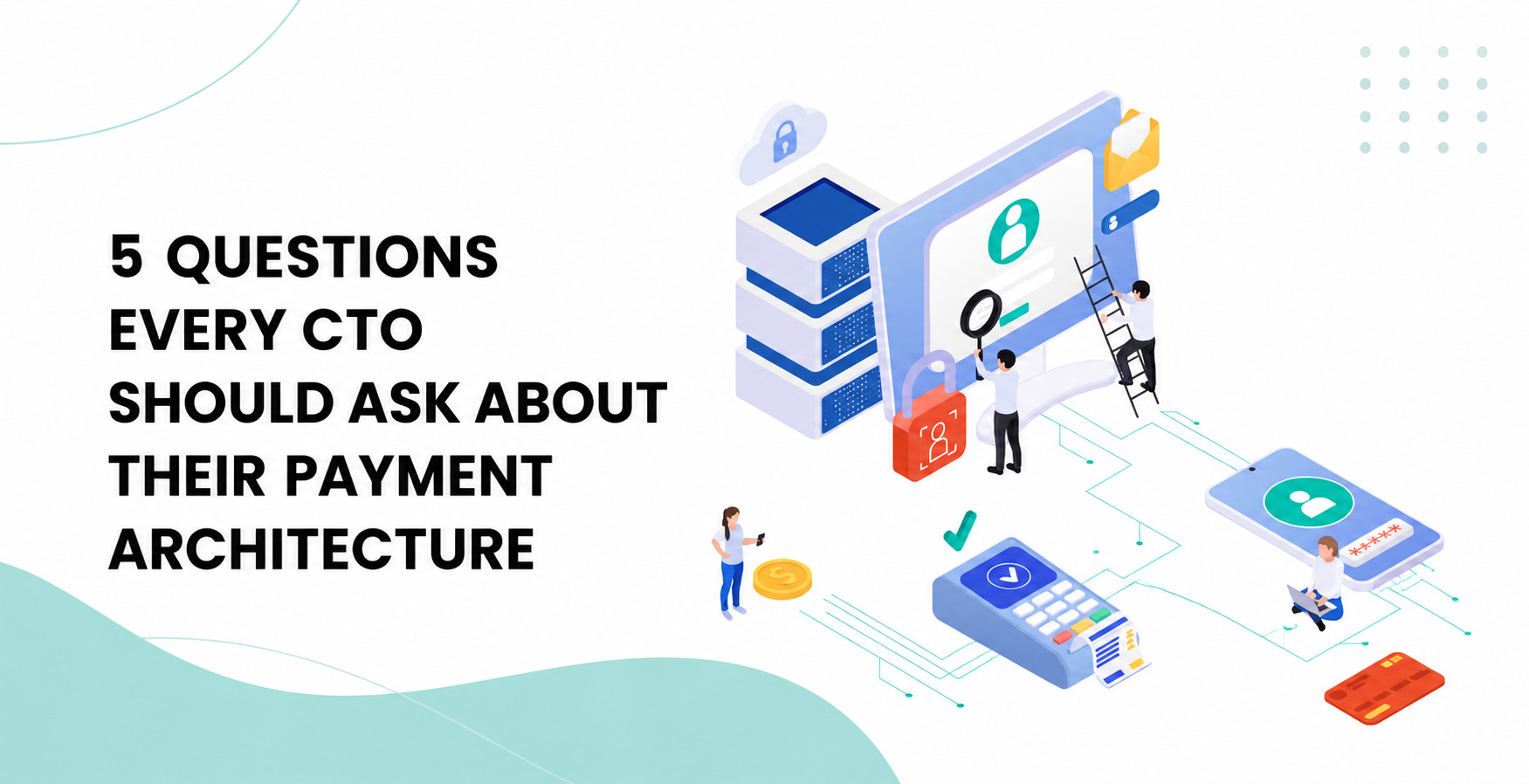
- 1. Is your payment infrastructure actually yours?
- 2. Do you know where transactions fail — and why?
- 3. How many engineering hours does your payment stack consume?
- 4. Can your architecture support the markets you want to enter next?
- 5. Is your payment stack built for where the company is going?
- Final thought
Payments are often treated as a solved problem.
You connect a provider, process transactions, receive reports, and move on to the next product priority. At an early stage, this approach can work. It is fast, practical, and usually good enough.
But as the business grows, payment infrastructure starts to show its real nature. More markets. More currencies. More payment methods. More providers. More fraud scenarios. More reporting requirements. More pressure from merchants, finance teams, risk teams, and regulators.
This is when payments stop being just an integration and become an architectural decision.
From a CTO perspective, the question is not only whether your payment stack works today. The real question is whether it will still work when your business doubles in volume, enters new markets, adds new providers, or needs to optimize approval rates without slowing down engineering.
Here are five questions every CTO of a scaling business, PSP, or enterprise merchant should ask about their payment architecture.
1. Is your payment infrastructure actually yours?
Many companies start with a simple model: one PSP, one integration, one API.
There is nothing wrong with that in the beginning. The problem appears when this temporary setup becomes the foundation for long-term growth.
If your entire payment flow depends on one provider’s API, logic, reporting, and uptime, then your architecture is not fully under your control. You are operating inside someone else’s infrastructure boundaries.
That means every provider-side change can become your problem. API updates, endpoint deprecations, downtime, approval rate drops, new compliance requirements, or limited market coverage can all directly affect your roadmap.
For me, ownership in payments means flexibility.
Can you add a new provider without rebuilding the whole flow?
Can you switch routing if approval rates drop?
Can you remove a provider without disrupting merchants?
Can you expand into a new market without starting from zero?
If the answer is no, then the company does not really own its payment infrastructure. It owns an integration.
And there is a big difference between the two.
2. Do you know where transactions fail — and why?
Most companies know their overall payment success rate.
Far fewer can explain what is happening inside that number.
Where exactly do transactions fail?
Is the issue connected to a specific provider, country, card type, payment method, currency, device, merchant category, or risk rule?
Are declines coming from the issuer, the acquirer, the fraud system, the payment method, or the gateway logic?
Without this level of visibility, optimization becomes guesswork.
And in payments, guesswork is expensive.
A 2–3% approval rate gap may look small in a dashboard. But at scale, it can mean a significant amount of lost revenue. The challenge is that these losses are often hidden inside aggregated reports. On the surface, the numbers may look acceptable. But inside specific routes, regions, or merchant segments, the business may be losing money every day.
A strong payment architecture should give the team real-time visibility into the transaction flow. Not only after settlement. Not only at the end of the month. And not only through provider-side reports.
The CTO should be able to answer a simple question quickly:
What failed, where did it fail, and what can we do about it?
If the payment stack cannot answer that, it is not giving the business enough control.
3. How many engineering hours does your payment stack consume?
This is one of the most underestimated questions.
Payment infrastructure does not only cost money through provider fees. It also costs engineering time.
New connector integrations.
Webhook issues.
Provider-specific edge cases.
Compliance updates.
Reporting mismatches.
Failed payment investigations.
Settlement data issues.
Risk rule changes.
Payment method updates.
All of this slowly consumes the roadmap.
The problem is not that payments require engineering attention. They always will. The problem is when senior engineers spend too much time maintaining payment plumbing instead of building product value.
At some point, the CTO has to ask:
Are we building competitive advantage here, or are we just keeping the payment stack alive?
This is especially important for PSPs and enterprise merchants. Their internal teams should not be stuck rebuilding the same payment functionality that already exists in mature infrastructure: routing, cascading, tokenization, reconciliation, merchant management, risk integrations, payment method connectivity, and reporting.
That is why white-label payment infrastructure and orchestration platforms exist.
The goal is not to remove engineering from payments completely. That would be unrealistic. The goal is to let engineering focus on the parts that are strategic for the business, while the infrastructure layer absorbs the repetitive operational complexity.
4. Can your architecture support the markets you want to enter next?
Geographic expansion is one of the fastest ways to expose weak payment architecture.
A stack that works well in one market may become a bottleneck in another.
For example, a company built around card payments in Europe may face a very different reality in Latin America, MENA, Africa, or Southeast Asia. Local payment methods, acquiring relationships, settlement practices, fraud behavior, currency flows, and compliance expectations can all change from market to market.
The technical challenge is not only to add one more connector.
The real challenge is to make different payment environments work inside one controlled architecture.
Can your routing logic support local acquirers?
Can your reporting handle different settlement structures?
Can your fraud setup adapt to regional behavior?
Can your team compare performance across providers and countries?
Can merchants still get a consistent experience while the infrastructure underneath becomes more local?
If every new market requires custom logic, a separate integration sprint, and manual operational workarounds, then expansion will always be slower than expected.
A scalable payment architecture should allow the business to localize without fragmenting.
This is the balance CTOs need to design for: local flexibility underneath, central control on top.
5. Is your payment stack built for where the company is going?
This is probably the most important question.
Payment infrastructure often reflects the company that existed two or three years ago. Not the company it is becoming.
The original decisions may have been logical at the time. The team needed speed. The business needed to launch. The provider worked well enough. The volume was manageable. The markets were limited.
But growth changes the requirements.
More volume creates new reliability expectations.
More markets create new payment method requirements.
More merchants create more support and reporting pressure.
More providers create more operational complexity.
More fraud exposure creates more risk management needs.
Technical debt in payments does not always appear suddenly. It accumulates quietly. Then one day the business wants to expand, optimize, or scale — and the architecture cannot keep up.
The best CTOs do not necessarily build the most complex payment systems from day one. But they do build with headroom.
They ask early:
What happens if transaction volume doubles?
What happens if we enter three new markets?
What happens if our main provider has downtime?
What happens if merchants start asking for more local payment methods?
What happens if approval rates become a board-level metric?
These questions should be asked before growth creates pressure, not during it.
Because the worst time to redesign payment infrastructure is when the business already depends on it at scale.
Final thought
Payment architecture is not a one-time integration decision. It is a long-term infrastructure decision.
For a CTO, the goal is not only to make payments work. The goal is to make payments controllable, observable, flexible, and scalable.
A good starting point is an honest audit:
How many providers do we depend on?
Where do we lack visibility?
How much engineering time goes into maintenance?
How fast can we add a new payment method or provider?
What would it really take to enter our next target market?
Can we optimize payment performance without rebuilding the system?
The answers will show whether your payment architecture is supporting growth — or quietly limiting it.
In payments, complexity is inevitable. Fragmentation is optional.