

- What are iGaming payment solutions?
- How do iGaming payments work?
- Which payment providers support iGaming businesses?
- What payment methods matter most in iGaming?
- What are the main iGaming payment challenges?
- How does payment orchestration help iGaming operators and PSPs?
- What should you look for in an iGaming payment solution?
- Build vs buy: should you develop iGaming payment infrastructure in-house?
- Best practices for iGaming payment operations
- Conclusion
For iGaming operators, payment performance directly affects deposits, withdrawals, player trust, fraud exposure, market expansion, and revenue continuity. iGaming payment solutions are not only about accepting card payments. They include gateways, PSPs, acquirers, wallets, bank payments, payouts, risk tools, routing, reconciliation, reporting, and compliance controls.
This matters because iGaming is operationally sensitive. A payment setup that works in one market may fail in another because of acquirer risk appetite, local payment preferences, regulation, issuer behavior, fraud patterns, or payout expectations.
For PSPs, fintech companies, and enterprise merchants, the main question is not simply “which provider should we connect?” The stronger question is: how should the whole payment infrastructure be designed so it can support high-volume, regulated, multi-provider iGaming operations?
What are iGaming payment solutions?
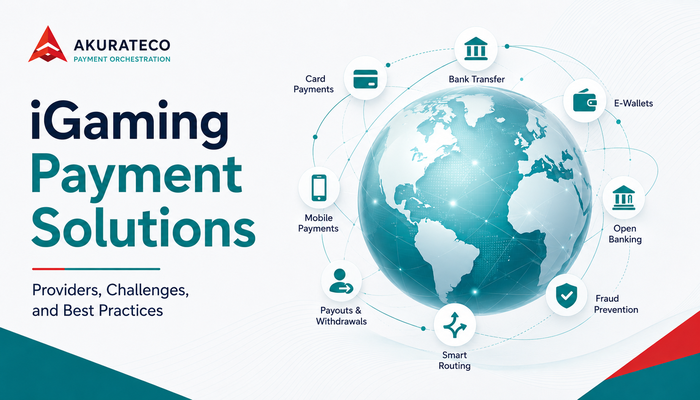
iGaming payment solutions are the systems, providers, and workflows that allow online betting, casino, sportsbook, lottery, and gaming platforms to accept deposits, process payouts, manage risk, and reconcile payment activity.
An iGaming payment solution can include:
- Payment gateways.
- PSPs and acquirers.
- Digital wallets.
- Open banking and pay-by-bank options.
- Card processing.
- Local payment methods.
- Payout tools.
- Fraud prevention.
- KYC and AML controls.
- Smart routing and cascading.
- Reporting, settlement, and reconciliation.
- Merchant management tools for PSPs and PayFacs.
In practice, iGaming payments are more complex than standard eCommerce payments because the payment lifecycle goes both ways. Players deposit funds, use balances, request withdrawals, receive winnings, trigger refunds, and may initiate chargebacks. Operators and PSPs must manage this while meeting regulatory, risk, and responsible gambling expectations.
That makes iGaming payment processing a mix of checkout performance, risk management, liquidity, compliance, and payment operations.
How do iGaming payments work?
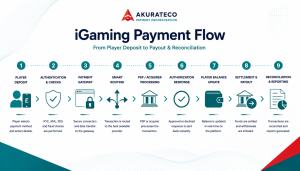
iGaming payments move through several connected stages: player deposit, authentication, risk checks, authorization, routing, settlement, balance update, withdrawal, and reconciliation.
A simplified iGaming payment flow looks like this:
| Stage | What happens | Systems involved | Operational risk |
| Player deposit | Player selects a payment method and enters payment details | Checkout, gateway, wallet, bank payment, card processor | Friction, failed deposit, abandoned session |
| Authentication and checks | Payment and account checks are triggered | 3DS, KYC, AML, fraud tools, responsible gambling rules | False declines, compliance gaps |
| Authorization | Issuer, wallet, bank, or provider approves or declines the payment | Acquirer, PSP, issuer, payment network | Declines, issuer restrictions, provider downtime |
| Routing / cascading | Transaction may be routed to the best provider or retried after a soft decline | Routing engine, orchestration layer, PSPs | Poor routing logic, duplicate retries |
| Settlement | Funds move between acquirer, PSP, merchant, and platform accounts | Acquirer, PSP, banking partners, ledger | Delays, fees, mismatch in reports |
| Player balance update | Platform reflects deposited funds or withdrawal status | iGaming platform, wallet ledger, payment status API | Status mismatch, player disputes |
| Withdrawal / payout | Player requests winnings or balance withdrawal | Payout provider, bank transfer, wallet, card payout | Delays, fraud, account mismatch |
| Reconciliation | Finance team matches payments, fees, settlements, refunds, and chargebacks | Reports, ledger, accounting, BI tools | Manual workload, revenue leakage |
The key operational challenge is that every stage depends on the quality of data exchange between systems. A deposit may be authorized but not reflected correctly in the player wallet. A withdrawal may pass internal approval but fail at payout. A provider may report settlement differently from the platform ledger.
For this reason, iGaming payment infrastructure should be evaluated as an end-to-end operating system, not only as a payment acceptance tool.
Which payment providers support iGaming businesses?
iGaming payment providers usually include specialist PSPs, payment gateways, acquirers, wallets, open banking providers, payout providers, fraud vendors, and orchestration platforms. For operators working in regulated or higher-risk segments, choosing reliable payment solutions for high-risk industries is especially important because provider coverage and risk appetite can vary significantly by market and business model.
There is no single provider type that solves every iGaming payment requirement. Most mature operators use a combination of providers.
| Provider type | What it does | Best for | Limitation |
| Payment gateway | Connects checkout to payment processing | Card and APM acceptance | Usually does not solve full routing, payouts, or reconciliation alone |
| PSP | Provides payment acceptance and processing services | Faster provider access and operational support | Risk policies may change; coverage varies by market |
| Acquirer | Processes card transactions and manages merchant risk | Card acceptance and settlement | iGaming approval depends heavily on risk appetite |
| Digital wallet | Lets players deposit and withdraw through stored-value accounts | Fast player experience, repeat users | Wallet availability varies by region |
| Open banking / pay by bank | Enables direct account-to-account payments | Lower card dependency, bank-based deposits | Coverage and UX differ by market |
| Payout provider | Handles withdrawals, winnings, and mass payouts | Faster withdrawal operations | Must be tightly controlled for fraud and account ownership |
| Fraud / risk provider | Detects suspicious activity and risky behavior | Chargeback reduction, fraud monitoring | Needs strong integration with payment and player data |
| Payment orchestration platform | Connects multiple PSPs, acquirers, and methods through one layer | Multi-provider control, routing, cascading, reporting | Requires clear payment strategy and rule design |
The UK payments market includes providers with very different focuses, from global and local payment methods to open banking, SEPA transfers, and payment orchestration. For businesses comparing providers, the key is to look beyond the number of supported methods and assess how well each platform fits their markets, payment flows, integration needs, and plans for scaling. Primer and Corefy both bring orchestration into the conversation, with emphasis on multi-PSP management, routing, fallback logic, checkout tools, dashboards, and unified payment control.
For PSPs and fintech companies serving iGaming merchants, this creates a strategic choice: either connect each provider, method, and workflow separately, or use white-label payment software and orchestration infrastructure to manage the stack through one control layer.
What payment methods matter most in iGaming?
The best iGaming payment mix depends on market, player preference, risk profile, regulation, settlement needs, and withdrawal expectations.
Common iGaming payment methods include:
- Debit cards.
- Credit cards where permitted.
- Digital wallets.
- Prepaid vouchers.
- Bank transfers.
- Open banking / pay by bank.
- Instant bank transfers.
- Card payouts.
- Local payment methods.
- Crypto payments, where legally and operationally appropriate.
The right mix is rarely universal. A sportsbook in the UK, an online casino in LATAM, and a regulated operator in Europe may all need different payment methods, risk checks, and payout flows.
Payment teams should evaluate each method by:
| Payment method | Strength | Operational consideration |
| Cards | Familiar, broad coverage, strong conversion | Chargebacks, issuer declines, scheme rules |
| Digital wallets | Fast deposits and withdrawals | Wallet availability and fee structure |
| Open banking | Direct bank payments, reduced card dependency | Bank coverage and user experience |
| Prepaid / voucher methods | Useful for privacy-conscious or cash-preferred users | Withdrawal limitations may apply |
| Local APMs | Stronger market fit | Requires local integration and reporting |
| Bank transfers | Useful for withdrawals and higher-value flows | Settlement speed and manual reconciliation risk |
| Crypto | Can serve specific segments | Regulatory, volatility, AML, and compliance complexity |
A mature iGaming payment setup should support method-level performance monitoring. Payment teams need to know which methods convert, which decline, which create the highest fraud exposure, which delay settlement, and which increase operational workload.
What are the main iGaming payment challenges?
The biggest iGaming payment challenges are provider risk appetite, payment failures, fraud, chargebacks, withdrawal expectations, compliance, market fragmentation, and poor operational visibility.
Provider risk appetite
iGaming is often treated as a high-risk vertical. PSPs and acquirers may apply stricter underwriting, reserve requirements, transaction monitoring, or termination clauses. A single-provider setup creates serious dependency risk.
Relying on a single PSP can expose operators to outages, fee changes, and sudden shifts in risk policies. Using multiple providers helps reduce this dependency and gives businesses more flexibility when payment conditions change.
Failed deposits and poor authorization rates
A failed deposit is not only a technical issue. It can affect player trust, marketing ROI, and revenue during high-traffic events. Declines may come from issuers, acquirers, fraud filters, incorrect routing, poor data quality, expired cards, unsupported payment methods, or provider downtime. Vertical-specific routing can make a measurable difference in high-risk sectors such as iGaming. Akurateco’s routing templates, combining intelligent acquirer selection with AI fraud scoring, have delivered up to 30% higher approval rates, according to Akurateco’s 2026 PSP research.
Withdrawal delays
Players usually tolerate some friction during deposits, but they are far less patient when withdrawing funds. Slow or unclear payouts can increase support requests, complaints, and reputational risk.
Fraud and chargebacks
iGaming businesses face account takeover, bonus abuse, stolen cards, friendly fraud, identity mismatch, multi-accounting, and withdrawal fraud. Fraud controls must be strong enough to reduce losses without blocking legitimate high-value players unnecessarily.
Compliance and responsible gambling pressure
Payment teams must work within gambling regulation, AML requirements, KYC expectations, card network rules, data protection requirements, and local restrictions on payment methods. PCI DSS also applies to entities that store, process, or transmit cardholder data, and PCI SSC defines PCI DSS as a baseline of technical and operational requirements for protecting payment account data.
Fragmented reporting and reconciliation
A multi-provider setup can improve resilience, but it also creates reporting complexity. Each provider may use different formats, statuses, settlement cycles, fee structures, and chargeback reporting. Without unified analytics and reconciliation, finance and operations teams may struggle to understand real payment performance.
How does payment orchestration help iGaming operators and PSPs?
Payment orchestration helps iGaming businesses manage multiple providers, routes, methods, fraud tools, and reports through one control layer instead of treating each integration as a separate operational silo.
Payment orchestration is especially relevant when an iGaming operator or PSP needs to:
- Connect multiple PSPs or acquirers.
- Reduce dependency on one provider.
- Improve authorization rates.
- Recover soft declines.
- Route transactions by country, currency, method, BIN, issuer, amount, or risk profile.
- Support local payment methods faster.
- Manage payouts and refunds more consistently.
- Consolidate payment reporting.
- Standardize merchant management across multiple clients or brands.
A payment orchestration platform such as Akurateco can help PSPs, fintech companies, and enterprise merchants manage complex payment infrastructure through a centralized layer. Akurateco provides white-label payment gateway software and payment orchestration capabilities for PSPs and other payment businesses. The platform supports multi-provider connectivity, routing, merchant management, reporting, and other tools needed to manage and scale payment operations.
For iGaming, orchestration is valuable because transaction performance changes constantly. One provider may perform better for a specific market, card type, currency, or player segment. Another may be more reliable for payouts. A third may be needed as backup when the primary route fails.
The goal is not to send every transaction to every provider. The goal is to create controlled routing logic that improves resilience while protecting risk, compliance, and reporting accuracy.
What should you look for in an iGaming payment solution?
A strong iGaming payment solution should provide reliable acceptance, fast payouts, multi-provider routing, risk controls, compliance support, reporting, reconciliation, scalability, and operational flexibility.
Use this checklist when evaluating providers or infrastructure:
| Capability | Why it matters | What to check |
| Multi-PSP connectivity | Reduces dependency on one provider | Number of supported providers, integration speed, routing options |
| Local payment methods | Improves market fit and conversion | Coverage by target country and player segment |
| Smart routing | Improves approval rates and cost control | Rules by country, currency, provider, BIN, risk, amount |
| Cascading / fallback | Recovers soft declines | Retry logic, duplicate prevention, compliance limits |
| Payout support | Improves player trust | Speed, payout rails, account verification, status updates |
| Fraud prevention | Reduces losses and chargebacks | Internal tools, third-party integrations, real-time monitoring |
| KYC / AML readiness | Supports regulated operations | Integration options, audit trails, risk workflows |
| Reporting and analytics | Helps payment teams make decisions | Approval rates, decline reasons, provider performance, fees |
| Reconciliation | Reduces finance workload | Settlement reports, fees, refunds, chargebacks, export options |
| Merchant management | Useful for PSPs and PayFacs | Merchant onboarding, permissions, pricing, billing, reporting |
| Deployment flexibility | Supports different compliance models | SaaS, on-premise, private cloud, data control |
| White-label capability | Supports PSPs and fintech brands | Custom branding, portals, payment pages, documentation |
Akurateco’s white-label payment gateway page highlights relevant capabilities for this type of evaluation, including 700+ connectors, white-label branding, reporting and financial control, routing, analytics, risk management, recurring payments, hosted payment pages, SaaS or on-premise deployment, and high-volume infrastructure.
Build vs buy: should you develop iGaming payment infrastructure in-house?
Building in-house gives control, but it also creates heavy engineering, compliance, maintenance, provider-management, and reporting responsibilities. Using white-label payment software or orchestration infrastructure can shorten time to market and reduce infrastructure complexity.
| Approach | Pros | Cons | Best for |
| Build in-house | Maximum control, custom workflows, direct ownership | High cost, long timelines, compliance burden, constant maintenance | Large operators with deep payment engineering teams |
| Use one PSP | Fast initial launch, simple setup | Provider dependency, limited routing, weaker resilience | Early-stage operators testing one market |
| Connect multiple PSPs manually | More flexibility than one PSP | Integration sprawl, fragmented reporting, difficult maintenance | Teams with strong engineering capacity |
| Use payment orchestration | Multi-provider control, routing, cascading, reporting | Requires strategy and governance | Scaling iGaming operators and PSPs |
| Use white-label payment software | Faster infrastructure launch, brand control, payment team support | Less fully custom than building everything | PSPs, PayFacs, fintechs, and payment companies serving merchants |
The operational difference can be substantial. One iGaming merchant processing about $3.5 million per month had built an in-house payment platform spanning roughly 40 connectors. After migrating to an orchestration layer, its approval rate increased by 23%, monthly processing costs fell by about $50,000, and the payment operations team was reduced from 18 to 10 people, according to Akurateco’s enterprise research.
For PSPs and fintech companies, the build-vs-buy question is especially important. If the business model is to serve iGaming merchants, the company needs more than a checkout integration. It needs merchant onboarding, role permissions, pricing and billing logic, payment pages, provider routing, reporting, risk tools, settlement visibility, and technical support.
Instead of building every infrastructure layer from scratch, companies can use Akurateco to access brandable payment software, orchestration capabilities, payment connectors, routing, fraud tools, analytics, and deployment flexibility while keeping control over their commercial model and merchant relationships. Akurateco’s own positioning emphasizes white-label software for PSPs, enterprise merchants, banks, and financial institutions.
Best practices for iGaming payment operations
The best iGaming payment operations are designed around resilience, local relevance, risk control, fast withdrawals, clean reporting, and continuous optimization.
1. Avoid single-provider dependency
A single PSP can be enough for launch, but it becomes risky as volume grows. Build redundancy through multiple PSPs, acquirers, or payment methods.
2. Separate deposit and withdrawal strategy
Deposit optimization and payout optimization are related, but not identical. Deposits prioritize conversion and authorization. Withdrawals prioritize speed, account ownership, fraud control, and player trust.
3. Use routing rules with business logic
Routing should not be random. It should reflect provider performance, market coverage, cost, approval rate, risk, and regulatory constraints.
4. Monitor payment performance by segment
Track approval rates and declines by provider, payment method, country, currency, issuer, card type, amount, and player segment. Aggregated approval rate alone hides too many issues.
5. Build reconciliation into the operating model
Finance teams need clean settlement visibility. Reports should connect transaction status, provider fees, refunds, chargebacks, withdrawals, and settlement batches.
6. Treat fraud controls as dynamic
Fraud rules should evolve with player behavior, markets, bonus campaigns, and abuse patterns. Overly aggressive rules damage conversion; weak rules increase losses.
7. Keep compliance and payment data connected
Regulated iGaming requires payment data to support compliance decisions. Payment systems should support audit trails, risk monitoring, reporting, and clear transaction histories.
Conclusion
iGaming payment solutions should be evaluated as infrastructure, not as a simple checkout feature. The right setup must support deposits, withdrawals, fraud controls, provider redundancy, settlement visibility, reconciliation, compliance workflows, and market-specific payment preferences.
For early-stage operators, one PSP may be enough to start. For scaling iGaming businesses, PSPs, fintech companies, and enterprise merchants, payment orchestration and white-label infrastructure become more important because they create control across multiple providers, methods, markets, and operational workflows.
For companies managing complex payment infrastructure, Akurateco can act as a technology partner that helps simplify orchestration, routing, provider connectivity, reporting, fraud controls, and scalability without requiring a full infrastructure rebuild.
FAQ
What are iGaming payment solutions?
iGaming payment solutions are the tools and providers that help online betting, casino, sportsbook, lottery, and gaming platforms accept deposits, process withdrawals, manage fraud, support compliance, and reconcile transactions. They may include payment gateways, PSPs, acquirers, wallets, open banking, payouts, routing, and reporting.
Why are iGaming payments considered high risk?
iGaming payments are often considered high risk because of chargebacks, fraud, regulatory scrutiny, AML requirements, player identity checks, responsible gambling obligations, and cross-border payment complexity. Providers may apply stricter onboarding, monitoring, reserves, and transaction controls before supporting gambling or betting merchants.
What should iGaming businesses look for in a payment provider?
iGaming businesses should look for market coverage, reliable deposits, fast payouts, fraud tools, compliance support, local payment methods, routing options, reporting, reconciliation, and strong provider uptime. For scaling operations, multi-PSP connectivity and orchestration are usually more important than one isolated gateway feature.
How does payment orchestration help iGaming platforms?
Payment orchestration helps iGaming platforms connect and manage multiple PSPs, acquirers, payment methods, fraud tools, and payout flows through one layer. It supports smart routing, cascading, provider redundancy, decline recovery, consolidated reporting, and faster expansion into new markets.
What is the difference between an iGaming payment gateway and payment orchestration?
An iGaming payment gateway usually connects the checkout to payment processing. Payment orchestration is broader: it manages multiple gateways, PSPs, acquirers, payment methods, routing rules, fallback logic, reporting, and sometimes fraud and reconciliation workflows across the payment stack.
Is it better to build or use white-label payment software for iGaming payments?
Building in-house gives more control but requires engineering, compliance, infrastructure, integrations, monitoring, support, and ongoing maintenance. White-label payment software is often better for PSPs, PayFacs, and fintech companies that want to launch or expand payment infrastructure faster while keeping brand and commercial control.