

In general, there is no need to process payments via one rail or system only. The payment hub helps to create a centralized level of payment management that can validate, route, process, and control payments across different rails and systems like ACH, wire, real-time and cross-border rails.
There are vendors who provide payments solutions, where the payment hub is just a part of a broader portfolio, and other vendors who specialize in certain aspects of the payment stack. This is important while comparing different vendors since a bank which plans to change multiple legacy systems may look for a completely different vendor than a PSP or acquiring bank which wants more control over card acceptance, routing, and connections with payment providers.
This comparison guide provides information about payment hub vendors and payment hub software for banks in 2026 with examples of enterprise vendors like Finastra, ACI Worldwide, FIS, Fiserv and specialized payment technology providers. We will tell you how the Akurateco Payment Hub relates to this landscape.
What to Look for in a Payment Hub
The selection process for a payment hub provider begins with defining the stages of the payment lifecycle that the organization would like to consolidate. Rail coverage is important, but other criteria include integration, operational control, exception management, deployment, and the ability to modernize without replacing all legacy systems at once.
- Breadth of the vendor’s technology stack. Some providers offer only the payment hub layer, while others are large banking technology vendors with stacks covering everything from core banking to digital banking, account processing, lending, fraud management, open banking, card issuing and acquiring, and payments. A broad technology stack means fewer vendors in the transformation program, whereas a narrow one makes it easier to replace just one part of the stack.
- Rail coverage. Assess which rails the hub currently handles and their relevance to your target markets based on geography – e.g., ACH, wires, RTP, FedNow, SEPA Instant, SWIFT, domestic RTGS systems, and others.
- ISO 20022 support. ISO 20022 is becoming more important for domestic, instant, and cross-border payments. Look beyond simple messaging and check native ISO 20022 support, enrichment, and validation, and how the platform handles legacy message types.
- Straight-through processing and exception management. The hub should provide straight-through processing for normal payment flows but give operations teams a way to look into, fix, authorize, or redirect exceptions.
- Core banking and channel integration. Consider APIs, adapters, file-based, and event-driven interfaces, plus any connectors that already exist. The hub must connect to core banking systems, digital channels, fraud prevention, liquidity management, and clearing networks without building yet another silo of integration.
- Routing and payment decisioning. Multi-channel environments require rules for deciding how a particular payment should be handled based on payment type, destination, amount, priority, availability, and scheme requirements.
- Fraud, AML, and sanctions controls. Some hubs have screening and fraud tools built in, whereas others can integrate with third-party fraud management solutions. Understand where screening and fraud checks are performed and what happens when exceptions occur before the payment is sent to the clearing network.
- Liquidity and operational visibility. The real-time nature and value of transactions make intraday liquidity management, queue visibility, status monitoring, and operational reporting crucial.
- Deployment and data residency. Assess which deployment models – SaaS, managed cloud, private cloud, hybrid, or on-premises – fit your own IT architecture, regulatory constraints, resilience targets, and data residency requirements.
- Migration flexibility. Payment modernization does not usually happen in one cutover. The hub must allow the migration of individual rails, markets, or payments in isolation from each other.
- RBAC, approvals, and audit logs. Enterprise teams need role-based access control, approval flows, and audit logs so that routing rules and payment settings are changed with clear accountability.
Top Payment Hub Platforms and Solutions in 2026: Shortlist
Payment hub vendors do not necessarily hold equal footing in the banking tech stack. On the one hand, there are major enterprise tech players, such as Finastra, ACI Worldwide, FIS, and Fiserv. Payment hubs offered by these companies are components of wider portfolios covering different domains of banking technology, such as payments, fraud management, digital services, or financial software, among others.
On the other hand, there are more niche vendors, specializing in payments technology, payments connectivity, real-time payments, or certain segments of institutions.
The difference can be valuable in selecting a shortlist of payment hub vendors. A global bank seeking a strategic tech vendor for different layers of its architecture will consider vendors in a different manner than an institution updating a certain payment layer.
The table below is not a ranking.
| Vendor | Hub product | Provider profile | Best fit |
|---|---|---|---|
| Finastra | Global PAYplus; Payments To Go | Large banking technology suite | Enterprise banks and mid-market financial institutions |
| ACI Worldwide | ACI Connetic; ACI Enterprise Payments Platform | Large payments technology provider | Banks with complex multi-rail payment environments |
| FIS | Open Payment Framework; Payment Hub – Enterprise Edition | Large banking and financial technology suite | Banks and corporate treasury teams |
| Fiserv | Enterprise Payments Platform | Large banking technology and processing provider | Banks consolidating payments within a wider technology stack |
| Volante Technologies | VolPay Hub | Payments specialist | Mid-sized and large financial institutions |
| Alacriti | Orbipay Payments Hub | Payments specialist | US banks and credit unions |
| Temenos | Temenos Payments | Broad banking technology provider | Banks operating across multiple markets |
| Infosys Finacle | Finacle Payments Suite | Broad banking technology suite | Banks undertaking wider technology modernization |
| Form3 | Form3 Platform | Cloud payments infrastructure specialist | Banks and payment providers using payments-as-a-service |
| Kyriba | Kyriba Payments | Treasury technology specialist | Corporate treasury |
Finastra Global PAYplus and Payments To Go
Finastra is one of the broader technology providers in this shortlist. Payments sit alongside a wider portfolio covering areas such as core banking, lending, digital banking, and financial messaging.
For payments, Global PAYplus serves large financial institutions that need an enterprise multi-rail hub for high-value, mass, real-time, and cross-border flows. Payments To Go brings similar modernization principles to a SaaS model aimed at smaller and mid-market financial institutions.
That broader portfolio makes Finastra relevant when payment hub modernization is part of a larger banking technology transformation rather than an isolated infrastructure project.
ACI Connetic and ACI Enterprise Payments Platform
ACI Worldwide is another large-scale provider, although its portfolio is centered more specifically on payments than the full core-banking stack.
Its products span account-to-account payments, acquiring, issuing, ATMs, fraud management, merchant payments, real-time payments, and central payment infrastructure. ACI Connetic brings many of these capabilities into a cloud-native payments hub designed to support multiple payment types and channels.
For banks, the appeal is therefore broader than connecting to a single rail. ACI can cover RTGS and wires, instant payments, cross-border flows, payment messaging, card-related infrastructure, and fraud capabilities within the same wider ecosystem.
FIS Open Payment Framework and Payment Hub – Enterprise Edition
FIS is one of the major global financial technology providers, with products extending well beyond payments into banking, capital markets, processing, and other financial infrastructure.
Its Open Payment Framework provides an ISO 20022-based payment processing foundation for financial institutions, while Payment Hub – Enterprise Edition targets corporate payment operations.
For institutions already using or evaluating other parts of the FIS ecosystem, the payment hub can therefore become one component of a broader technology relationship rather than a standalone payment application.
Fiserv Enterprise Payments Platform
Fiserv belongs to the group of large banking technology suppliers where payments are one component of a much broader product set.
Its portfolio includes core banking, digital banking, open banking, cards, merchant services, and real-time payments. The Enterprise Payments Platform offers financial institutions a common platform for ACH, wires, real-time payments, SWIFT, and other clearing platforms.
That breadth matters to banks interested in consolidating several areas of infrastructure with a few strategic technology partners.
Volante VolPay Hub
VolPay Hub sits in a more payment-specific category. Volante focuses on cloud-based payments infrastructure rather than the wide range of core banking technologies offered by the largest vendors.
The platform supports real-time, wire, cross-border, and regional payment schemes and may be implemented in an incremental way. This makes Volante interesting for those banks willing to modernize payment processing but not change anything else in their banking stack.
Alacriti Orbipay Payments Hub
Orbipay Payments Hub is a cloud-native platform focused largely on US financial institutions. It supports services including RTP, FedNow, Fedwire, ACH, Visa Direct, and Zelle.
Its narrower payments focus provides another model for modernization: instead of selecting a large technology suite, banks and credit unions can introduce a dedicated hub to connect new payment rails while retaining other banking systems.
Temenos Payments
Temenos Payments forms part of a banking technology offering that provides account-to-account payment processing in various schemes, parties, currencies, and countries.
The capabilities of the solution include instant payments, ACH, RTGS, and SWIFT payments. It can be deployed as SaaS, in the cloud, or on-premises. Temenos Payments can thus be viewed as either a payment hub offering or as a component of a broader banking technology initiative for modernization.
Infosys Finacle Payments Suite
Finacle Payments Suite is a component of the overall Infosys Finacle banking platform.
That makes it relevant where payment modernization is part of a wider transformation of core banking and digital systems. The payments suite is aimed at supporting enterprise payment processing, real-time payments, and ISO 20022 payments modernization.
Form3 Platform
Form3 follows a different model. Rather than providing a broad banking software suite, it specializes in cloud-native account-to-account payment infrastructure delivered as a managed service.
Its platform connects institutions to payment schemes across the US, UK, and Europe through common APIs. This approach can appeal to banks and payment providers that want to consume payment infrastructure as a service rather than maintain a conventional payment hub themselves.
Kyriba Payments
Kyriba Payments is the exception in this shortlist because its primary audience is corporate treasury rather than banks processing payments for customers.
The platform centralizes outbound corporate payments, connectivity, approvals, fraud controls, sanctions screening, and reconciliation. It demonstrates why the term “payment hub” can refer to different technology categories depending on who is operating the system.
Selection Checklist for Top Payment Hub Platforms and Solutions in 2026
Before comparing individual functions, institutions should decide whether they are looking for a strategic banking technology provider or a specialized payments layer.
| Criterion | Question to ask each vendor |
|---|---|
| Technology scope | Do we need only a payment hub, or a broader provider covering other areas of banking infrastructure? |
| Rail coverage | Which ACH, wire, instant, RTGS, cross-border, and local clearing schemes are supported today? |
| ISO 20022 | Is ISO 20022 native to the platform, or mainly handled through message transformation? |
| Integration | How does the platform connect to our existing core, digital channels, fraud systems, and clearing infrastructure? |
| STP and exceptions | How are non-STP payments identified, repaired, approved, and returned to processing? |
| Routing | Can payment routing use rail, value, urgency, availability, geography, or other transaction attributes? |
| Deployment | What SaaS, cloud, private-cloud, hybrid, or on-premises models are available? |
| Migration | Can we move one rail at a time while legacy systems keep running? |
| Organizational structure | Do we need multi-entity support across brands, business units, or geographies? |
| Data | What are the data residency requirements? |
| Governance | What audit artifacts, logs, approval controls, and change history are available? |
Where Akurateco Fits
Akurateco belongs to a different area of the payment technology stack from major banking technology companies like Finastra, FIS, Fiserv, or ACI Worldwide.
These vendors build the bank’s payment infrastructure: account-to-account processing, connections to clearing systems, and, in some cases, much wider banking technology platforms. The Akurateco Payment Hub is not meant to replace that infrastructure.
Instead, it covers the card-acceptance and acquiring layer that acquiring banks and PSPs run alongside that infrastructure.
The Akurateco Payment Hub is a central software layer that manages multiple PSPs, acquirers, and payment methods, providing unified reporting and operational control. It helps payment teams manage routing, retries, cascading, reconciliation, and provider performance without hardcoding every payment decision into the product.
It is designed for companies that need multi-provider control, payment routing, retries, cascading, transaction monitoring, and centralized reporting in one operational layer. For a vendor-by-vendor view of this layer, see our comparison of orchestration vendors; for the rule logic behind retries and cascading, see how transactions are routed between acquirers.
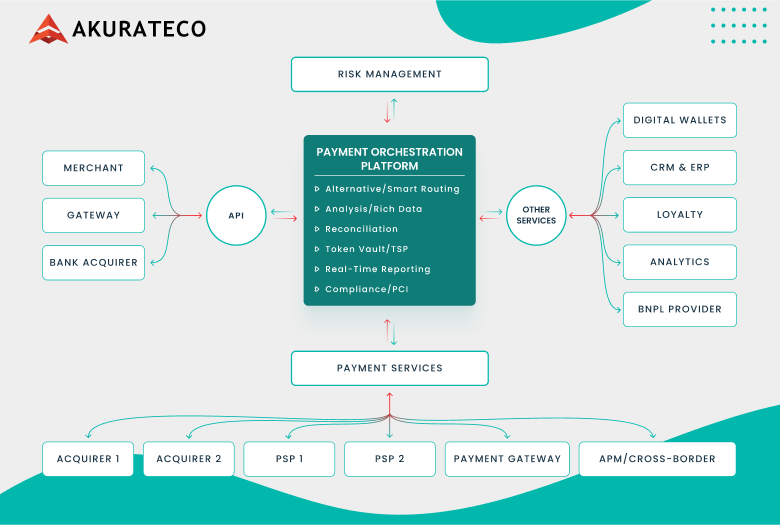
In practice, an acquiring bank can keep its banking payment hub for account-to-account processing and clearing and run Akurateco alongside it for card acceptance, acquirer connectivity, routing, and payment orchestration, as described on Akurateco’s page for banks and acquirers. For the bank, this means the card side can be modernized without replacing the account-to-account hub.
For PSPs and acquiring banks, Akurateco can also support a white-label payment hub model with a branded control plane.
For on-premises deployments, clients need their own PCI DSS certification, and Akurateco can assist with documentation and instructions for the QSA. Note that PCI DSS should be treated as a shared responsibility, not as a burden that disappears automatically.
Akurateco does not clear ACH, wire, or instant payments, and it does not process transactions itself: it provides the gateway and orchestration layer on top of acquirers for card and alternative payment acceptance.
Choosing the Right Payment Hub Model
The payment hub market ranges from global technology providers capable of supporting large parts of a bank’s technology estate to specialized companies solving a specific infrastructure problem.
The first decision is therefore not simply which vendor has the longest feature list. Banks should define how much of the technology stack they want one provider to own, which payment systems need to change, and which existing components should remain in place.
For acquiring banks and PSPs, that can also mean combining the two models: maintaining dedicated banking infrastructure for account-to-account rails while using a specialized platform such as Akurateco for acquirer connectivity, card acceptance, and multi-provider payment management.
FAQ
What is a Payment Hub?
A payment hub is an intermediate software layer that enables a bank to process payments across various rails through shared functionality such as validation, enrichment, processing, and routing. Depending on the specific solution, it may cover ACH, wire transfers, instant payments, RTGS, and cross-border networks such as SWIFT.
What does a Payment Hub do?
A payment hub receives the payment instruction, validates and enriches it, applies processing and routing logic, and sends the instruction to the corresponding clearing or settlement system. It may also handle exceptions, status updates, reporting, and audit, and integrate with fraud, compliance, and liquidity management solutions.
Who are the Leading Payment Hub Providers in the Financial Institution Market?
Leading vendors in this space include major financial technology providers (Finastra, ACI Worldwide, FIS, Fiserv), broader banking platforms (Temenos, Infosys Finacle), and specialized payment infrastructure providers (Volante Technologies, Alacriti, Form3). These vendors vary significantly in their coverage, so they should be compared against the institution’s architecture rather than viewed as interchangeable products.
What Is the Difference Between a Payment Hub and a Payment Gateway?
A bank’s payment hub mostly handles account-to-account transactions over rails such as ACH, wires, instant payments, and cross-border networks. A payment gateway sits closer to payment acceptance: it connects merchants or PSPs to acquirers and payment methods. An institution can therefore run both in its technology stack at the same time.
What Are the Most Secure Payment Hubs for Banks?
Security is better assessed against the institution’s own requirements than through a universal vendor rating. Key considerations are access management, approval processes, audit logs, anti-fraud and AML capabilities, sanctions screening, encryption, resilience, data jurisdiction, and certifications.