

- What Akurateco Does
- Building a Remote Payment Technology Company
- The Founder Journey behind Akurateco
- Why the Payment Industry Needed Akurateco
- Launching a Payment Company during the Pandemic
- How the Pandemic Changed Payment Behavior
- The Global Evolution of Payments
- The Role of AI in Payment Technology
- Making Payments Seamless for Customers
- The Complexity behind Simple Payment Experiences
- Reducing Time to Market for New Payment Features
- Inside the Akurateco Platform
- Customer Success in Central Asia
- Customer Success in Qatar
- Why the UK Is a Key Market for Akurateco
- Network Tokenization and the Future of UK Payments
- Who Should Work with Akurateco
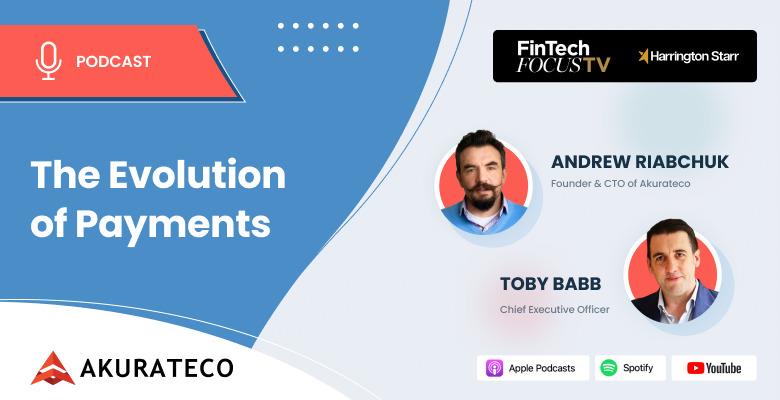
On 30 August, 2024, Andrew Riabchuk, Founder of Akurateco, joined Toby Babb on an episode of FinTech Focus TV to discuss Akurateco’s journey, the evolution of payment orchestration, and the broader changes shaping the fintech industry.
In this conversation, Andrew shares insights into how Akurateco is helping businesses build more flexible payment infrastructures, why orchestration is becoming increasingly important, and what today’s fintech landscape means for companies, professionals, and future talent.
Podcast source: https://www.harringtonstarr.com/resources/podcast/the-evolution-of-payments/
Video: https://www.youtube.com/watch?v=ttTuBHpIqhk
Read the full conversation below.
What Akurateco Does
Andrew: Sure. So, I’m Andrew Riabchuk, originally Ukrainian, and I’m a proud founder and CTO of Akurateco.
Akurateco is more than just a company. It’s a solution to complex problems in the payment industry. We specialize in payment orchestration, and the majority of our customers are payment providers, banks, and fintechs. That makes us different from others in the payment orchestration market.
Our mission is to make payment processing as simple as possible so our clients can focus on what they do best: growing their business, engaging with customers, and driving sales. We take the complexity out of payments so they can concentrate solely on their passion and their business.
All the technical things are outsourced to us, and we try to solve them as fast as we can, and most probably faster than they could as well.
Host: This outsourcing thing is interesting as well. As you said beforehand, you’re in Alicante at the moment, but originally from Kyiv. Tell me how the business is shaped. Are you based down there in Spain? Are you completely remote and fully remote across Europe? What’s the setup of the organization?
Building a Remote Payment Technology Company
Andrew: Well, I was not in Spain all the time, let’s say. I completely moved to Spain only four years ago. But I have more than 20 years of experience in payments, and my co-founders are also Ukrainian. Together, we have something close to 50 years of cumulative experience.
All of us have worked at different periods of time in the same companies. Most of them were also founded by me. It’s not actually my first business. The majority of them are payment service providers, either local ones in Ukraine or also in Europe.
Before COVID, we normally worked in the office. But since COVID, we, like many other companies, including Akurateco, switched to being fully remote. So far, let’s say that COVID was quite a good lesson for us in learning how to work fully remotely.
Currently, in Akurateco, we have a team that is spread, if I’m not mistaken, across 16 countries. Of course, the majority of those countries are mainly located in Europe, but still, it is fully remote.
Nevertheless, we have operational offices. We have an operational office in the Netherlands and in Portugal. So, if someone wants to work in office mode, they have that option. But for me, it’s not a problem at all to work fully remotely.
Actually, I’m still traveling a lot, and I meet people and my colleagues at different events, offices, and so on.
Host: And you say this isn’t your first time as an entrepreneur and founder. What prompted you to say that this is the right business to be starting and the right area to be moving into?
You’ve obviously been in and around the space, as you say, for 20 years. You’ve got an established founding team that has been there with you. Quite often, when people start businesses, they go down different pathways and go again.
I love those serial entrepreneurs who are there, fixing problems and utilizing all the lessons from the previous games they’ve played and the businesses they’ve run, etc. What was the real catalyst for you to say, “We need to go again. Akurateco is the vehicle. This is the problem we’ve got to solve”?
The Founder Journey behind Akurateco
Andrew: First of all, all my previous businesses, and actually, they are currently still up and running, are related to payments. So, I was never outside the payment sector. They have somehow always been related to this area.
Because of that, I was able to track the changes in the payment industry. The payment industry has undergone a tremendous transformation recently. The complexity of payment matters nowadays is not comparable to how it was 20 years ago.
Payments are now seamlessly integrated into our everyday tech, and to do it efficiently, they should be smoother than ever. Companies from different business segments and different industries are jumping on board to offer payment solutions, not just to become payment providers, but because they realize that payments are such a significant part of their business and product creation.
They can increase their revenue when they manage payments efficiently. They can increase revenue a lot.
Why the Payment Industry Needed Akurateco
Andrew: So, with that, most international merchants that work in different markets have to work with multiple payment providers. This means that all of them need to somehow consolidate those payment providers, connect them to accounting software, and connect them to other parts of their infrastructure.
To do all that, they actually need software and expertise. Sometimes they don’t have time, and sometimes they have neither the expertise, nor the software, nor the time. But they need to decrease the time to market for new products and consolidate those payments faster.
So, I identified about four years ago that there was a huge need in the market for such a technological solution. That is how Akurateco was born.
Based on our expertise and experience in payments, and also having some platforms before, Akurateco was actually based on technology that is the third generation of the payment platform.
We had the first and second generations being used for the internal needs of other companies I mentioned earlier. So, we understood that we had almost everything to dedicate it as a business, purely technological, with no limits such as licensing issues or any other regulatory issues.
Akurateco is a purely technological company. We are not touching the money. We are providing only technology. That is why we created Akurateco. We are happy about that, and I hope our clients are as well.
Host: I’m sure they are. I’m sure they are. And when did you launch the business?
Andrew: The first client transaction was in March 2020, actually.
Launching a Payment Company during the Pandemic
Host: 2020. Okay, wow. So, right as the pandemic was happening.
I’m always fascinated by this. We launched the show in earnest around the same sort of time. We’d done various incarnations of FinTech Focus TV beforehand, but never in quite the same way.
Ever since then, we’ve had a show every single week, at least since launching at that time. During the pandemic, the idea was to show the innovation and resilience of the industry at that stage and help people spread their message and spread the word a little bit.
But what I loved about that time was speaking to people who had done what you were doing, which was launching during an unprecedented period. You had all this planning, you had moved into something, and then the world changed immediately.
I think there are some stunning stories about businesses that had this plan and vision of how everything was going to run, and then the world changed almost instantaneously. For some of them, that changed perfectly for them. They were able to innovate and use that, and their products helped in that situation.
Payments obviously changed a fair amount during that time as well. If you look at pre-2020 and where payments were going, there was an evolution, of course. But I think everyone pays in a completely different way now compared to where they did before.
I think about cash, for example, pre-pandemic. To me, it was the death knell of cash during that period, and that’s where payments really took off.
Did you find that in your world? Was the pandemic an accelerator for the business, or was it something that threw you off course a little bit?
How the Pandemic Changed Payment Behavior
Andrew: You know, the pandemic itself was kind of a trigger. I would not say it was something revolutionary, but rather evolutionary.
People were stuck in their houses for almost one and a half to two years. Businesses never stopped because of that. Businesses changed because much more of the current established businesses were trying to survive and were trying to concentrate more on online activities or additional online services, and so on.
All of those changes required payments to be part of them. It’s all about developing something into your current infrastructure.
So, you have one product. Maybe you were successful or not successful before the pandemic. During the pandemic, you identify the problem. You understand how to solve it. You understand that you have to implement payments into that process.
Then you understand that it’s not as simple as just adding credit cards from one payment provider or just putting Stripe on it. You have to do it with Stripe in one country and a different provider in another country. You have to add cascading, vaulting, and some other criteria.
Then you understand that you are lacking something. You don’t have the technology for that. Then you start to understand how you can achieve it. Should I build it in-house? Should I rent it from someone? Should I switch from one provider to another payment provider?
And then you understand that none of those providers can offer you the full variety of services you expect.
So, yes, of course, it was a trigger for us. It was also a good time to do our homework and concentrate on putting together all those features and technologies that we had previously seen and identified as valuable and important for our customers.
So, the simple answer is that the pandemic was quite important for many businesses, including payment orchestration.
Host: Yeah, absolutely. You mentioned the evolution of the industry. You mentioned how it has grown and developed in what you’ve just been saying.
I’m interested to find out more about how you see payments at the moment globally, where the opportunities are, and what’s happening in the marketplace.
The Global Evolution of Payments
Andrew: Payments, like every vertical, every business, and every industry, depend on the most recent technologies and revolutionary things, like AI.
Of course, if we talk about payments, there are very regular, simple things that always have to be well developed, like adding new payment integrations. Because business is going global and becoming more international.
To fulfill the expectations of customers, you have to provide them with their desired payment methods, in their local currency, and in the way they are used to buying. So, increasing the number of payment integrations is important.
Adding features like anti-fraud, KYC, KYB, and collecting documents is also important.
The Role of AI in Payment Technology
Andrew: But what I’m trying to say is that I probably would not be wrong if I said that AI, over the last one and a half years, has been one of the most interesting topics to discuss, and the payment business is no exception.
So, implementing AI into payments is very important and very crucial on different levels. It can be used for anti-fraud, for example, to identify potentially fraudulent transactions. But also for making analysis for new features and even for creating code, actually, because that’s what we do in Akurateco.
For the last one and a half years, we have been massively using AI, and we even have some parts of our functionality that were developed with the help of AI.
Making Payments Seamless for Customers
Andrew: Payments themselves are developing, on the one hand, to become more seamless for customers, like mobile wallets, Google Pay, Apple Pay, and so on. It is all about decreasing the effort required from the customer to pay.
If you look at it historically, first, there were credit cards with a swipe of the magnetic stripe. Then came the chip, the EMV chip, where you entered your PIN code. Then came NFC, where you would use your card and just tap it on the POS terminal. Then it came to the phone, so you could pay with your phone. Now you can use any device, like a watch or whatever, to pay.
So, it’s just about decreasing the effort and time needed for the payment to be made from the very beginning to the end. All payments, at the end of the day, are trying to make the customer experience more seamless.
But on the back side, it becomes more complex every time. Because when something is easy to use, it is more complex to deliver.
The Complexity behind Simple Payment Experiences
Host: Yeah. I think that’s so important to say, isn’t it? I hadn’t really thought about it like that, but it makes absolute sense.
There is a huge focus on customer experience. I always say that this piece of machinery has made us so expectant in the modern world about how easy everything should be for us. We’re aghast when something requires anything more than two steps of friction in a process.
But I think the complexity required to make that happen is often underestimated. Those businesses that are able to fight through that complexity and create complex solutions to enable an easy customer experience are such an important part of it.
Payments are exactly that kind of area that makes everything so much easier.
Reducing Time to Market for New Payment Features
Andrew: Exactly. And to fulfill this, the time to market for a new feature is also decreasing.
If you spent half a year, let’s say 10 years ago, implementing a new feature, it was quite okay. But now it’s not okay. You have to do it in one week, two weeks, or three weeks.
You should be ready to launch it in multiple markets and in multiple environments. So, yes, it’s like that.
Host: Absolutely. So, talk to us about your business.
You mentioned a couple of things at the start of the show about what makes you stand out and what makes you original and unique within the space. Talk to us about the specifics. Talk to us about the features you’ve got.
Then I’d love to hear a little bit about the success stories, where you’ve worked with customers, how they’ve used the platform, and how they’ve benefited from everything you were doing at the same time.
Inside the Akurateco Platform
Andrew: Okay. So, as I said, at Akurateco, we specialize in payment orchestration, in particular for fintech businesses, payment service providers, both greenfield and more mature ones, banks, and other fintechs.
But not only them. Also telecom providers that would like to step into the fintech space, because they have a more or less similar clientele.
We offer a full white-label orchestration platform that supports a wide array of payment methods. Currently, we have 350+ payment methods on board: bank cards, Visa, Mastercard, mobile wallets like Google Pay and Apple Pay, cryptocurrencies, and so on. (Editor’s note: Since this episode was recorded, Akurateco’s ecosystem has expanded from 350+ payment methods to 700+ connectors.)
We even have our own proprietary crypto payment method, crypto-to-crypto, as well as other types of payments and alternative payment methods, like direct carrier billing, all types of wallets, loyalty cards, and so on.
The platform itself also includes advanced embedded features, like fraud prevention, tokenization, reconciliation, and all types of reconciliation, including technical reconciliation and financial reconciliation.
We really have a lot of features because a demo of the platform takes one and a half to two hours just to give a brief overview of all the features we have.
We are trying to develop those features in the direction we discussed in the previous question: the direction in which the payment business is growing. Based on the requirements of our customers and the strategic directions we identify, we always add those features to the platform.
The list of features we have is not limited, and it is growing from one day to another.
As I said, we are providing unified and optimized payment performance, helping businesses concentrate on what they do better: their product, sales, and clients, rather than payments.
Customer Success in Central Asia
Host: It’s fascinating, isn’t it? There are so many layers within that. Having a business that can help people focus on doing the things they are good at makes it important.
So, if you go into specifics and some of those direct success stories, where can you show us some of the direct use cases and where you’ve been able to help?
Andrew: Since we are white-label, we always respect our clients.
Host: Of course. Yeah.
Andrew: Sometimes we cannot disclose names, but I will give you some examples of anonymized success stories.
One of our clients is the largest telecom provider in Central Asia, in particular in Kazakhstan. They already had a large client base as a telecom provider.
Then they identified that they could generate an additional revenue stream based on the same customers by offering them more fintech solutions, like a mobile wallet with the ability to handle payments and offer payment processing services to their customers.
They obtained a license from Visa and Mastercard, so they became a principal member of Visa and Mastercard. It basically means that they are not only a telecom provider, but also a bank. It’s a kind of combination.
Their goal was to gain more control over all their payment offerings and reduce costs when working with their current financial partners, like banks that help them build acquiring channels.
Thanks to Akurateco, they launched this process because we provided them with full connectivity to all those current providers, and not only for pay-ins, but also for pay-out payment methods, implemented into the current infrastructure of the telecom company.
With the help of that, they can actually see a significant increase in transaction volumes. It works quite well for them. We see that they started with a couple of hundred thousand transactions per month, and currently, it is millions.
Host: Wow. So, clearly, value added to them.
Customer Success in Qatar
Andrew: Yes. Another great story is from Qatar.
Actually, it is also related to telecom, but one of our customers is a payment provider, one of the biggest in Qatar, certified by the Qatar Central Bank.
By relying on Akurateco’s technology, they focus on their main business, as I said earlier: sales, marketing, and clients. We are actually the technical backbone for them. We do all the technical work.
With the help of our platform, they also got certified by the Central Bank. Certification has two parts: financial obligations and requirements, but also technical ones.
Using our platform, they were able to go through this certification and obtain all the required certifications. It is growing quite fast as well, because their client is the biggest telecom in Qatar, and not only in Qatar, but in different countries too.
Host: It’s fascinating how all of these pieces of the jigsaw come together, isn’t it, to create this opportunity?
I love the foresight of being able to look at that and say, “This is how we can help, this is where the problem is, and this is how we can come through.” It’s very interesting.
You mentioned Qatar there. We know you’re based across Europe as a team and organization, but you’re also seeing a significant amount of movement in the UK market, where 50% of your current client base is at the moment.
I know you see big potential in the UK marketplace. Tell us a little bit about why and what you’re seeing there.
Why the UK Is a Key Market for Akurateco
Andrew: Before Brexit, the UK was by far the biggest financial center in Europe. Nowadays, it is still there, but there have been some changes because of Brexit and regulatory changes, first of all.
I would not spend too much time focusing on this fact, but still, the UK is quite an important market because a lot of companies that specialize in payments, such as payment institutions and financial institutions, are registered and located in the UK.
So, it is already a mature market for financial companies. It is not a big surprise that, as we are targeting payment service providers, a significant part of them are registered in the UK.
Not all of them work solely in the UK market, but they are registered in the UK market. At least some parts of their businesses are somehow focused on the UK market.
Compared with other countries in Europe, I would say it is a much more developed market for these types of financial institutions, credit companies, processing companies, and neobanks.
All of us know that one of the biggest neobanks, Revolut, is from the UK. Other players are also quite significant in London.
Host: It received a banking license today, at the time of filming, didn’t it?
Andrew: Yes, we’ll see. That is why the UK has always been very interesting for us. We see that it is developing from the technological side as well.
Network Tokenization and the Future of UK Payments
Andrew: Recently, we participated in London Tech Week. We were invited by Mastercard to a roundtable where the biggest merchants and players from the financial market discussed a recent feature: network tokenization, which is currently quite a hot topic.
Using network tokenization could really help businesses better structure their payment flows and increase user experience, as we said earlier, even more.
So, again, a few facts: it is a well-developed market, a lot of companies are registered there, and all the big players are already there. That is why it is interesting.
Host: Yeah, I agree. I’ve long been passionate about the UK and London-specific fintech scene and have embedded ourselves in the business over the years.
I think you said some interesting things there at the start. Obviously, we’ve got some challenges. Brexit hasn’t helped in many different ways. We’ve had some political challenges over recent years, and obviously, regulation has continuously evolved within that.
But I also think it’s a resilient fintech capital and has proven that over time. It has had innovation and opportunity here for years and years, and businesses are tapping into it. I’m really passionate about helping with that.
I think London Tech Week is a classic example of where people are coming together from all around Europe and recognizing the opportunities within it, for all the reasons you’ve just mentioned.
So, Andrew, it has been fascinating talking to you about Akurateco. I love those founder stories and hearing the journey and the pathway that everyone has been on.
Wrap up by telling us who should be reaching out to you. Who can you help? Who should specifically be finding out how Akurateco can help them in their business, and what is the best way for them to get in touch with you?
Who Should Work with Akurateco
Andrew: Thank you. Akurateco’s main segment of clients, as I said, is financial companies.
If you are a financial company, if you are a payment service provider, and if you are greenfield, of course, it is much easier and faster for you to rent the team, the software, and the expertise than to build it in-house.
For more mature ones, sometimes you are probably working on legacy software and you have a lack of time and resources to develop new features. Sometimes you have technological bottlenecks when adding those new features to your current platform.
With the help of Akurateco, you can make gateway extensions, as we call them, and connect one platform to another to get immediate access to all the features we have and increase value for your customers. (Editor’s note: For a closer look at the model Andrew describes, here is how PSPs add new capabilities on top of an existing platform.)
For banks, sometimes even bigger banks, they are quite bureaucratic organizations. They understand that they have to provide their customers with the most recent features. Even if they identify those features, they don’t have the resources or a dedicated team for that.
More and more often, we see interest from banks in tenders for such white-label solutions as ours. So, for them, obviously, Akurateco’s services could be interesting.
Another example, as I said earlier, is telecom providers or any other enterprise-level merchants that are at the stage where they understand and are ready to implement payment solutions into their current infrastructure.
But as they are merchants and their business is different, they sometimes don’t understand where to start. For them, Akurateco can help solve this problem and find a place in their infrastructure where our services and features can fit.
All of the mentioned categories, but not only them, could definitely be interested in our services.
You are more than welcome. At Akurateco, we are always ready to make an internal check of your payment infrastructure and provide consultancy absolutely for free, and probably find the right fit for our future collaboration.
Or, if not collaboration, we can just advise you on something, and probably advise you to come back to us at the next stage.
Host: Fantastic. Well, Andrew, listen, it has been fantastic to hear a little bit more about the business. I’m sure there will be some people wanting to reach out and find out a little bit more.
Thanks very much for coming on the show. I wish you the very best of luck.
Andrew: Thank you very much. And thank you to everyone who was with us today.
Host: I echo that. Thank you all for watching. We’ll see you soon on the next episode of FinTech Focus TV. Thanks a lot.
Andrew: Thank you. Have a great day.