

- Alexandra’s Early Path into Payments
- Why Payments Become a Never-Ending Learning Journey
- Mentorship, Knowledge Sharing, and Leadership Foundations
- First Leadership Experience and the Cost of Always Solving Everything
- Imposter Syndrome, Growth, and Becoming a Stronger Leader
- The Origins of Akurateco and the Market Opportunity During COVID
- Scaling Customer Support Through Education and Payment Expertise
- Finding a Niche in Payment Orchestration and White-Label Software
- Akurateco’s Product Focus and the Future of Local Payment Methods
- Returning from Maternity Leave and Redefining Balance
- Personal Goals: Empowering Teams and Building Confident Decision-Makers
- Final Advice to Alexandra’s Younger Self
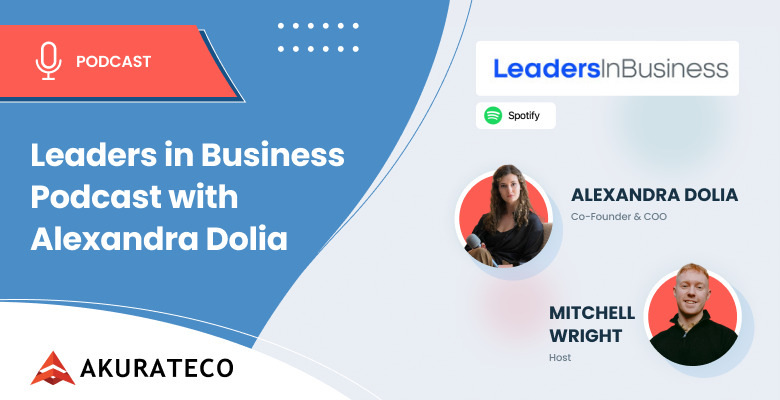
On 22 April 2026, Alexandra Dolia, Co-founder and Chief Operations Officer at Akurateco, joined the Leaders in Business Podcast and talked with Mitchell Wright about her journey into the payments industry, the leadership lessons that shaped her career, and the story behind Akurateco’s growth. The conversation covers how Akurateco built its approach around customer support, payment expertise, and long-term partnership with clients, as well as Alexandra’s personal experience of redefining leadership after returning from maternity leave.
Podcast source: https://open.spotify.com/episode/6j5vlKQZtw3NYOTadvCKwE?si=dSLqgea2TPmWOOcuMToPWw&nd=1&dlsi=4731b3bd6d5148a6
Find the full conversation below.
Alexandra’s Early Path into Payments
Host: Hello, and welcome back to another episode of the Leaders in Business Podcast. Just before we get started, I want to say a big thank you for the really great reception we had on our last episode with Rich Bracken, an executive coach across the financial services industry. It was a brilliant episode, and if anyone has not managed to listen to it yet, go and check it out.
I’ll have it linked in the description below. As always with the show, any shares, reposts, likes, and comments are all super appreciated. So big thanks to everyone for supporting the show. Without further ado, I do not want to waste any more time, and I want to introduce today’s guest. We have been speaking back and forth for what feels like a good couple of months now, but we finally found some time, and I’m looking forward to getting into it.
So this week, we are joined by an executive-level operator in the payment space with over 13 years of experience, and the current Chief Operations Officer at Akurateco, Alexandra Dolia. Alexandra, how are you?
Alexandra: I’m good, thank you. Thank you, Mitchell, for having me here today. I’m a little nervous since this is my very first podcast ever, but I will still try to share my experience in the most engaging way, and I hope that listeners will get some valuable insights from my experience.
Host: Perfect. Well, Alexandra, please do not be nervous. You have nothing to be worried about. I think we have a really good format and some good topics to get into for the show. So, Alexandra, if you could just give the people listening a bit of a long story short, introduce yourself, and let them know who we are speaking with today, that would be brilliant.
Alexandra: Yes, so I’m the Co-founder and Chief Operations Officer at Akurateco. Akurateco is a white-label payment software vendor that powers PSPs, acquiring banks, and enterprise-level merchants with a scalable and secure infrastructure. We have been doing this since 2020.
We are quite a young company, I would say, but still, we are doing a very good job. I hope that today I can share something about what we do, about our approach to work, and also about my personal experience in payments, which is already more than a decade.
Host: It’s crazy, isn’t it, how quickly time flies? But 100%, we are definitely going to dig into everything with Akurateco because I think even the way that you and I initially connected, and how I connected with the Akurateco team, was from seeing a lot of the marketing, advertising, and posts across LinkedIn. You guys have fantastic visibility.
So yes, I’m very excited to dig into it all. But I want to start a little bit earlier in your own personal journey and kind of follow through to see how we got to this point. So, from your perspective, Alexandra, tell me about growing up and what you wanted to do, because I do not think anyone grows up thinking, “I want to be in the payments world.” It is not usually a dream for most young kids. So give us the early career story, whether you were in college or university, how you got into the world of payments, and some of that early story.
Alexandra: Exactly. So I would start with the fact that I have always been quite independent. When I was 15, I went to the U.S. for one year as an exchange student, and that experience did shape me as a person, not only by improving my language but also by changing my entire worldview. Being a teenager very far from home, in a different part of the world, in a different culture, and having to make decisions on your own really makes you grow very fast. When I came back home, I had already realized that I wanted to build my own path and be independent.
After graduating from school, I chose to study marketing, despite the fact that my parents actually encouraged me to pursue linguistics because I was good with languages. But I had a very good friend who worked in marketing back then, and he told me that very good professionals in this field are rare. I decided that I wanted to be a good professional in marketing.
So I enrolled in a university that my parents had not even considered for me. However, during my studies, I started to realize that marketing was not really something I truly enjoyed doing. In fact, I was more drawn to finance and banking. Looking back right now, that kind of makes sense because my family has a background in finance, and probably this is something that is part of my DNA.
I started working from the very first year of university. I did different part-time jobs, like waitressing, translating, and different administrative roles.
During the third year of my studies, I decided to find something more stable, but at the same time, something that would allow me to combine my studies and work. This is actually how I ended up at Portmone.com, which is a Ukrainian local PSP, quite a big one, and one of the very first ones in Ukraine.
This happened quite accidentally because I was choosing between different companies that were offering contact center jobs, and they offered me a position on the afternoon shift, which was exactly what I was looking for. But I decided to stay at Portmone because of how I felt during the interview. I really liked the people there.
Back then, I did not know that online card payments even existed. I did not know what fintech was. But from the very beginning in this company, I was surrounded by great professionals who were very open in sharing knowledge. That was something unique, something I had never experienced before. They did not gatekeep this knowledge or make it some kind of secret expertise. They would openly invest in empowering people and investing in other people’s knowledge.
I started to become very interested in the mechanics behind payments, not just answering customer questions like why a transaction was not successful, but actually understanding the reasons and how these systems work, how they interact with each other, and how banks and merchants are connected.
This curiosity, combined with a lot of responsibility because I was working late and, in most cases, I was alone on the shift and had to solve problems on my own, helped me grow very fast and improve my skills in payments quickly. Quite soon, I was offered a new B2B position, working directly with banks and managing integrations.
So this is actually how I started in payments accidentally. But once I was there, I realized that this was something I wanted to do.
Why Payments Become a Never-Ending Learning Journey
Host: There is so much to unpack there. Just as a starter, it is probably my favorite thing about working within payments from a recruitment perspective as well. From the outside, everyone in the world uses payments in some form every second of the day, but when you really delve into it, the vastness of payments, and as you said, rails, embedded finance, card payments, digital wallets — there is such a vast amount of information that when you really start thinking about it, it is so interesting and almost never-ending.
So I can understand that. I speak to a lot of payments experts on the show, and people all have a very similar story where they first got into payments and then just kept going with it because it is such a never-ending cycle.
One question I will ask you quickly: you went over to the U.S. for a year when you were 15. Whereabouts in the States did you go for that year?
Alexandra: Tennessee.
Host: Tennessee, wow. And how was that experience for a year?
Alexandra: It was great, actually. I really enjoyed it, and I really loved my host family, where I stayed. We still have a very friendly and good relationship. Being there, seeing the world at such a young age, being independent, seeing a different culture, and even having some kind of culture shock really changed my life completely.
Mentorship, Knowledge Sharing, and Leadership Foundations
Host: Yes, Nashville is at the top of my list to hopefully visit at some point soon, so I’m sure that was amazing. Something else you mentioned from your time at Portmone was how open people were with information and how willing they were to share it. From an early and initial time in your career, being able to soak up a lot of information is so vital to your early development as you are starting in a new industry and moving out from marketing.
Is that something that you keep in mind now? Obviously, you have a lot more leadership responsibilities now than I imagine you have probably ever had as a Chief Operations Officer and a co-founder of your own business. How have those early lessons taught you that you have always got to put time into younger members of staff and share ideas and insights? How do you still keep that in mind now?
Alexandra: The approach that I received from other people and from my mentors back then did shape my leadership style and actually made me the professional that I am right now. Before Akurateco happened in my life, I had worked at three companies, and each contributed to my growth.
The first two companies built the foundation in payments, including my expertise and my confidence in the field, and the third one built me as a leader. But still, the very first company, Portmone, probably had the biggest influence because of how people contributed to me.
I would even name the person who contributed the most to me. It was the founder of Portmone and the ex-CEO, Igor Gorin. He was the person to whom you could ask any question, and he would always answer you. He would not ask you back, “Why do you need this?” He would always give you an example. He would explain in detail how things worked.
I thought that this is how a leader should behave. This is actually what I am doing right now at Akurateco as well, and also in my other roles and positions that I have had. I try to educate people. I try to invest in their expertise, and I think that this is very important.
It is important to remove this black-box effect in fintech because the more people know and the more they understand about how payments work and how these systems interact with each other, the better they do their job, the better they communicate with clients, the better they sell, and the better features they develop on the platform.
I am convinced that it is very important to understand how payments work, not only for people who work directly with customers, like sales managers, account managers, or technical support agents. This is also very important for everyone who is contributing to the growth of a company in payments.
Host: Yes, and I think that is something we see from our perspective. Let’s say sales, commercial, or go-to-market: it is easy for someone to think that sales is sales, and if I can sell one item or one product, I can do the same in a different industry. I think payments is slightly different in that respect because the domain knowledge, in particular, is so important to your customer base, your clients, and your understanding, so you can really get into detail on it.
I do think that is slightly different in payments compared to maybe some other industries. So from your perspective then, when you were at Portmone, was that your first taste of leadership there, or were you still more of an individual contributor at that company?
First Leadership Experience and the Cost of Always Solving Everything
Alexandra: The very first taste of leadership was unexpected for me. When I left Portmone and joined a PSP that worked globally, I thought that I was stepping into a typical account management role, something that I had been doing before. But in fact, when I started in this company, I realized that I had a team reporting to me, and I was not prepared for that at all.
Back then, I was 24. I was the youngest in the company, and my team was in their 30s and mostly men. I did not even know how to position myself back then.
My initial instinct was that I needed to become the most knowledgeable person in the room. From my perspective and from how I understood leadership back then, a leader was someone who knew the most, understood the most, and could solve any problem.
So this is where I started. I decided that I needed to know the most, and I needed to invest more time and more effort into building my expertise. Back then, it probably took around six months for me to dive into all the details since I was moving from a local PSP to a global PSP with different regulatory and legal frameworks.
Eventually, whenever there was a problem, I would be the very first person to jump in and solve it. That approach worked back then. I was completely and always available 24/7, always solving problems, but eventually, this led to burnout.
I started to feel very tired and very frustrated. I decided to leave for a different company and a different position, a founding position, actually, where I had the task of building a whole new PSP from scratch. That was the turning point for me. This is where I started to read more about different leadership styles and think about my own experience. I understood that when a team performs well when I am there, but does not perform well when I am absent, that is a sign of poor leadership.
The definition of a strong leader changed for me back then. I wanted my team to be very strong when I was there, but still very strong when I was not there. That meant that I needed to invest more time in building processes, empowering people, and creating a system that does not depend on one person.
So leadership did not come naturally to me at all, and I had to study it, sometimes through mistakes and sometimes through difficult experiences.
Host: Yes, and it is so interesting to hear that because I think that is the thing with leadership, and what probably explains it best, at least to me, is that it is such a conflicting journey depending on your environment, the people you are working with, the people above you, and the people who are reporting to you. There are so many different personalities, styles, ways of working, and pressures that people will have externally or within work.
So it is never just, “This is how to be a good leader,” because it is not as simple as that. There are so many external factors. I remember my first management responsibilities and my first taste of leadership. I was also managing someone who was a good few years older than me, and I almost had that sense of imposter syndrome, which I am sure you probably experienced in those first six months, where it was a team of older guys, and you were there as a young 24-year-old woman thinking, “Should I really be the person doing this?”
All while trying to upskill yourself from a local to a global level. There is so much to take into account there. During those first six months, while you were still there and taking on this management for the first time, did you have many moments where you thought, “I can’t be doing this. This shouldn’t be me”? How did you deal with those first six months? I know you said it led to some burnout, but what was that experience like?
Imposter Syndrome, Growth, and Becoming a Stronger Leader
Alexandra: It was difficult. You know, for a woman, it can also be challenging to be heard and to be promoted. You have to always win battles. You have to always prove yourself, not only to people around you but also to yourself.
Because yes, I did feel that I was too young. I was not meant to be there. I did not expect that I would have a team reporting to me. Probably, even if I had known that I would be responsible for a full team, I would not have gone for this position because I did not expect it.
But still, these kinds of processes always create space for growth. Of course, this can be difficult. Growth is always difficult. But once you overcome it, you grow very fast, especially when you can reflect on your experience and the mistakes that you made and make decisions based on those mistakes.
Host: Yes, and this is a question I want to ask you, and it is something I have asked a couple of different guests: do you think anyone can become a leader and a good leader, or does it take a certain type of person and a specific type of characteristics and skill set?
Alexandra: That is kind of a difficult question, to be honest. I still do not have a proper answer for that. From what I see, there are people who want to become leaders and people who do not want to become leaders.
My personal mistake was that I was trying to promote people who were great and very good in payments, with great knowledge, but who were not ready to become leaders and were not ready to lead and be responsible for others. That is also something that you, as a leader, always have to consider because you cannot promote someone who is not ready to lead.
The people who are ready to lead, in most cases, yes, they can become good leaders. There can be different leadership styles. They will probably make mistakes from the very beginning. But I also saw people who were natural leaders, born leaders. They understand how to give tasks, how to contribute, and how to encourage other people. Others have to learn it, sometimes in easy ways and sometimes in hard ways.
The easy ways are that you can go to different trainings, you can see people who you admire and take on parts of their leadership styles, or you can make your own mistakes and learn from them.
Host: I think that is always what is so tricky, right? Everyone makes mistakes, but it is the people who can reflect on those mistakes so they do not happen again, compared to maybe other people who disregard them, point blame elsewhere, and just continue trying to move on.
You have to be able to slow down, take a step back, analyze everything that is going on around you, and really be able to pinpoint and find out what has gone wrong.
Okay, I want to fast forward a little bit then to the start of the Akurateco journey. So, October 2020. First off, how was this around COVID and coronavirus, starting a business in that kind of time frame? Was that a decision that came pretty quickly? Give me the backstory and the origins of Akurateco.
The Origins of Akurateco and the Market Opportunity During COVID
Alexandra: Akurateco was initially part of a PSP, like the technical department of a payment service provider. When COVID started, there was a boom in payments. You can understand why. The world was closed, cash was not needed, people were not interested in cash, and payments were booming.
In many countries, especially in the MENA region, for example, regulations were becoming less strict, and a lot of companies were looking to launch payments immediately, at that very moment.
We already had the idea. We had been discussing this idea since 2016. Back then, there were companies on the market with very strong technical platforms and great products. But in 2020, we understood that this was a great time to start because there was a big demand for payments. Payments were growing, there was demand, and we had to take this chance.
Since we were going to a market where there were already some very strong players, we understood that we could not compete on the product side immediately. There were competitors that were stronger. But what was lacking in the market back then was responsive customer support.
People who were launching payments were not always very strong technically. They were very strong in business. So we made our go-to-market strategy about being exceptional in customer support. We positioned ourselves as the technical department of our customer: you do business, we do tech.
This is how we actually started, and this gave us very good feedback from the market. We still have customers from back then who have been working with us for five years already and are very happy with the level of our customer support and how we work with them, not just as vendors but also as their partners.
Host: Yes, and it is such a good angle to come in at. You are totally right. Coming out of coronavirus and COVID-19, even saying COVID-19 sounds like such a long time ago, like a different lifetime. But being able to understand the market and see that shift and pivot to where something was lacking, and where you could take advantage during that boom, is such brilliant thinking and such a good way of operating.
How do you hold those standards now? Five, almost six years on, how do you hold those same standards of amazing customer support and being that one extra rep better than the rest of the competition on the market? Is it from within the culture of the business, the kind of people you hire? How do you retain such strong customer support?
Scaling Customer Support Through Education and Payment Expertise
Alexandra: You know, a lot of times I have heard from potential investors or from other companies that you cannot scale support. I would disagree here. There is no immediate scaling, but it is about the structure and the level of knowledge of the people who are working with you.
For account management and technical support positions, we hired people at the entry level and invested a lot in educating them. This is actually something that I really care about at Akurateco and that I take personal responsibility for.
We are building courses and strong systems to educate people and explain how payments work. As you mentioned before, you cannot become a good salesperson in payments if you do not understand how this works. That is exactly the point.
We want our people, our technical support engineers and account managers who work with customers and assist customers, to be confident not only in answering questions like how to create a merchant, how to create a MID, or how to create an anti-fraud rule, but to actually understand the cases of the clients and the pain points that the client wants to solve.
So when a customer comes and says, “I want to set up anti-fraud,” our account manager’s task is to understand the exact idea and purpose of this particular anti-fraud module. Then they can probably suggest an even better way.
This is also the approach that we take in additional development. For example, customers often come to us and ask for additional development of this feature or that feature. In most cases, they expect that we will build the feature exactly the way they want it to be. But our task is not just to take money and develop the feature the way they want it to be. Our task is to provide them with a solution. They explain the business case and the idea they want to have eventually, and we provide a solution that probably does not correspond exactly with what they have described to us, but probably covers their goal even better.
For this, we have to educate people, and we have to invest in people’s knowledge. I would say that Akurateco has contributed a lot to building fintech specialists who have moved to senior positions across the industry in different companies. We have contributed a lot to the development of the fintech infrastructure as a whole.
Host: Yes, and it is such a good way of thinking because it would be so easy just to go back and build whatever was asked for, then move on and go to the next one. But I guess when you talk about that difference maker, customer support, and the retention of the clients that you keep, it is because you really immerse yourselves in their problems and provide detailed solutions that can really help them further, rather than just saying, “Here is some work back that should help for now.”
It gives such an extra element and layer to the kind of services that you provide. What I wanted to touch on as well was Akurateco. You have been there for five and a half years or so now, and obviously the starting point was during COVID when there was a big boom in the market.
How have you dealt with there being a slight drop-off in the market, if you have seen that curve coming out of coronavirus once everything settled down a little bit? How has the business evolved to keep up with the market and the industry over the past five years or so?
Finding a Niche in Payment Orchestration and White-Label Software
Alexandra: To be honest, I did not see that big drop-off. In fact, we have been growing, and I do not see any pause or delay in this growth. Why? Because it is very important in this field to find a niche and to find specialization.
Even two or three weeks ago, one of my ex-colleagues asked my opinion about them creating another payment orchestrator, another white-label company that would service clients and provide services probably similar to what we offer. She asked my opinion on whether it is worth entering the market right now since there are already a number of orchestrators out there.
I still think that there is space for everyone, but their success story will depend on whether they have specialization in a particular niche or a particular business.
It is impossible to make a white-label system that is tailored to the needs of the customer 100%. The best you can reach is 80%. This would already be a success story, reaching 80% in covering a client’s demands.
For a customer or a company that would like to manage payments, the best thing to do is to build the system on their own because they know their business best, and they can build the system that is best for them. No other vendor can cover all of their needs. But to build the system on their own takes time, money, and expertise. Sometimes, you have to make the decision to rely on an external vendor and take that system from the market. This is why it is very important to find the perfect match. You have to find the system that is tailored to your business type. If you are doing subscription-based models, go and find the system that is developed for recurring payments management and subscription management. If you are working with a marketplace, you have to find the orchestrator that has specialization and knowledge in marketplaces, and so on.
When you find this niche, when you find this segment, and you keep developing your product according to the needs of this particular segment, when you see how this segment is growing and where it is growing, and you change your product accordingly to meet the needs of this particular niche, then you will be successful. It does not matter whether there is growth or a downturn after COVID.
Host: Yes, and it is so good to hear you really focus on those words: expertise and specialization. You can clearly see that all the way through your business, it must be so important to have that early learning, education, and courses to upskill.
What are the long-term and short-term objectives for the business? If we look over the next six to 12 months, and then maybe longer-term planning over the next two, three, or four years, where do you see the business moving and evolving?
Akurateco’s Product Focus and the Future of Local Payment Methods
Alexandra: My personal goal right now at Akurateco, after I came back from maternity leave, is first to redefine our communication approach. Customer support, as I mentioned, is one of our USPs, but I still see that there are a lot of things that can be done and improved there, starting from very small operational details like checklists for integrations and finishing with the overall approach to make us even better.
Also, what is very important is that, of course, you have to have card payments at your orchestration level, but it is not the most important thing right now. Card payments will exist and will be there, but payments are becoming more and more fragmented.
Each region has its own payment methods, local payment methods that are growing very fast. PIX appeared not that long ago and is very popular right now. For each orchestrator right now, it is very important to think about the best way to provide management of these local payment methods, cascading methods, remembering the method with the best conversion, and offering the best user experience on the checkout page.
I see this as something that we have to focus on in the coming years of developing our product.
Host: Amazing. You touched slightly on your maternity leave that you have just come back from, and that is something I wanted to ask you about in some more detail. How has that been over the last year or two, managing having a young child and work as a C-suite executive? Tell me a little bit about the story from a personal perspective and finding that right balance.
Returning from Maternity Leave and Redefining Balance
Alexandra: Well, you know, this changed my life completely, of course. Everyone’s life changes with a child, but it also changed my approach to work quite significantly. I expected that things would change, but reality was still different from what I had imagined in my early life and in my early career.
I remember that when I was younger, in my 20s, I admired women who seemed to come back to work right after giving birth to a child. At that time, I thought, “Wow, I want to be that kind of person as well.”
But as I grew older, and after I invested more than a decade of my life into building my career in payments, I realized that I actually wanted to experience this side of my life as well, to experience motherhood in full. I wanted to be present for my child.
So I made a conscious decision when I got pregnant that I would give myself time both before and after childbirth. I did not set strict deadlines for myself to come back to work after having a child.
I discussed this openly with my co-founders, Vladimir and Andrew, and I am very grateful to them that they supported me. They have been an incredible support to me, and they gave me all the time that I needed.
After about six months, I started to feel that I was ready to come back, and I eventually came back to Akurateco part-time. But that transition was harder than I expected.
Before, I was fully immersed in the company’s life. You could wake me up in the middle of the night, and I would tell you precisely the details of each deal, lead, partner, company, or any company that we had been interacting with. But after I had a child, part of my brain was always thinking about my child.
To be honest, I am not ready, and I do not even want, to dedicate 100% of my mental space to work anymore. Another challenge that I met when I returned was that the company had evolved, and so had my role.
The responsibilities that I owned before were distributed between different people, which makes sense, and people grew into their roles. They were great in these roles, and there was no reason to take that back because it made no sense for the business.
I found myself in a position where my role formally existed, but in fact, I had to redefine it from scratch. That period was quite stressful. I felt a little loss of clarity and an identity crisis. I even started to think about whether I actually fit here anymore, and whether I probably needed to find something else.
But over time, I started to reflect on my strengths and my new priorities, and I started to think about what I actually enjoy doing. Step by step, I began rebuilding my role in accordance with the company’s priorities and my new priorities.
I think the key thing that I learned here is that balance is not about doing everything perfectly at the same time, but about accepting that your role might change and your priorities can shift, and you need to redesign how you contribute.
These periods of uncertainty, despite the fact that they can be very stressful at the moment, can still become the most productive ones. They give you the space to rethink, to create, and to build something new.
Host: Yes, and I think you should be incredibly proud. It is so hard to separate work and life, especially when you have had the last five or six years or so of being at Akurateco since its inception, essentially, and then having a child and being strong enough to take that time out. Coming back, it is a change in the situation and stance, but being able to think to yourself, “How can I approach this differently now? How can I redefine this role?” while also having the responsibilities of a young child to look after is incredibly inspiring. You should be totally proud of yourself for that.
As we begin to wrap this up, Alexandra, I wanted to ask you: I know we touched on some of the longer- and shorter-term goals for the business, but for you personally over the next year or two, what kind of things do you have in mind?
Personal Goals: Empowering Teams and Building Confident Decision-Makers
Alexandra: First, to think about how we work with our customers and how to become even better partners for them. Second, to continue empowering people and building these structures to educate them, give them even more knowledge, and make them confident decision-makers.
I strongly believe that a company will be successful when everyone takes care of the global result, not just their individual tasks. This means that leaders like me, Vladimir, Andrew, the founders, and other people who are leading Akurateco have to invest in people, in sharing knowledge with them, and in their growth.
This is what I see as my biggest goal for the nearest year, two years, and three years: to create systems where people can learn, where people understand how everything works, and where people see their own possibilities for further growth within the company and beyond.
Host: Amazing. Well, Alexandra, you have been a fantastic guest, and for your first podcast, I would say 10 out of 10. I hope you have enjoyed it as well.
One final question that I like to ask all of our guests. I am going to change it slightly for you because I think there is a moment in time I want to pick out. Typically, it would be the start of your career, and I would ask what one lesson from everything you have learned you would give yourself.
But in your instance, I want to go back to that first management responsibility, those first six months where you were a young woman leading a team of older men. If you could go back to that moment in time and give yourself a lesson or a piece of advice from everything you have learned over the past decade or so, what would it be?
Final Advice to Alexandra’s Younger Self
Alexandra: I would suggest that young woman not be afraid, because I was very afraid back then. I would suggest not being afraid. Everything is going to be fine. When you want to grow, when you want to develop, you have all the possibilities, and you will always have people around who support you and invest in your knowledge and development.
This is also something that I am trying to do right now. People invested in me a lot, and I am trying to invest in people a lot, especially in women, because it has always been the case that the biggest part of my team has been women. I am trying to be there for them.
That is something that I would say to my younger self back then.
Host: Amazing. Thank you. That has been brilliant. Of course, all of Alexandra’s details will be in the description of this episode, and everything to check out about Akurateco and anything else will be down below.
Alexandra, I just want to say again, thank you so much for coming on the show. It has been a pleasure to have you on.
Alexandra: Thank you. Thank you a lot. It was my pleasure as well to talk to you.
Host: Perfect, thank you so much. Bye-bye.
Alexandra: Thank you.