- What does payment performance mean?
- Why does payment performance drop?
- Which KPIs should payment teams track?
- How can payment teams increase payment performance?
- Payment performance for enterprise merchants and PSPs
- Build vs buy: should you optimize payments in-house or use orchestration?
- Common mistakes that reduce payment performance
- Where Akurateco fits into payment performance optimization
- Conclusion
Payment performance is not just a question of transaction approval or rejection. It is a combination of many factors, including checkout experience, payment types, authorization data quality, routing strategies, fraud filters, PSP uptime, visibility into the settlement process, and operations management.
For merchant-side payment teams, improved payment performance means higher transaction success rates, fewer false declines, reduced processing fees, minimized revenue leakage at checkout, and greater control over PSPs, acquirers, fraud solutions, reporting, and payment methods.
What makes things complex is that payment performance problems are rarely just one issue. A payment might fail or be abandoned due to issuer-side risk rules, improper routing, lack of authorization data, inaccessible payment methods, PSP downtime, fraud settings, expired credentials, or a bad checkout experience.
This guide is aimed at the payment teams at enterprise merchants working with multiple PSPs or acquirers. It also addresses the performance issues encountered by PSPs and acquiring banks processing payments for multiple merchants.
What does payment performance mean?
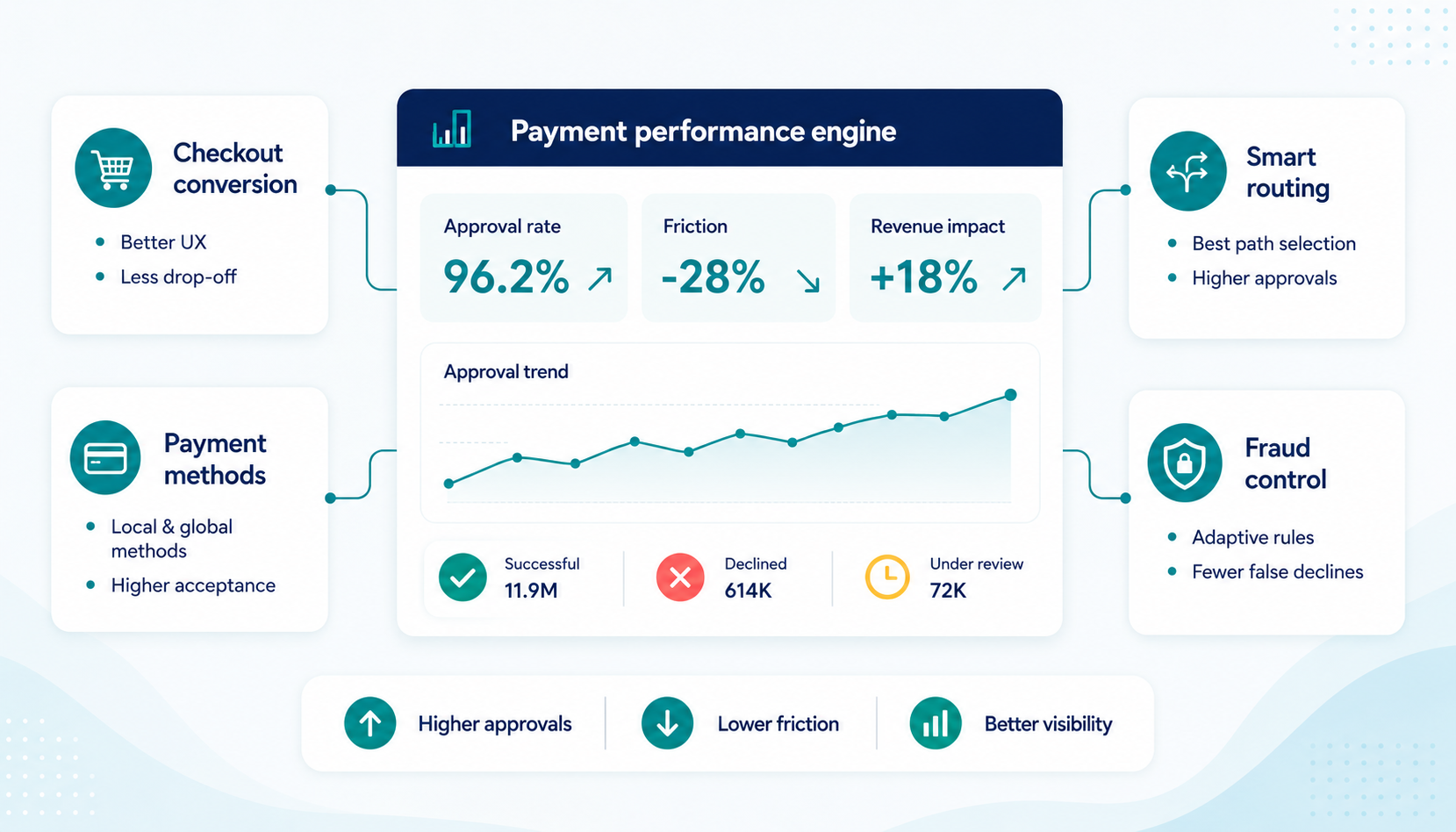
Payment performance measures how effectively your payment setup converts payment attempts into successful, profitable, and compliant transactions. It should be measured across approval rate, cost, fraud, checkout conversion, retry recovery, and reporting accuracy.
In a basic setup, payment performance is often calculated using approval rate or authorization rate. This is useful but not entirely sufficient. A high approval rate can still be very costly when processing goes through expensive providers. A low fraud rate can still damage revenue if a fraud engine blocks legitimate customers. A good checkout experience can still fail due to poor PSP or acquirer routing.
A stronger definition includes:
- Payment approval rate: The percentage of authorization attempts approved.
- Payment success rate: The percentage of payment attempts resulting in completed payments.
- Payment conversion rate: The percentage of checkout users who successfully pay.
- False decline rate: Legitimate payments incorrectly rejected.
- Retry recovery rate: Failed transactions recovered through retry or cascading.
- Cost per successful transaction: Total processing cost divided by successful payments.
- Chargeback and fraud rate: Risk exposure after authorization.
- Settlement and reconciliation accuracy: Whether finance teams can match transactions, fees, refunds, and payouts.
For multi-brand merchants and marketplaces, efficient payment processing also depends on visibility at the account level. One region might need local acquiring, another could need more robust fraud protection, and a third could need a completely different combination of payment methods.
How to calculate payment approval and success rates
Approval rate and payment success rate measure different parts of the transaction lifecycle.
Payment approval rate = (Approved authorization attempts / Total authorization attempts) × 100
Payment success rate = (Completed payments / Total payment attempts) × 100
Consider an illustrative example:
An enterprise merchant receives 10,000 payment attempts. Of these, 9,400 reach authorization, and 8,272 are approved and completed.
- Approval rate: 8,272 / 9,400 × 100 = 88%
- Payment success rate: 8,272 / 10,000 × 100 = 82.7%
The distinction stems from attempts that fail to reach the authorization phase, such as abandoned checkouts during the authentication process and technical problems. This simplified example assumes that every approved authorization turns into a completed payment; in practice, some approvals are later reversed or never captured.
Some service providers may call their statistics payment acceptance rate or transaction success rate. Before benchmarking, the payment team needs to check how each number is defined: the numerator, the denominator, and how retries are handled.
Why does payment performance drop?
Payment performance drops when the complexity of payment infrastructure grows beyond the team’s capability to monitor and manage it. Causes may include inadequate provider coverage, inconsistent transaction information, overly strict fraud management, and limited visibility of processing routes.
Generally, payment teams start out with a provider that suits their requirements. When the merchant begins to grow and enters new countries and currency zones, the operations of payment teams get more complicated. New customers bring a wide range of card types and preferences.
Common causes include:
| Cause | How it hurts performance | Example |
|---|---|---|
| Poor local payment coverage | Creates checkout friction or forces less suitable payment methods | A Dutch customer cannot select iDEAL |
| Single-provider dependency | Leaves transactions without an alternative processing path | An outage interrupts payments |
| Weak routing logic | Sends transactions through poorly matched providers | A card segment goes to an underperforming acquirer |
| Missing or inconsistent data | Reduces authorization quality | Incomplete billing or authentication information |
| Overly strict fraud rules | Rejects legitimate customers | A returning customer is challenged unnecessarily |
| No cascading logic | Prevents recovery from eligible temporary failures | A recoverable decline becomes a final failure |
| Fragmented reports | Conceals the cause of performance deterioration | Declines and fees are stored in separate systems |
Which KPIs should payment teams track?
Track payment KPIs at route, provider, market, card type, issuer, payment method, and merchant level. Aggregate numbers hide the exact failure points that payment teams need to fix.
A global approval rate can look stable while one market is leaking revenue. A PSP can show acceptable total performance while a specific merchant category is struggling with issuer declines. A fraud tool can reduce chargebacks while silently increasing false declines.
The core KPI model should include:
| KPI | Why it matters | Best segmentation |
|---|---|---|
| Authorization rate | Shows issuer approval performance | Provider, acquirer, issuer BIN, country, card type |
| Payment success rate | Shows full payment completion | Checkout, provider, payment method, market |
| Decline rate by reason | Identifies fixable failure patterns | Hard decline, soft decline, fraud, technical, insufficient funds |
| Retry recovery rate | Measures cascading and retry effectiveness | Decline reason, provider, card type, subscription cohort |
| Checkout abandonment rate | Shows UX and payment method friction | Device, country, payment method, page step |
| Cost per approved transaction | Connects performance to margin | Provider, scheme, acquirer, payment method |
| Fraud and chargeback rate | Protects revenue after approval | Merchant, product type, region, fraud rule |
| Settlement mismatch rate | Measures finance accuracy | Provider, merchant, currency, settlement batch |
| Timeout and latency rate | Early signal of provider degradation before approvals fall | Provider, acquirer, endpoint, time of day |
These metrics become valuable when teams use them to investigate specific issues and decide what to change.
Understanding how payment data drives decisions helps teams connect transaction-level signals to routing adjustments, fraud policies, provider comparisons, and financial outcomes.
How to detect PSP underperformance before revenue drops
Merchants can detect PSP underperformance by comparing each provider against its historical baseline and against alternative providers handling similar transactions. The strongest warning signals often appear within individual segments before the overall approval rate changes.
Rather than waiting for a global KPI to decline, payment teams should monitor five signals.
- Approval rates fall within a specific segment. A provider may continue performing normally overall while approvals deteriorate for one BIN range, country, or card type. Compare the affected segment against its historical performance and equivalent traffic sent to other providers.
- Soft declines increase or decline reasons change. A growing concentration of temporary failures on one route may indicate an emerging issuer, acquirer, or provider issue. An unexpected change in decline categories deserves investigation even when overall volume remains steady.
- Timeouts and latency begin climbing. Slower provider responses can signal degradation before it results in widespread transaction failures. Monitor response-time patterns by endpoint, acquirer, and time of day, alongside timeout rates.
- Fallback volume increases unexpectedly. If more payments are moving to backup providers, the primary route may already be underperforming. Successful cascading can protect the aggregate success rate while concealing the underlying issue.
- Cost per approved transaction rises. A provider may sustain approval performance while becoming more expensive because of fee changes, transaction mix, or greater reliance on costly alternative routes.
Once a potential issue is identified, the next step is confirmation.
If the merchant controls the traffic distribution, diverting a limited volume of similar traffic to a different provider will show whether the issue is specific to the provider.
The test traffic should match the original by country, BIN range, card type, transaction amount, and time interval.
If the merchant cannot control traffic distribution, the analysis has to wait until similar volumes build up in the same segments, rather than assuming that any difference between providers reflects their technical performance.
For PSPs and acquiring banks, the same monitoring rules apply one level down: the performance of each connector, downstream acquirer, or MID should be analyzed. This keeps monitoring deep enough without adding friction for every merchant.
How can payment teams increase payment performance?
Effective payment success rate optimization requires coordinated improvements throughout the payment lifecycle, from checkout and authorization to transaction recovery and reporting. The checkout experience, authorization performance, provider choice, recovery options, fraud protection, and financial reporting all affect the final result.
Payment optimization is most effective as a continual feedback process that involves measuring existing performance, identifying an area for improvement, taking action, comparing performance, and repeating the process.
1. Improve checkout and payment method relevance
The first layer of performance is checkout. If customers are unable to find appropriate payment methods, if they are faced with unnecessary input fields, redirect loops, or poor load times, then their payments may never reach authorization.
For enterprise merchants, this means offering payment methods that match customer preferences and devices in each market. PSPs need to give merchants flexible checkout configuration without custom engineering for every account.
Useful improvements include:
- Display locally relevant payment methods.
- Prioritize suitable wallets, cards, and bank payment options.
- Simplify payment forms and remove unnecessary fields.
- Make error messages clear and actionable.
- Optimize mobile checkout speed and usability.
- Localize payment language and currency.
These changes affect more than checkout usability. A locally preferred payment method may offer better conversion and lower processing costs than an international card transaction.
2. Improve authorization data quality
Issuer decisions are influenced to some extent by the data provided in the authorization request. Missing, inconsistent, or badly formatted data may raise the probability of the request being rejected, especially in cross-border and repeat payment situations. One practical way to improve payment approval rates is to ensure that every authorization request contains accurate, consistent, and properly formatted transaction data.
Payment teams should review the quality and consistency of:
- Billing and shipping details.
- Device and IP information, where appropriate.
- Merchant categories and payment descriptors.
- 3DS authentication data.
- Stored credential indicators.
- Card-on-file tokenization and account updates.
- Customer-initiated and merchant-initiated transaction indicators.
For instance, a subscription provider needs to differentiate between an initial customer-initiated transaction and a recurring merchant-initiated transaction. Inappropriate credential indicators may influence how the issuing bank analyzes the authorization request.
3. Use smart routing across PSPs and acquirers
Smart routing selects a processing route according to transaction characteristics and defined business priorities. The optimal provider is not necessarily the least expensive one: approval probability, market coverage, processing cost, and availability may all affect the decision.
A strong routing model can consider:
- Country and currency.
- Card brand, card type, and issuer BIN.
- Transaction amount and payment method.
- Merchant ID and customer segment.
- Provider availability and historical approval performance.
- Processing cost and transaction risk.
Rules should be evaluated against actual transaction outcomes, not assumed provider strengths.
Teams also need to understand how routing rules are built and tested before changing traffic distribution.
In Akurateco, routing rules can use card brand and type, BIN, currency, transaction amount, and region. BIN-based issuer routing combined with AI scoring and latency prioritization has reduced declines by up to 30% on Akurateco’s platform, per its 2026 PSP infrastructure research.
4. Set up fallback PSPs and cascading rules
Cascading involves retrying a failed transaction via a secondary channel. It works best for soft declines, system errors, PSP outages, temporary issuer problems, or failures at the route level.
Cascading provides a mechanism to recapture eligible transactions without asking customers to begin the checkout process again. Nonetheless, excessive and untargeted cascading may lead to increased fees and unnecessary authorizations.
A practical retry framework is:
| Decline type | Retry approach | Risk |
|---|---|---|
| Technical timeout | Retry promptly when safe, potentially through another provider | Duplicate processing if the original status is unresolved |
| PSP/acquirer unavailable | Use an available backup provider | Fallback route may cost more |
| Suspected fraud | Avoid automatic retry until risk is reviewed | Increased fraud exposure |
| Insufficient funds | Consider a later retry for eligible transactions | Excessive attempts may frustrate customers |
| Authentication required | Initiate the appropriate authentication flow | Additional checkout friction |
| Hard decline | Do not automatically retry | Potential scheme or issuer rule violations |
Effective fallback requires more than connecting a backup PSP.
Step 1: Establish overlapping provider coverage. Connect at least two providers capable of processing the relevant card brands, currencies, and markets. A backup route cannot recover transactions it is not eligible to process.
Step 2: Define failure-specific fallback rules. Determine which failures justify moving to another provider, establish route priority, and limit the number of providers involved in each payment. These controls should follow applicable scheme requirements and the guidance on which declines are worth retrying.
Step 3: Account for authentication when switching MIDs. Define whether and how existing 3DS authentication information can be reused. A change in merchant identity or processing context may require fresh authentication rather than transferring the previous result unchanged.
Fallback performance should then be measured using recovery rate, incremental processing cost, and the final outcome of each original payment.
For a closer look at the underlying mechanisms, see how a cascade moves a payment to another provider.
For PSPs, cascading is especially valuable when supporting many merchants with different processing needs. The PSP can offer fallback logic as an infrastructure capability rather than forcing each merchant to build its own retry system.
5. Balance fraud prevention and approval rates
While fraud controls help safeguard revenue, overly strict fraud rules can hurt the payment success rate. This does not mean the objective is to approve everything; rather, the objective is to approve good transactions and reject bad ones.
A fraud setup that cuts chargebacks at any cost may also reduce conversions, so its success should be measured alongside the authorization success rate. To improve approval rates while reducing chargebacks, PSPs need to assess fraud rules against two outcomes: the risk they prevent and the legitimate payments they block.
PSPs serving several merchants need the flexibility to tailor fraud rules for each merchant or MID, rather than applying the same set of rules to all.
Similarly, 3DS challenges need to consider the risk level of the particular transaction and whether there are any authentication policies governing such transactions.
For the technologies behind these controls, see the fraud prevention tools PSPs use.
6. Reduce processing costs without hurting conversion
Cost optimization should center on the financial result of approved transactions rather than the processing fee alone.
A cheaper route can end up costing more when low approval rates, repeated attempts, and operational costs outweigh the fee savings.
Cost optimization opportunities include:
- Using local acquiring where appropriate.
- Evaluating lower-cost methods with competitive conversion.
- Reducing unnecessary retries.
- Monitoring PSP, acquirer, and scheme fees.
- Identifying cross-border and currency conversion expenses.
- Comparing costs across card types and transaction segments.
- Investigating reconciliation discrepancies that reveal fee leakage.
For a meaningful comparison, merchants should measure cost per approved transaction rather than relying on the fee charged for an individual authorization attempt.
This creates a clearer view of whether a processing route actually improves payment economics.
7. Build unified reporting and reconciliation across PSPs
Reporting is more than a back-office administrative process. It is the diagnostic layer of payment performance. Without clean reporting, it is impossible to know if a provider is underperforming, if a decline pattern is issuer-specific, if routing changes have improved margin, or if settlements match expected amounts.
Effective payment performance reporting requires a consistent view of the transaction lifecycle across all PSPs, including authorization attempts, retries, final outcomes, and settlement data.
First, each unique payment must have an identifier that ties together its authorizations, cascades, and outcomes. Provider IDs stay available for tracing, but they should not fragment the view of the payment.
Second, decline reasons have to be normalized into a common taxonomy. Various PSPs may use different codes or terminology for the same issuer response. Without this normalization, decline patterns are easily misread.
Third, fees, refunds, settlements, and chargebacks have to be matched back to the original authorization. This lets payment operations and finance work from the same information rather than separate reports.
A practical reporting setup should show approval and decline patterns, route performance, retry recovery, fraud results, transaction costs, and settlement issues.
For PSPs, merchant-facing reporting can also become a product differentiator. Merchants expect performance data from their PSP, beyond the monthly settlement report.
Payment performance for enterprise merchants and PSPs
Enterprise merchants and PSPs share many payment performance objectives, but they operate at different levels. Merchants focus on maximizing the value of their own transactions, while PSPs must manage performance across merchants with different processing arrangements and risk profiles.
| Area | Enterprise merchant focus | PSP focus |
|---|---|---|
| Checkout | Improve customer conversion | Provide configurable merchant checkout |
| Payment methods | Offer relevant methods for target markets | Maintain connector and payment method coverage |
| Routing | Optimize own transactions for cost and approval | Manage rules across merchant portfolios |
| Cascading | Recover eligible failed payments | Provide reusable fallback infrastructure |
| Fraud | Balance risk and legitimate conversion | Support merchant-level and MID-level controls |
| Reporting | Monitor own transaction KPIs | Provide transparent merchant reporting |
| Reconciliation | Match transactions with settlements | Support multi-merchant fee and settlement reporting |
| Scalability | Enter additional markets efficiently | Accelerate merchant and provider onboarding |
For merchants, the main question is: How do we make more customer payments succeed profitably?
For PSPs, the question is broader: How do we give every merchant better performance without rebuilding custom infrastructure for each one?
This difference shapes how performance systems are designed. An enterprise merchant can often fix an issue within its own scope by changing its provider configuration. PSPs need an approach that supports many integrations, processes, and merchant-specific needs at scale.
Monitoring depth is a key parameter here. PSPs can save time and reduce merchant friction by using MID-level alerts and risk rules instead of manually reviewing every merchant’s transactions. Acquiring banks face the same portfolio problem, with per-MID risk and compliance controls on top.
Build vs buy: should you optimize payments in-house or use orchestration?
The in-house approach gives payment teams complete control over integrations and optimization logic, but it comes with permanent connector maintenance. A payment orchestration platform turns that maintenance into an operating cost, with one technology layer for all connected PSPs.
The right approach depends on transaction volume, available engineering resources, and expansion plans. For a more detailed comparison of costs and payback, see what building payment orchestration in-house costs over time.
For PSPs developing or expanding their own services, ready-made fintech payment infrastructure can provide a foundation for managing providers and merchant operations without developing every component from scratch.
Common mistakes that reduce payment performance
Payment performance often deteriorates when teams optimize individual metrics without considering the entire transaction lifecycle. A change that improves one KPI can simultaneously increase costs or introduce risks elsewhere.
Seven mistakes deserve particular attention:
- Optimizing only for approval rate. More approvals are not useful if fraud and chargebacks rise faster than revenue.
- Choosing the cheapest route by default. A low-cost provider with weak approval performance can reduce net revenue.
- Retrying every failed payment. Retry logic should respect decline reason, scheme rules, cost, and customer experience.
- Using one fraud rule set for every merchant or market. Risk patterns differ by geography, vertical, ticket size, and customer type.
- Ignoring issuer and BIN-level patterns. Aggregate approval rates hide valuable optimization opportunities.
- Treating reporting as a finance-only function. Payment operations, product, fraud, and finance teams all need the same source of truth.
- Adding PSPs without orchestration. More providers do not automatically improve performance if routing, monitoring, and reconciliation stay manual.
Where Akurateco fits into payment performance optimization
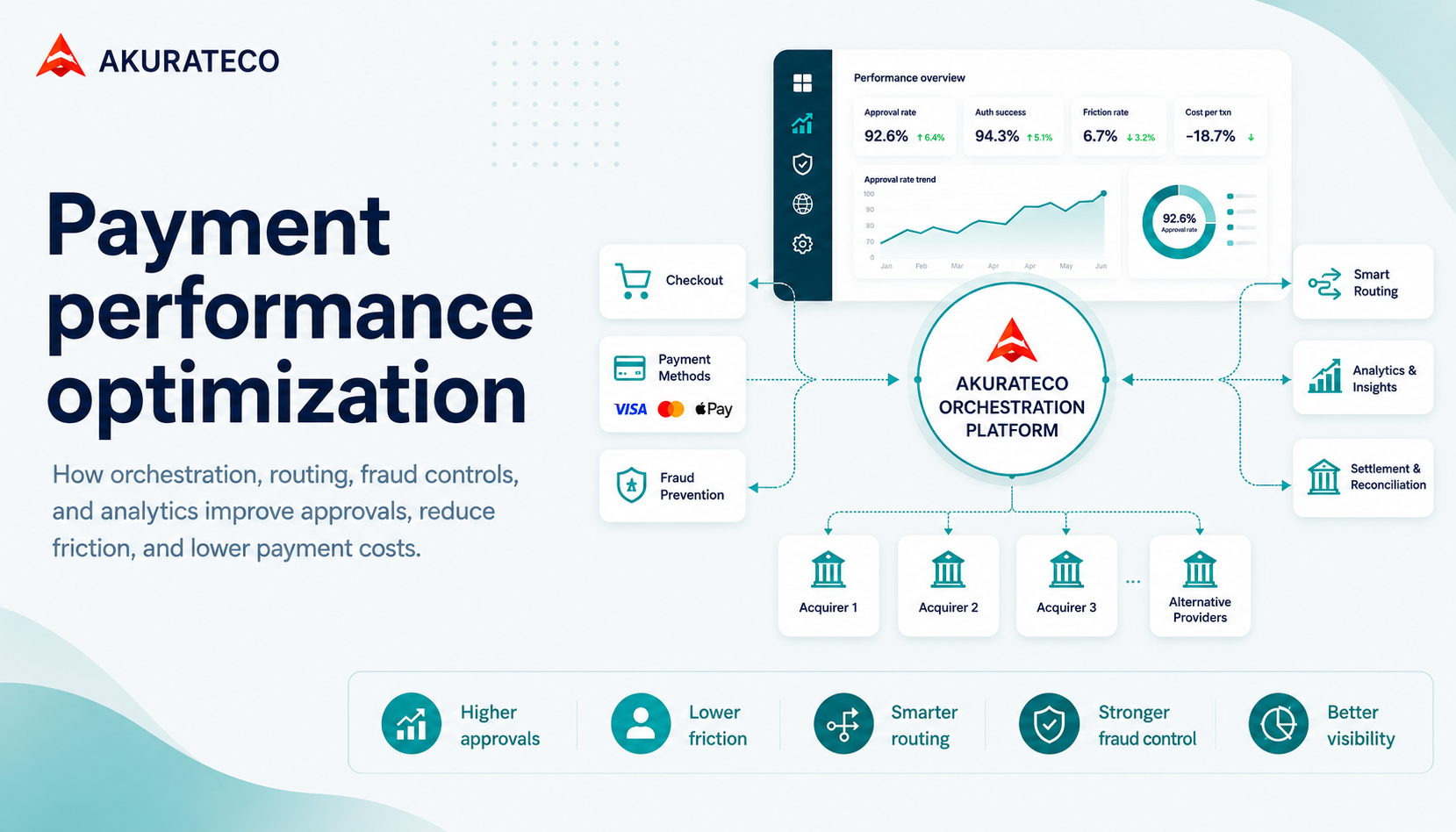
Akurateco provides the payment gateway and orchestration layer on top of acquirers; it does not process transactions itself. With 700+ integrations, Akurateco helps enterprise merchants, PSPs, and acquiring banks coordinate multiple payment providers through a common infrastructure layer.
The platform combines provider connections with routing, cascading, fraud controls, analytics, and reconciliation. This lets payment teams apply optimization rules without managing separate processes for each connected PSP.
Relevant use cases include:
- An enterprise merchant expanding internationally needs to manage local acquiring relationships and compare performance across markets.
- A PSP managing multiple merchants wants to provide configurable processing rules and transparent reporting without creating individual systems for each customer.
- An acquiring bank needs payment infrastructure that supports merchant management, risk controls, and transaction visibility.
- A marketplace requires several payment methods together with merchant onboarding, recurring payment capabilities, and settlement visibility.
- An enterprise merchant already working with several PSPs needs centralized reporting, consistent fallback rules, and better control over provider performance.
In a published Akurateco e-commerce case, a merchant entered four new markets at once and experienced declining approval performance alongside rising processing costs. Akurateco helped connect local providers and configure routing that prioritized local acquirers while maintaining fallback paths.
Following these changes, the merchant reported an 11% increase in payment success rates and a 38% reduction in processing costs.
Conclusion
Sustainable payment performance optimization starts with measuring KPIs at the transaction-segment level, identifying where revenue is lost, and continuously comparing provider performance. Fix the lever behind the biggest loss first, then measure again.
This will benefit enterprise merchants by increasing their payment efficiency and margins, while PSPs and acquiring banks gain consistency in how they manage performance.
Akurateco helps bring these operations together through a unified payment gateway and orchestration layer. Explore the Akurateco platform to see how it can support your payment infrastructure.
FAQ
What is payment performance?
Payment performance measures how efficiently a payment setup converts payment requests into successful, profitable, and compliant transactions. It includes approval rate, payment success rate, checkout conversion rate, fraud rate, retry recovery, transaction cost and settlement performance. A robust payment performance model goes beyond approvals and links payments with revenue, margin and operations.
What is a good payment approval rate?
There is no single approval rate that works for all merchants. Factors influencing the outcome include market, vertical, card mix, transaction amount, and nature of payments being made – initial purchase, recurring payment, or repeat purchase. The best benchmark is the merchant’s historical approval rates by segments and the relative performance of providers for comparable transactions.
How can enterprise merchants increase payment performance?
Merchants can increase payment performance by offering relevant payment methods, improving checkout UX, submitting better authorization data, using local acquiring where useful, applying smart routing, recovering soft declines through controlled retries, and adjusting fraud rules to reduce false declines. The best results come from continuous monitoring rather than one-time optimization.
How do you compare payment performance across PSPs?
Compare PSPs using equivalent transaction segments, including BIN range, country, card type, amount band, and time window. Measure approval rates, soft-decline share, latency, cost per approved transaction, and chargeback rates. Normalize decline reasons before comparing results, and confirm potential differences through a controlled traffic split where possible. A payment orchestration layer enables these comparisons using a common transaction dataset.
Why do legitimate payments get declined?
Legitimate payments can be declined because of issuer risk rules, missing transaction data, expired credentials, insufficient funds, PSP downtime, authentication issues, fraud filters, or poor routing. Some declines are hard declines and should not be retried. Others are soft declines that may be recovered through authentication, retry scheduling, or cascading.