

- What is automated payment reconciliation?
- Why reconciliation becomes difficult for PSPs and fintech companies
- How automated payment reconciliation works
- What payment data should be reconciled?
- Manual vs automated payment reconciliation
- Why reconciliation should be part of white-label payment gateway infrastructure
- Common reconciliation challenges in global payment operations
- Build in-house or use white-label payment software?
- What to look for in automated reconciliation functionality
- How automated reconciliation improves PSP operations
- Where Akurateco fits
- Common mistakes PSPs should avoid
- Conclusion
For PSPs, fintech companies, and payment businesses, payment processing does not end when a transaction is approved. The more difficult part often starts after the transaction: matching orders, payments, provider records, settlement files, fees, refunds, chargebacks, merchant balances, and payouts.
That is where automated payment reconciliation becomes a core part of payment infrastructure.
When a payment business works with one provider, one currency, and a small merchant portfolio, reconciliation may still be manageable manually. But once the company expands across markets, payment methods, acquirers, and merchants, spreadsheet-based reconciliation becomes too slow and too fragile.
For global payment businesses, reconciliation is no longer just a finance task. It is an infrastructure requirement.
What is automated payment reconciliation?
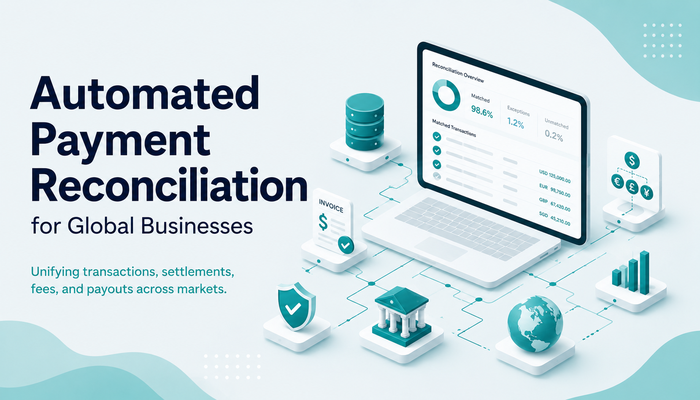
Automated payment reconciliation is the process of matching payment data across different systems without checking every transaction manually. It helps payment businesses compare expected transaction records with actual settlement, fee, refund, chargeback, and payout data.
In a payment infrastructure environment, reconciliation usually connects data from:
- payment gateway transactions;
- merchant orders;
- PSP or acquirer reports;
- bank settlement files;
- alternative payment method reports;
- refunds;
- chargebacks;
- processing fees;
- rolling reserves;
- merchant balances;
- payouts;
- accounting or ERP systems.
The goal is simple: every transaction should have a clear financial status.
A payment team should be able to see whether the transaction was authorized, captured, settled, refunded, charged back, partially paid out, or still pending. For PSPs and fintech companies, this visibility is especially important because the business is not only managing its own payments. It is managing payment flows for multiple merchants.
Why reconciliation becomes difficult for PSPs and fintech companies
Reconciliation becomes harder when a payment business starts scaling across merchants, providers, currencies, and settlement models. Each new integration adds data formats, reporting rules, fee structures, and operational exceptions.
A PSP may process transactions through several acquirers and alternative payment methods. Each provider may return reports in a different format. Some may settle daily, others weekly. Some may deduct fees before settlement, while others invoice fees separately. Refunds and chargebacks may appear days or weeks after the original transaction.
This creates several problems.
First, payment teams lose time combining reports from different systems. What starts as a small manual process can become a daily operational bottleneck.
Second, finance teams may struggle to understand the real net amount received after processing fees, FX conversion, reserves, refunds, and chargebacks.
Third, merchant reporting becomes harder. If a PSP cannot clearly show merchants what was processed, settled, refunded, or deducted, merchant trust can suffer.
Finally, scaling becomes more expensive. Every new provider or payment method increases the workload unless reconciliation is automated at the infrastructure level.
How automated payment reconciliation works
Automated reconciliation collects payment data from multiple systems, normalizes it, matches transaction records, and flags exceptions for review. Instead of asking teams to check every transaction manually, the system helps them focus only on mismatches and unresolved cases.
A typical reconciliation workflow looks like this:
| Stage | What happens | Why it matters |
| Data collection | Transaction, settlement, refund, chargeback, and fee data is imported from connected systems | Reduces manual file handling |
| Data normalization | Different provider formats are converted into a consistent structure | Makes multi-provider reporting possible |
| Transaction matching | Gateway records are matched with provider and bank settlement data | Confirms whether money movement matches expected records |
| Fee and deduction mapping | Processing fees, reserves, chargeback fees, and FX differences are separated | Helps calculate accurate net amounts |
| Exception detection | Missing, delayed, duplicated, or mismatched records are flagged | Helps teams investigate issues faster |
| Merchant balance calculation | Settled funds, fees, refunds, and deductions are assigned to merchant accounts | Supports accurate merchant payouts |
| Reporting | Finance, operations, and merchant-facing reports are generated | Improves visibility and audit readiness |
Once reconciliation data is centralized and consistent, teams can use payment analytics for payment businesses to evaluate transaction performance, identify trends, and support better operational decisions.
What payment data should be reconciled?
A strong reconciliation process should cover the full transaction lifecycle, not only approved payments. For payment businesses, the financial reality of a transaction includes settlement, fees, refunds, chargebacks, reserves, and payouts.
Key data points include:
| Data type | Why it matters for payment businesses |
| Transaction ID | Connects the payment gateway record to provider and merchant records |
| Order ID | Helps match payment activity to the merchant’s commercial record |
| Authorization and capture status | Shows whether the payment was only approved or actually captured |
| Settlement amount | Confirms how much money was received from the provider |
| Processing fees | Shows the cost deducted from the transaction |
| Currency and FX rate | Explains differences between transaction and settlement amounts |
| Refunds | Tracks money returned to customers |
| Chargebacks | Identifies disputed transactions and related deductions |
| Rolling reserves | Helps PSPs manage delayed or withheld merchant funds |
| Merchant balance | Shows what should be paid out to each merchant |
| Payout status | Confirms whether merchant funds were transferred correctly |
For PSPs, merchant-level reconciliation is especially important. The platform must not only reconcile money at the provider level, but also explain how funds belong to each merchant.
Manual vs automated payment reconciliation
Manual reconciliation may work at low volume, but it becomes inefficient and risky as payment operations scale. Automated reconciliation gives PSPs and fintech companies a more reliable way to manage financial data across multiple payment flows.
| Area | Manual reconciliation | Automated reconciliation |
| Data handling | Teams download and combine reports manually | Data is collected from connected systems |
| Transaction matching | Payments are checked row by row | Matching rules identify records automatically |
| Provider formats | Each file must be interpreted separately | Data is normalized into one structure |
| Error detection | Issues are found late or inconsistently | Exceptions are flagged faster |
| Merchant reporting | Reports depend on manual preparation | Reports can be generated from centralized data |
| Scalability | Every new provider increases workload | New providers can be added into the process |
| Audit trail | Harder to track changes and decisions | Clearer transaction history and exception logs |
Automation does not remove human oversight. It removes repetitive manual checks and gives finance and operations teams more control over exceptions.
Why reconciliation should be part of white-label payment gateway infrastructure
For PSPs and fintech companies, reconciliation should not sit outside the payment gateway as a disconnected finance process. It should be part of the infrastructure that manages transactions, merchants, reports, balances, and payouts.
A white-label payment gateway is not only a branded payment interface. For payment businesses, it should also support the operational foundation behind the brand.
That foundation often includes:
- merchant onboarding;
- merchant management;
- payment page configuration;
- transaction monitoring;
- provider integrations;
- routing logic;
- reporting;
- fee management;
- reconciliation;
- settlement visibility;
- merchant payout support;
- back-office tools.
When reconciliation is built into the payment infrastructure, PSPs can manage payment data more consistently. They can connect transaction records to settlement data, show merchants clearer reports, investigate exceptions faster, and reduce the operational cost of scaling.
This is especially important for payment businesses operating under their own brand. Merchants expect the PSP to provide clear reporting and settlement visibility, not fragmented spreadsheets from multiple back-office systems.
Common reconciliation challenges in global payment operations
Global payment reconciliation is difficult because payment data rarely arrives in one clean format. PSPs need to manage provider differences, merchant structures, currencies, fees, and delayed financial events.
The most common challenges include:
Multiple providers and acquirers
Different providers use different report formats, status names, settlement timelines, and transaction identifiers. Without normalization, payment teams spend too much time interpreting provider data.
Multi-currency settlements
A transaction may be processed in one currency and settled in another. FX rates, conversion fees, and rounding differences can create mismatches if they are not tracked properly.
Refunds and chargebacks
Refunds and chargebacks may appear after the original payment has already been settled. They must be connected back to the original transaction and reflected in merchant balances.
Fee complexity
Processing fees, gateway fees, acquirer fees, chargeback fees, scheme fees, and reserves can all affect the final amount received. If these deductions are not separated clearly, net revenue reporting becomes unreliable.
Merchant-level accounting
PSPs must assign transactions, fees, deductions, and payouts to the correct merchant. This becomes harder when the business serves many merchants across different pricing models and regions.
Delayed or missing settlements
Settlement delays can happen because of provider rules, banking timelines, holidays, risk reviews, or reporting issues. Automated exception detection helps teams identify these cases faster.
Build in-house or use white-label payment software?
Building reconciliation tools in-house gives control, but it also creates long-term maintenance, integration, and compliance work. White-label payment software can help PSPs launch reconciliation and reporting capabilities faster as part of a broader gateway infrastructure.
| Approach | Pros | Cons | Best for |
| Build in-house | Full control over logic and architecture | High development cost, long launch time, ongoing maintenance | Large payment companies with mature engineering teams |
| Use separate reconciliation software | Faster than building everything internally | May remain disconnected from gateway, merchant management, and payout logic | Businesses solving finance reconciliation only |
| Use a white-label payment gateway with reconciliation capabilities | Combines transaction processing, merchant management, reporting, and reconciliation in one branded infrastructure | Requires choosing a provider that matches business needs | PSPs and fintechs launching or scaling payment services |
For many PSPs, the question is not whether reconciliation matters. The question is whether it should be built as a separate internal system or embedded into the payment infrastructure from the beginning.
What to look for in automated reconciliation functionality
A strong reconciliation setup should give PSPs visibility at transaction, provider, merchant, and settlement level. It should help teams understand not only whether money arrived, but why the final amount differs from the original transaction.
Important capabilities include:
| Capability | Why it matters |
| Multi-provider data aggregation | Brings reports from PSPs, acquirers, banks, and APMs into one environment |
| Transaction-level matching | Connects gateway transactions with provider and settlement records |
| Merchant-level reporting | Helps PSPs provide clearer visibility to merchants |
| Multi-currency support | Explains FX differences and settlement currency changes |
| Fee breakdowns | Shows processing costs, deductions, and net amounts |
| Refund and chargeback tracking | Connects post-transaction events to the original payment |
| Exception management | Flags missing, duplicated, delayed, or mismatched records |
| Payout visibility | Helps track what should be paid to each merchant |
| Audit trail | Supports internal controls and investigation |
| Export and reporting tools | Helps finance teams use reconciliation data in accounting workflows |
For PSPs, these capabilities are not just internal convenience. They affect merchant experience, financial accuracy, and operational scalability.
How automated reconciliation improves PSP operations
Automated reconciliation helps payment businesses reduce manual workload, improve merchant reporting, and scale payment operations with fewer operational risks.
The operational benefits are practical:
- finance teams spend less time combining provider files;
- operations teams investigate mismatches faster;
- merchants receive clearer reports;
- management gets better visibility into payment performance;
- provider settlement issues become easier to detect;
- payouts can be calculated with more confidence;
- expansion into new regions becomes easier to manage.
A PSP that wants to scale cannot rely on manual reconciliation as a permanent process. The higher the transaction volume and provider complexity, the more important automation becomes.
Where Akurateco fits
A white-label payment gateway provider such as Akurateco can help PSPs and fintech companies manage reconciliation as part of broader payment infrastructure. Instead of building every gateway, reporting, and back-office component from scratch, payment businesses can use ready-to-use infrastructure under their own brand.
For PSPs, Akurateco’s relevance is not only in payment acceptance. The stronger value is infrastructure control: provider connectivity, merchant management, transaction monitoring, reporting, and payment operations tools that support a scalable payment business.
This makes automated reconciliation more useful because it sits closer to the transaction flow. Payment teams can connect payment activity with settlement, reporting, and merchant-level visibility inside one infrastructure environment.
Akurateco should not be seen as a replacement for financial oversight. It is better understood as a technology partner that helps payment businesses reduce infrastructure complexity while keeping control over their branded payment offering.
Common mistakes PSPs should avoid
The biggest mistake is treating reconciliation as a back-office problem that can be solved later. If reconciliation is not planned early, it becomes harder to fix once transaction volume, provider count, and merchant complexity increase.
Payment businesses should avoid:
- relying on spreadsheets for high-volume reconciliation;
- adding providers without planning reporting and settlement data flows;
- separating merchant reporting from reconciliation logic;
- ignoring fee and reserve visibility;
- treating refunds and chargebacks as isolated finance events;
- using inconsistent transaction identifiers across systems;
- building merchant payout processes without clear balance logic;
- choosing gateway infrastructure that lacks operational reporting.
Reconciliation should be evaluated together with the gateway, merchant management, provider integration, and reporting layers.
Conclusion
Automated payment reconciliation is becoming essential for global payment businesses. As PSPs and fintech companies add merchants, providers, currencies, and payment methods, manual reconciliation becomes too slow and too risky to support scalable operations.
The right reconciliation setup helps payment teams understand what happened to every transaction after authorization. It connects payment activity with settlements, fees, refunds, chargebacks, reserves, merchant balances, and payouts.
For PSPs building or improving their payment infrastructure, reconciliation should be evaluated as part of the white-label payment gateway layer, not as a separate afterthought. A provider such as Akurateco can support this approach by helping payment businesses launch and manage branded payment infrastructure with stronger operational visibility, reporting, and scalability.
FAQ
What is automated payment reconciliation?
Automated payment reconciliation is the process of matching payment, settlement, fee, refund, chargeback, and payout data across systems using software. For PSPs, it helps connect gateway transactions with provider reports, bank settlements, and merchant balances without checking every record manually.
Why do PSPs need automated payment reconciliation?
PSPs need automated reconciliation because they manage payment flows for multiple merchants, providers, currencies, and settlement schedules. Manual checks become slow and error-prone as transaction volume grows. Automation helps improve reporting accuracy, detect exceptions faster, and support merchant-level settlement visibility.
How does automated reconciliation work in a payment gateway?
In a payment gateway environment, automated reconciliation collects transaction data, imports provider and settlement reports, normalizes formats, matches records, calculates fees and deductions, and flags unmatched transactions. The result is clearer visibility into payment status, settlement amounts, merchant balances, and payout readiness.
Is payment reconciliation part of white-label payment gateway software?
It should be. For PSPs and fintech companies, white-label payment gateway software should not only process payments but also support merchant management, transaction monitoring, reporting, settlement visibility, and reconciliation. These capabilities help payment businesses operate under their own brand with stronger back-office control.
What is the difference between payment reconciliation and settlement reporting?
Settlement reporting shows what funds were settled by a provider or bank. Payment reconciliation goes further by matching those settlements against transactions, orders, fees, refunds, chargebacks, reserves, and merchant balances. Reconciliation explains whether the financial outcome matches the expected payment activity.
How can Akurateco help with payment reconciliation?
Akurateco helps PSPs and fintech companies by providing white-label payment gateway infrastructure with tools for provider connectivity, merchant management, transaction monitoring, and reporting. This infrastructure can support more centralized payment operations and reduce the need to build every reconciliation-related component internally.