
- Why PSPs move beyond a single acquirer
- What is a white-label payment gateway?
- How a white-label gateway simplifies acquirer integrations
- Business benefits of multi-acquirer PSP infrastructure
- Capabilities PSPs should evaluate before choosing a gateway
- Building in-house vs using a white-label gateway
- How Akurateco supports multi-acquirer PSP expansion
- Conclusion
A PSP may be able to launch with one acquiring connection, but it is unlikely to scale efficiently with that setup for long. As the merchant portfolio grows, the provider must support more countries, currencies, business models, payment methods, and risk profiles. One acquirer rarely covers all of these requirements equally well.
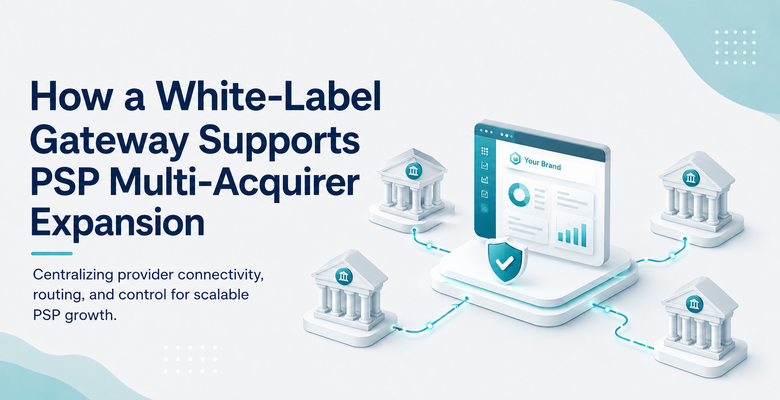
A white-label gateway for PSP multi-acquirer expansion provides the infrastructure needed to add and manage acquiring partners without building every gateway component from scratch. It gives the PSP a centralized environment for transaction processing, merchant management, routing, reporting, tokenization, billing, and provider connectivity while allowing the entire service to operate under the PSP’s own brand.
For payment businesses, this model reduces integration overhead and creates a more scalable foundation for geographic and commercial growth.
Why PSPs move beyond a single acquirer
A single-acquirer setup limits market coverage, merchant flexibility, resilience, and negotiating power. Connecting multiple acquirers allows a PSP to serve more merchants and reduce dependency on one provider.
Different acquirers offer different combinations of geographic reach, supported industries, currencies, settlement models, pricing, and risk appetite. An acquiring partner suitable for a European retail merchant may not support a gaming company, subscription platform, or business expanding into Latin America.
A PSP connected to only one acquirer may face several restrictions:
- Limited geographic coverage
- Inability to onboard merchants from certain industries
- Dependence on one provider’s uptime and technical performance
- Restricted access to local acquiring
- Fewer settlement currencies
- Limited commercial flexibility
- Longer expansion timelines
Multi-acquirer connectivity gives PSPs more options. Merchants can be assigned to an acquiring partner based on their location, industry, transaction profile, currency, or commercial agreement.
It also improves operational resilience. When one acquiring connection is unavailable or unsuitable for a particular transaction flow, the PSP has alternative infrastructure available instead of placing the entire payment operation at risk.
What is a white-label payment gateway?
A white-label payment gateway is ready-to-use payment software that a PSP or fintech company can launch under its own brand and configure around its business model.
The platform acts as the technical layer between merchants and payment providers. It receives transaction requests, applies configured processing logic, sends transactions to the relevant provider, collects responses, and makes transaction data available through merchant and administrative interfaces.
Unlike a basic processing API, white-label payment gateway software typically includes the operational tools required to run a payment business.
| Capability | Role in PSP infrastructure |
| Merchant onboarding | Creates and configures merchant accounts |
| Merchant management | Controls permissions, limits, fees, currencies, and services |
| Provider integrations | Connects acquirers, processors, PSPs, fraud tools, and payment methods |
| Transaction processing | Manages authorization, capture, refunds, voids, and recurring payments |
| Routing | Selects an appropriate provider or MID for each transaction |
| Tokenization | Stores payment credentials securely for future use |
| Reporting | Centralizes transaction and merchant data |
| Billing | Calculates commissions, fees, and merchant charges |
| Back office | Supports operations, finance, risk, and customer service teams |
| Payment page | Provides a branded checkout experience |
This infrastructure allows a payment company to focus on merchant acquisition, provider partnerships, pricing, support, and expansion rather than developing every technical component internally.
How a white-label gateway simplifies acquirer integrations
The gateway standardizes multiple acquiring connections behind one processing layer, reducing the amount of provider-specific development required from the PSP and its merchants.
Without a centralized gateway, every acquiring integration becomes a separate technical project. The PSP must account for differences in:
- API formats
- Authentication methods
- Transaction statuses
- Error codes
- Webhook structures
- Refund and capture logic
- Recurring payment requirements
- Settlement reports
- Reconciliation files
- Certification processes
These differences increase development and maintenance costs. They also create inconsistencies for merchants, especially when each provider requires a separate connection.
A white-label gateway introduces a unified merchant-facing API. Merchants integrate once with the PSP, while the gateway handles communication with the underlying acquirers.
The simplified transaction flow is:
- A merchant sends a payment request to the PSP’s gateway.
- The gateway validates the request and applies merchant settings.
- Routing logic selects the appropriate acquirer or processing route.
- The transaction is converted into the provider’s required format.
- The acquirer processes the request and returns a response.
- The gateway normalizes the response for the merchant.
- Transaction data becomes available in reporting and back-office systems.
When a new acquirer is added, the PSP expands the provider layer without forcing every merchant to rebuild its integration.
Business benefits of multi-acquirer PSP infrastructure
Multi-acquirer infrastructure helps PSPs expand their addressable market, improve service continuity, negotiate stronger commercial terms, and create more flexible merchant offerings.
Wider merchant coverage
Acquirers differ in their merchant acceptance policies. Some focus on low-risk ecommerce, while others specialize in travel, digital services, subscriptions, gaming, or other business models.
Multiple connections help a PSP support a broader range of merchants without relying on a single underwriting approach.
Faster geographic expansion
Entering a new market often requires local acquiring, domestic settlement, additional currencies, or region-specific payment methods. A gateway that can integrate and manage additional providers gives the PSP a repeatable expansion model.
Instead of replacing its core platform, the PSP extends the existing infrastructure with new connections and merchant configurations.
Reduced provider dependency
An outage, compliance change, commercial dispute, or risk-policy update at one acquirer can affect a large share of a PSP’s portfolio. Diversifying provider relationships reduces the operational impact of such events.
This does not eliminate provider risk, but it prevents one external partner from becoming the only viable processing route.
Greater commercial flexibility
With multiple acquirers, PSPs can compare pricing, settlement terms, supported currencies, onboarding requirements, and service quality.
They can build different merchant packages or select providers based on the economics of a particular market or transaction type. Understanding the economics of scaling a gateway business helps PSPs balance provider costs, merchant pricing, revenue streams, and expansion into new markets.
Stronger product positioning
A PSP with broad acquiring coverage can present a more complete offering to merchants. Instead of selling access to one processor, it can provide a configurable payment infrastructure with multiple integrations, reporting, merchant controls, and branded services.
Capabilities PSPs should evaluate before choosing a gateway
The platform should support more than transaction forwarding. PSPs need provider connectivity, merchant operations, routing, security, reporting, billing, and infrastructure control.
Flexible provider integration
The gateway should support different integration models, including direct acquirer connections, processors, alternative payment methods, fraud tools, and third-party services. For PSPs evaluating Mastercard-based gateway connectivity, MPGS explained offers a closer look at how Mastercard Payment Gateway Services fits into payment infrastructure.
It should also provide a practical process for adding new connectors. A large existing integration portfolio is valuable, but the ability to develop and maintain additional integrations is equally important.
Merchant-level configuration
Each merchant may require different providers, MIDs, currencies, limits, fees, and transaction types. The PSP should be able to manage these settings centrally without creating separate infrastructure for every customer.
Routing and cascading
Routing determines where a transaction is sent based on configurable parameters such as currency, country, merchant, card type, amount, or provider availability.
Cascading allows a failed transaction to be redirected to an alternative route when the decline reason and processing rules permit it. For a PSP, these capabilities support multi-acquirer operations while keeping provider logic inside one platform.
Centralized reporting
When transaction data is distributed across separate acquirer portals, operational teams struggle to obtain a consistent view.
A white-label gateway should normalize provider data and make it available through unified dashboards, exports, and reports. This supports merchant service, financial operations, transaction monitoring, and reconciliation.
Tokenization and PCI DSS-ready infrastructure
Handling payment credentials creates significant security and compliance responsibilities. Tokenization reduces exposure by replacing sensitive card data with reusable tokens.
A PCI DSS-ready platform can reduce the amount of payment infrastructure the PSP must design and maintain independently, although the PSP’s own compliance obligations still depend on its operating model and transaction flows.
Billing and fee management
PSPs need to monetize their service. The gateway should support configurable fees, commissions, markups, and billing rules across merchants and transaction types.
Without integrated billing functionality, finance teams often rely on spreadsheets or separate systems that are difficult to scale.
Building in-house vs using a white-label gateway
In-house development provides deep control, but it also creates long-term responsibility for integrations, security, maintenance, compliance, and product development. White-label software reduces time to market while preserving control over the PSP’s brand and commercial model.
| Approach | Advantages | Limitations | Best suited for |
| In-house development | Maximum architectural control and custom logic | High development cost, longer launch time, continuous maintenance | Large payment companies with experienced internal engineering and compliance teams |
| Basic third-party gateway | Faster initial integration | Limited branding, merchant controls, and infrastructure ownership | Companies that only need payment acceptance |
| White-label payment gateway | Branded infrastructure, faster launch, provider connectivity, back-office tools | Requires vendor evaluation and implementation planning | PSPs and fintechs launching or scaling payment services |
Building a payment gateway is not a one-time software project. Provider APIs change, card network requirements develop, security standards evolve, and merchants request new payment capabilities.
The initial build cost is therefore only part of the decision. PSPs must also consider connector maintenance, system availability, monitoring, token security, merchant support, reporting, billing, and further product development.
White-label infrastructure transfers much of this technical workload to a specialized platform provider while allowing the PSP to retain its merchant relationships, pricing, branding, and provider agreements.
How Akurateco supports multi-acquirer PSP expansion
Akurateco provides white-label payment software that helps PSPs and fintech companies connect providers, manage merchants, process transactions, and scale payment infrastructure under their own brand.
Instead of developing every gateway layer internally, a payment business can use Akurateco as the foundation for its PSP infrastructure.
The platform brings together payment processing, provider integrations, merchant management, transaction routing, tokenization, reporting, billing, payment page functionality, and administrative tools.
For a PSP expanding its acquiring network, this creates a centralized environment in which new connections can be added without fragmenting merchant-facing infrastructure.
The PSP remains responsible for its commercial strategy, acquiring partnerships, merchant portfolio, risk model, and regulatory obligations. Akurateco provides the technology layer needed to operationalize those relationships and services at scale.
Conclusion
Multi-acquirer expansion is not only an integration project. It affects merchant onboarding, transaction routing, reporting, billing, security, reconciliation, risk controls, and the overall scalability of the PSP’s operating model.
A white-label gateway gives PSPs a structured way to manage this complexity. It creates one infrastructure layer for merchants while allowing the payment business to expand its provider network, commercial offering, and regional reach.
For PSPs and fintech companies building or modernizing payment infrastructure, Akurateco can act as a technology partner that supports multi-acquirer connectivity, merchant management, transaction processing, reporting, and growth under the PSP’s own brand.
FAQ
What is a multi-acquirer payment gateway?
A multi-acquirer payment gateway connects merchants to more than one acquiring partner through a centralized processing platform. It allows a PSP to configure different providers by merchant, country, currency, industry, or transaction type while maintaining one merchant-facing integration and a unified operational environment.
Why do PSPs need multiple acquirers?
PSPs use multiple acquirers to expand geographic coverage, support more merchant categories, reduce dependency on one provider, access different currencies, and create more flexible commercial terms. Multiple connections also improve resilience when an acquirer experiences technical, operational, or policy-related limitations.
How does a white-label gateway support PSP expansion?
A white-label gateway provides ready-to-use payment infrastructure under the PSP’s brand. It centralizes provider integrations, merchant management, routing, tokenization, billing, reporting, and transaction monitoring, allowing the PSP to add acquiring capabilities without rebuilding the entire gateway for each new provider.
Is a white-label gateway better than building in-house?
The right approach depends on the PSP’s resources and strategy. In-house development offers greater architectural control but requires significant engineering, compliance, security, and maintenance capabilities. White-label software is usually more practical when faster market entry and scalable provider connectivity are priorities.
What features should a PSP look for in gateway software?
A PSP should evaluate provider integrations, merchant onboarding, merchant management, routing and cascading, tokenization, PCI DSS readiness, payment page customization, reporting, billing, role-based access, transaction monitoring, API quality, deployment options, and the process for adding new acquirers.
Can Akurateco help a PSP connect multiple acquirers?
Akurateco provides white-label payment gateway software designed for PSPs and fintech companies. It supports centralized provider connectivity, merchant operations, routing, reporting, tokenization, billing, and branded payment infrastructure, helping payment businesses expand their acquiring network without developing every component from scratch.