

- Highlights
- What Inspires Andrew
- From a Ukrainian PSP to Akurateco
- Running a Business Through COVID and War
- What Akurateco Does and How Payment Orchestration Works
- Payment Team as a Service and Why Orchestration Became Necessary
- Why Airline Payments Are More Complex
- How Akurateco Adapts Orchestration for Airlines
- Akurateco’s First Customer and AI Adoption
- Agentic Payments and Agentic Commerce
- Closing Thoughts
- Twitter Session
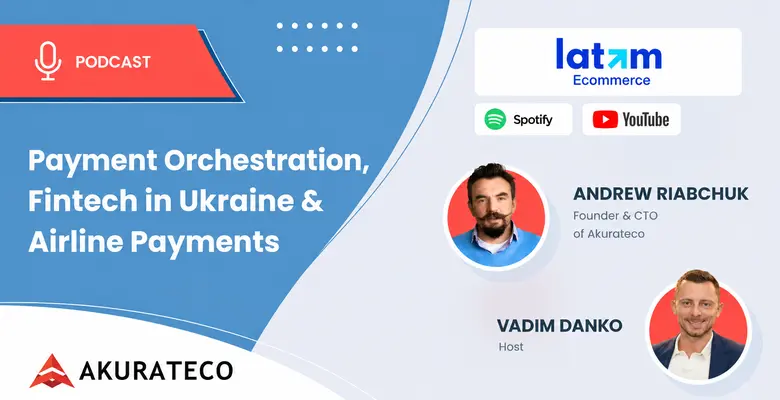
On July 29, 2026, Andrew Riabchuk, Founder and CTO of Akurateco, joined host Vadim Danko on the LATAM Ecommerce podcast.
In this LATAM Commerce podcast episode, Andrew Riabchuk, Founder & CTO of Akurateco, shares how the company grew from payment expertise in Ukraine and continued building through the pandemic and war.
Andrew explains payment orchestration in simple terms, including routing, acceptance rates, cost control, risk management, provider integrations, and payment operations. The conversation also covers Akurateco’s white-label payment gateway and Payment Team as a Service, the complexity of airline payments, and the role of AI and agentic payments in the future of the industry.
Podcast source: https://open.spotify.com/episode/6mdhZvOcOBwRAoSiwTTM49?si=O3XgaFNJSMqk6lHynMVGZw&nd=1&dlsi=893915cf749b41f2
Video: https://www.youtube.com/watch?v=k2yzCdp4nlo&feature=youtu.be
Read the full conversation below.
Highlights
Host: How’d you make it? Because my family is in Ukraine, you know, there were hours and days without electricity.
Andrew: Well, at the beginning of the war, there were not so many problems with the electricity supply or these other aspects which happened afterwards, but it was, you know, a great stress. And of course, let’s say, if before you used to live a normal life and now you’re living with a potential or not very practical danger to your life or to your family’s life, it’s a different thing.
Electricity supply or internet connection is just a matter of… Since it’s a global business, it has a lot of issues with cross-border payments and multi-currency effects, costs, you know, and other, you know, and other things related to exchanging from one currency to another.
Host: The next question is: the best AI tool is?
Andrew: Anthropic Claude is the best.
What Inspires Andrew
Host: Andrey, you’re running the company, you’re traveling a lot, you’re originally from Ukraine, but today, what wakes you up?
Andrew: Well, you know, first of all, let’s say, it’s, you know, I’m very much inspired by my family and by a lot of things that I do in my life, and the majority of things I do are for them.
And it gives me, let’s say, the energy to wake up and also to move forward. Also, I’m very much inspired by the team and by people who are around me and who are, I mean, who are in my team or in other teams, who have, let’s say, big ideas, think big, let’s say, you know, dream a lot, dream great. So, this is probably the biggest inspiration.
So, I’m inspired by people, inspired by what they do, what they dream about. And I’m always getting this energy from them, and it inspires me more than anything else.
From a Ukrainian PSP to Akurateco
Host: You mentioned your team.
I know you built a payment business, a PSP, in Ukraine. Can you tell us a little bit about your story? How did it start, and how was Akurateco born?
Andrew: Well, okay. So, once again, I will start with a short intro.
So, my name is Andrew Riabchuk. I’m the founder and CTO of Akurateco, the payment orchestration platform and white-label payment gateway. I’ve been in payments for more than 25 years.
And, like, I, you know, graduated from the technical university, and 24, 23 years ago, together with my colleague, also from the same university, we were participating in some outsourcing projects. Some of them, let’s say, were related to payments. So, I was really interested from day one in payments.
Nevertheless, it was quite a different payment landscape compared with what we have now. So, it was much simpler and much less sophisticated. But, you know, it was interesting.
So, I continued to, let’s say, look for knowledge and information in that field. And after some years, I created, you know, based on the experience and based on what I saw about how it was working outside Ukraine, I created my first PSP in Ukraine. And obviously, it, you know, should have a technical platform, a technical backbone.
So, first, it was the first, third generation of the platform. Then, we created the second generation of the platform, and the PSP business and payments in general were developing throughout the world and particularly in Ukraine. And it became, you know, more interesting, more sophisticated, more challenging, but also more limited in regard to licensing, in regard to vertical businesses, competition in the market, and other aspects.
So, after a while, I decided to concentrate my efforts on creating a purely technological company, which Akurateco actually is, which has no limits, has no licensing issues or any other limitations. And that’s how Akurateco was born, and that’s how it’s growing and developing. It’s already been five and a half years on the market, and I’m really excited to move forward with that.
Running a Business Through COVID and War
Host: Tell us a little bit about this tough period for every Ukrainian and every Ukrainian business that was five years ago. Where were you, how did you run the business, and what’s changed in your mentality and in the way you operate the business?
Andrew: Well, before the war, and I assume that you’re referring to the war which, unfortunately, is currently happening in Ukraine, we had two years, almost two and a half years, of the COVID pandemic.
And before the pandemic, we worked the way most people did, so from the office. And those two years taught us how to operate fully remotely, and it was a good lesson for all of us. I mean, we learned how to use Slack, Jira, and Zoom far more efficiently than before.
And then just how to use that in general, because, like, Zoom, I never tried Zoom before, maybe before the pandemic. And working remotely is a completely different story compared with working from the office. You lose the day-to-day and in-person contact.
And for a lot of people, it means a significant change in their approach, in their day-to-day operations, and how they, let’s say, could organize themselves, how they, let’s say, could start the working day and end the working day, finish it, and so on and so forth.
Host: So, but, you know, where were you? Where was the company, where were you when the war started?
Andrew: Before the war, I was already outside Ukraine. I was living in Spain.
So, in these conditions, when it’s much more, let’s say, stressful than it used to be before. And I’m very proud of my team that, let’s say, all of us were aligned that, let’s say, regardless of what’s happening, we should be in working mode.
We should deliver the product. We should deliver support and other things which are, you know, what our clients expect. And that’s why I think it’s one of the keys and the secret sauce that Akurateco has.
What Akurateco Does and How Payment Orchestration Works
Host: Let’s talk about Akurateco. You mentioned it’s a purely tech company. Can you explain in simple words what it means and what’s the difference versus what we currently have on the market today?
Andrew: Well, okay.
So, Akurateco is a payment orchestration platform and white-label payment gateway. So, why am I using two terms? Because, I mean, since we are the company mostly dedicating our services to payment service providers, acquiring banks, and enterprise-level merchants, it’s closer to a white-label payment gateway. But the core feature of Akurateco is payment orchestration.
So, what is payment orchestration? Actually, you know, six years ago, hardly anyone, let’s say, had heard about that. But nowadays, it’s quite a popular word, and a lot of companies use it to name their services and what they do. But in fact, they do quite different things.
And, you know, the very simple explanation is that it’s a way, and not a tool, but a set of tools and measures to optimize your payment flow. And by optimizing, I mean how to make it more efficient in regard to the acceptance rate, how to make it less costly in regard to selecting and using your payment providers and banks, how to make it less risky using top-notch anti-fraud tools, how to be aligned with the requirements of regulators using KYC, KYP providers, how to create interconnectivity and exchange data with third-party systems like CRMs, ERPs, or whatever, and how to make it all happen in one place and get control over that. So, Akurateco, using all the experience that I have and that my colleagues have, because the majority of Akurateco employees used to work in the payment business before.
So, this expertise helped us, let’s say, to create a really great product and helps us, let’s say, to continue to improve that product. And this is actually a platform which helps you, let’s say, either to run your payment business if you’re a payment provider, or to enrich your payment business if it’s already running with new features or with more payment integrations, or to streamline your payments and significantly increase the efficiency of your payment flow if you’re an enterprise-level merchant, or add new features and, let’s say, make, you know, a significant improvement in regard to the service you’re offering to customers if you’re an acquiring bank. So, it’s all in one.
So, it’s a technological platform with all the features and also payment team as a service. So, we position ourselves as payment experts.
Payment Team as a Service and Why Orchestration Became Necessary
Host: You said payment team as a service.
Andrew: Correct. Correct. Because if you have a sophisticated tool, you need, you have to understand how to use that tool.
Because, let’s say, if you don’t, if you have, you know, a whole variety of features and payment integrations, but you don’t know how to use them properly, you either, let’s say, will be disappointed after a while or you will not get even 10% of the potential outcome which that platform could bring to you.
Host: I personally heard about orchestration for the first time, I think, three years ago. First, I thought, what does music orchestration have to do with payments?
That was the first thing in my mind. But then I said, wow, it totally makes sense, like, how did it not exist before? Like I said, this is such a simple but such a unique thing.
Why do you think it became necessary six years ago? Or, like, I don’t know, for me, three years ago, I’m talking mostly about LATAM. And which industry needed it most?
Andrew: Well, I would say that the payment world and the payment space are developing maybe even faster than others. It becomes more complex, with new payment methods appearing, new standards appearing, which make payments for the end customer more seamless and easier, like Apple Pay or Click2Pay or any other wallets, which help. Let’s say, 25 years ago, you were paying with a slip.
So, you put your card on some paper, did like that, and then put a signature. Then you were paying with a card by swiping the card through the machine. Then you were, and every time it was, wow.
So, we didn’t know that it was possible. It’s much easier than it used to be before. Then there were NFC chips, then there were, you know, EMV chips, then it became, you know, contactless, and it became, let’s say, that you’re paying with your phone, then with your watch, whatever.
But every time it, you know, makes life better for the customer and makes it easier to pay, it becomes more complex, you know, behind the scenes.
Why Airline Payments Are More Complex
Host: Right. And to… Because online payments and digital, like e-commerce, were growing, there was more need for faster payments, different payments, a better experience.
I see this a lot in the airline industry, where usually 80% of their business is online. It’s a high-ticket merchant. What makes airline payments unique, and what are their biggest challenges?
Andrew: Okay.
You know, airline payments are unique, starting with the fact that they’re global by default. You’re absolutely right that these are high-ticket transactions with, obviously, high fraud exposure. You know, there are also other facts which people forget about airline payments.
The payment itself has to carry far more information than a regular e-commerce transaction. So, it should have the passenger name record, electronic miscellaneous documents, information about a potential exchange rate. So, I mean, all of that so-called long record.
So, and that’s why, I mean, having this long record, you can use, let’s say, different MCCs related to airlines, which have different, you know, pricing from schemes. Billing and settlement plans and many other elements. So, which, I mean, eventually makes the payment far more complex compared with regular e-commerce.
In addition to that, there are, you know, multiple sales channels. So, a lot of tickets are sold through resellers and agencies. And, you know, a lot of them are done at the last second.
So, with a high risk of, let’s say, cancellation of their services. Since it’s a global business, it has a lot of, I mean, issues with cross-border payments and multi-currency effects, costs, you know, and other, you know, and other things related to exchanging from one currency to another. So, as any global business, it should work with alternative payment methods because people normally like to pay with a payment method which they normally use.
Like, if you are in India, obviously, if you’d like to sell airline tickets in India, you should use UPI. You should have UPI as a payment method. If you sell in Brazil, it should be PIX.
If you sell in other countries in Latin America, like Colombia, they should have local payment methods in Colombia, like Bre-B, and others. So, all of that together makes payments in airlines far more sophisticated compared with others. And so, with payment orchestration, it’s hard to overestimate the importance of payment orchestration for airline payments because, since you have a really, let’s say, long list of requirements in regard to features, since you have a potentially high-risk, you know, business in the eyes of issuers and acquiring banks, and you, let’s say, your airline, which is expanding to new markets, it’s a lot of work.
It’s a lot of things, let’s say, to be done by your payment team. And in addition to that, let’s say, let’s not forget about routing and retries and cascading just to keep the acceptance rate at an acceptable level because, since it’s a high-ticket size, and if you talk about even cards, and you are an airline from Latin America, and you are selling to European customers, and if you have an acquirer in Latin America, most probably the acceptance rates for European cards would be significantly lower. So, you need to have a local acquirer in Europe.
You need to have local financial partners in Asia or any other region where you target your services. So, like that. So, keeping the acceptance rate at a high level, potential fraud exposure, and about fraud, it could be just, you know, stolen cards, and, you know, account takeovers, you know, even friendly fraud, because there is a lot of friendly fraud in, you know, that industry.
So, all of that makes this business, on the one hand, quite solid, but on the other hand, in regard to how it’s considered by acquirers and issuers, it’s quite risky. So, I think that makes the airline industry one of the most sophisticated and the hardest in regard to, let’s say, implementation of payments and payment processing compared with others. So, yes, I think so.
How Akurateco Adapts Orchestration for Airlines
Host: When you explain it, it sounds like a nightmare. So many options, cross-border, high-ticket, integration with their GDS, passenger information, last-minute transactions. Where do you guys come into the game? Like, maybe, do you have any stories from that industry or another industry about how you help the merchants?
Andrew: Well, I would say that, first of all, you have to understand that payment orchestration is no longer one size fits all.
So, you cannot be good enough for marketplaces and for airlines. And let’s say, if you would like to step into airline payments, you should be prepared. You should be integrated with GDS.
You should be integrated with anti-fraud providers which specialize in airline tickets. You should understand potential risks and thresholds in regard to chargebacks. You should understand, let’s say, what this particular airline company is doing, what their plans are.
And if you understand that, let’s say, and if you dedicate some effort, time, and money to that, you’re ready. And I mean, which means that if you’re doing that, you’re not doing something else. And this is actually a story not only about Akurateco, it’s about the other players who are moving strategically in some direction.
But for us, we see it as a very promising market, and we are already putting a lot of effort into adjusting our product to fit the requirements of airline companies. We have a few ongoing projects and are integrating with the majority of the main systems like Galileo, Sabre, Amadeus. And yeah, I strongly believe that we will be very competitive in that regard.
Akurateco’s First Customer and AI Adoption
Host: Do you remember your first business in Akurateco? Who was our first customer?
Andrew: Yes. Well, it’s funny enough because our first customer was from Saudi Arabia, and it was during the COVID time. And, you know, since we are white label, you know, quite frequently, I cannot share the names of our customers because they would like to, I mean, they’re using us under their own brand.
So, I mean, it’s a financial company, a payment provider in Saudi Arabia, and they reached us at the beginning of the COVID time. And compared with what’s currently happening and how the financial market looks now in Saudi Arabia, it was, you know, the very, very beginning.
There were hardly a few players with these licenses because of security issues, because of an ability to change their processes, or just because we used to do it that way and we don’t want to change that, and, you know, other aspects. But I think it’s obvious to me that whoever is using AI now is gaining time. And time is the most valuable resource ever.
Host: I was just at another conference in New York two months ago. And there were around 300 people, like leaders in e-commerce payments and fraud prevention. And they did an outlook on AI implementation in companies.
It was around 40% already have something in-house. 30% are actively evaluating. And what is that? And another 30% are thinking of implementing a system.
So, yeah, you’re still there. Definitely not the last one, but not the first one. That’s the trend that I saw.
Andrew: Yeah. Yeah. I’m not surprised.
I’m not surprised.
Agentic Payments and Agentic Commerce
Host: You said something about agentic payments. Can you explain what that is and what’s the difference with agentic commerce?
Andrew: In very simple words, it’s when, you know, I mean, nowadays, the process of payment on a checkout page or clicking, I mean, with biometric authentication or whatever, until agentic payments, of course, is purely controlled by the person.
So, the person decides that, well, now I decide to pay. I confirm that. So, an agentic payment, in general, is a payment which is fully processed by the, you know, by the machine.
So, I mean, now when you’re paying through the checkout page on a different site, it’s already a machine. And you, because when you’re paying, your data is transferred to the payment gateway and then to the payment provider and then to the acquiring bank or whatever. So, on the other side, this machine is already there.
And agentic payment is designed to replace you with the machine so that you, let’s say, will say that, well, I would like to buy, you know, yellow shoes, not more than 150 pounds. And I would like to have them by next Tuesday. And I would like to have them cheap, you know, I mean, in a certain size and in a blue box.
And the agent will search all varieties and options which are offering those boots with that box. And it will do the payment, of course, if the agent has access to the payment data. But immediately, a lot of questions arise.
Who would be controlling that the agent would not buy that from a legal source? Who would be controlling the execution of the payment, that it would be for a certain amount, under certain conditions, and who is taking responsibility? And when something, you know, happens with that payment? What would happen with refunds or with the return of money, with cancellation of the payment? What would be the scheme? I mean, how would it work? And the most important thing, what would be the legal basis of all of that? Yes, under which legal framework would it be done? Because the internet still, let’s say, allows cross-border payments and other options and, you know, different jurisdictions. So, I think that those questions are arising massively now, and it’s a hot topic nowadays. But still, I don’t see that we are coming closer to this legal and practical framework which will bring us closer to having these agentic payments massively used by everyone tomorrow.
So, it’s great, but as it normally happens, it definitely, you know, will be something in place to use, maybe in our day-to-day routines. But when and in what form, I don’t know.
Host: Are you more excited or are you more concerned?
Andrew: No, I’m not concerned at all.
And since I’m in the payment landscape, I see potential here. But what I’m trying to say is that it’s better, let’s say, not to try to implement that immediately, but rather wait a bit and see what’s happening and, you know, how to make it happen and to see the outcome of that. And when I’m saying outcome, I mean that you see a substantial amount of transactions.
Closing Thoughts
Host: We heard a lot of valuable information. We need to get to the end of this episode, the Twitter session. The Twitter session means that I will start a phrase and you need to finish it as if it were a short message on Twitter.
Andrew: Sure.
Host: But before that, is there anything else that maybe you want to tell the people who will listen to the episode before we go to the ending?
Andrew: Well, you know, I would like to say that I’m happy to be here today and share my thoughts and my, you know, knowledge related to payments. And I’m always happy to talk with people who are, let’s say, interested in payments and to share ideas or to share opinions.
So, you know, you can find me on LinkedIn, you can find me on our website, and feel free just to get in contact with me and let’s talk about payments.
Host: Let’s talk about payments. We will probably leave your personal LinkedIn, or professional LinkedIn, in the description.
Andrew: Sure.
Twitter Session
Host: Let’s get to the Twitter session. It’s my favorite part.
Andrew: Sure.
Host: The future of payments is?
Andrew: The future of payments is seamless for the customer and even more complex for providers and for orchestrators.
Host: Seamless for providers and more complex for?
Andrew: The other way around.
The other way around. So, it becomes simpler and simpler for the customer. Now, as I said, we pay with just a double click on our iPhone.
Maybe, I don’t know, we would pay in the next result without even having to click, double click, but saying, well, I would like to pay, and it’s already done. Or maybe you would just be thinking about it.
Host: Actually, now I remember, I never commented.
You have a blog, right, Andrew?
Andrew: No, I don’t. I don’t have a personal blog. We have a blog on our website, and we share some ideas and some white papers and some materials related to payments and to our, you know, payments niche, to the whole payments landscape.
Host: We have some people from the community signed up for it. We have them signed up. They gave me good feedback, so I recommend everyone check the Akurateco blog.
The next question is: the best AI tool is?
Andrew: So far, I believe Anthropic Claude is the best.
Host: For personal use or business?
Andrew: Well, it’s a good question. Yes, for both, I would like to say, but it depends on who you are as an individual.
If you need, if you are using an AI tool for some, you know, practical tasks, regardless of whether you’re an individual or a company, it’s certainly Anthropic, in my opinion. But if you are looking for a friend to talk with, maybe OpenAI is better from that perspective, but I don’t know. So, my answer is Anthropic.
Host: Guys, let’s get in touch with Akurateco, see what’s possible. I have worked in the payments industry for three years, much less than Andrew, but I already see the difference. And I think what makes it different, the biggest difference, as you said, is people, how you set up payment team as a service: your speed, the quality, support.
This is, for me personally, the biggest challenge in Latin America. It’s the service. We have technology, we have people, but sometimes it’s either late or the service part is a bit weak in the company, where I see huge potential, you know, the speed, support, people, the way you respond, the way you provide a solution.
So, when you have a European mindset, you definitely can succeed. Thanks again for your time, and until the next one. Thanks, everyone.
Bye-bye.
Andrew: Thank you very much. Thank you, everyone.
Thank you, Vadim. Yeah, it was a great talk.