

International PSPs and enterprise merchants can now reach regional acquiring, local payment methods and real-time fraud scoring in Latin America through a single connection to Akurateco’s orchestration layer.
At a glance
The challenge
Losing the merchants you already have
When a global payment provider weighs Latin American expansion, the conversation is usually about growth: a new market, a new revenue line. The more urgent case is defensive.
Most international PSPs already serve enterprise merchants with Latin American operations. If those merchants don’t get regional coverage from their current provider, they turn to a local PSP. A competitor that comes in to solve a business-critical need stops being a regional supplier. It becomes a partner with credibility inside the account and a real chance to expand its share in other markets.
Latin America is not one market
Each country has its own payment preferences, regulation and tax regime. Even cards, still the largest rail, behave differently. A Visa or Mastercard card in the region is often a local product, with local settlement behaviour and scheme rules that change from country to country. In Europe, by contrast, one acquiring relationship can reasonably cover several markets.
Alternative payment methods add another layer. Instant account-to-account payments are growing fastest and are starting to compete with cards on volume. Mobile wallets are unevenly available, and the mix shifts quickly. Until recently, Boleto Bancário was a must for anyone selling in Brazil. Today it barely registers. A provider that builds country by country should expect part of its first-year integration work to be commercially irrelevant by year three.
Fraud models trained elsewhere misread the region
A shopper in São Paulo buying a washing machine in twelve monthly instalments creates a transaction that a European-trained model scores as suspicious: high ticket, deferred capture, a repeat pattern. The engine declines it. Multiply that across a dozen local payment methods, and a provider spends its first months in the region turning away the customers it came to win.
Starting from scratch doesn’t work either. A model with no history detects very little. The right approach keeps the existing intelligence and retrains it on local purchasing behaviour, and that retraining period is a step new entrants often leave out of the launch budget.
Pix leaves no time to react
Card fraud gives risk teams days to work with. Pix removes that window entirely. With Pix Automático, launched in June 2025, recurring billing has moved onto the same real-time rail.
Recovery after the fact remains limited. In 2024, Pix’s special refund mechanism (MED) recovered R$459 million of the R$6.5 billion lost to fraud, about 7% (Poder360, based on Central Bank data). Fraud control is also now a regulatory obligation. Brazil’s Central Bank requires participants to reject payments to accounts with well-founded suspicion of fraud (BCB Resolution 501). Its Pix penalties manual sets fines for weak fraud controls and, for repeat offences, exclusion from Pix (BCB Resolution 507).
The fraud itself has also changed. In many Pix scams, the victim is persuaded rather than hacked, and authorises the transfer themselves. The money lands in mule accounts that are increasingly registered as businesses, which pass document checks with ease.
The solution: one integration, many markets
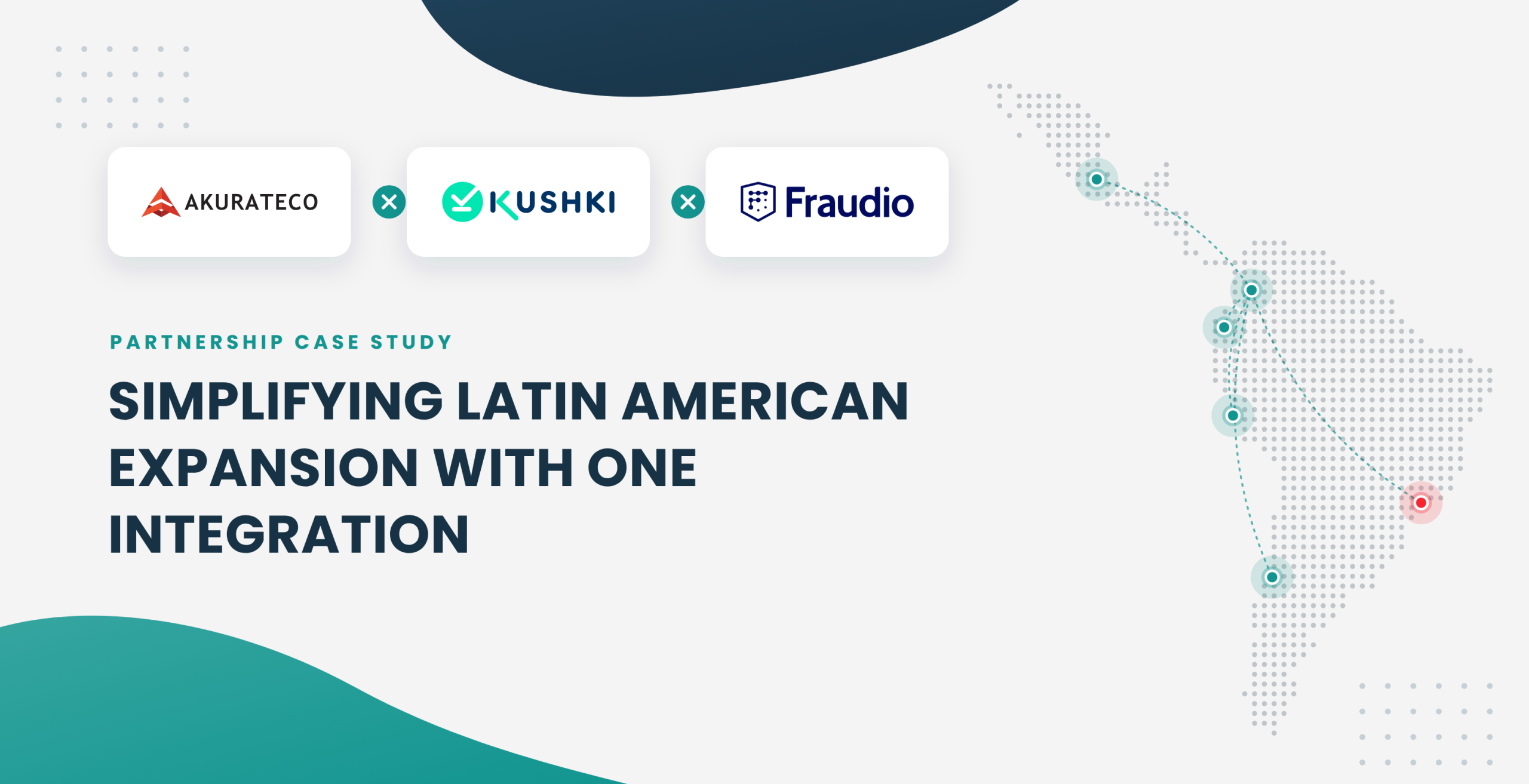
Akurateco, Kushki and Fraudio combined their capabilities so that the technical side of Latin American entry becomes one integration instead of dozens.
Kushki: regional acquiring and local payment methods. Kushki contributes regional acquiring and local payment methods across Mexico, Colombia, Chile, Peru and Ecuador. It also brings the market knowledge that comes from operating locally: which methods matter in each country, how local cards behave, and how both change over time.
Fraudio: network-level fraud detection. Fraudio contributes AI-driven fraud detection built on a network dataset that spans issuers, acquirers and the instruments they process. That network view catches patterns no single institution can see. In one case, a single foreign BIN appeared across a cluster of Latin American merchants, backed by accounts opened on fabricated identities. Inside any one acquirer’s portfolio, the volume looked ordinary. At network level, the pattern was visible within days.
For Pix, Fraudio’s model runs on two rails. One scores each transfer. The other profiles the receiving account over time (inflows, outflows, velocity and counterparties), which is where mule behaviour shows up.
Akurateco: one connection and the decision point. Akurateco’s orchestration layer is the single point of connection. It brings Kushki’s coverage and Fraudio’s scoring together with the KYC and CRM connectivity a regional launch needs but rarely budgets for. Pix fraud protection with Fraudio is available now to Akurateco clients, with no separate project.
How it works: fraud scoring inside the routing decision
The first design for Pix protection looked like a conventional fraud product: a scoring service that sat beside the payment method, was called before authorisation, and answered in its own time. It held up in testing but broke down at Pix speed, because two systems passing messages back and forth spend most of the time budget on the hand-off.
So the scoring moved into the routing path. It now runs as part of the same decision that selects where the transaction goes, rather than as a separate call made ahead of it. Fraudio’s network data supplies the context, and Akurateco’s orchestration layer supplies the position in the payment flow.
This has three practical results:
- It works at Pix speed. Scoring finishes before the transfer executes, while the payment can still be stopped.
- It covers everything. Because scoring runs in the orchestration layer, it reaches all Pix traffic in the portfolio, not only the merchants where someone switched it on.
- It sees the full picture. Each decision uses the complete context of the transaction.
“Anything a provider intends to do about a fraudulent Pix payment has to happen before the transfer executes.”— Rodrigo Vilariño, VP Go to Market, Americas, Fraudio
What this means for PSPs and merchants
- Expansion without country-by-country builds. The second and third markets extend what already works, with the same flows, reporting and routing rules, instead of starting new projects.
- Less exposure to market shifts. When a payment method fades or a new one appears, the change happens on the partner side, not in the provider’s own code.
- Fraud control that meets regulators’ expectations. Real-time scoring runs before the money moves, in line with the Central Bank’s push for preventive controls on Pix.
- Capacity for the work that wins the market. Sales and marketing don’t transfer from other regions: a campaign that fills a pipeline in Europe won’t produce merchant enquiries in São Paulo or Bogotá. A single integration frees the launch team to focus there.
“The providers we see succeeding here treated the integration question as solved early and spent their energy on the local commercial work instead.”
— Andrew Riabchuk, Founder & CTO, Akurateco
Lessons from the partnership
- Start with one country, not “Latin America.” Choose it based on where your merchant base already has volume and where the regulatory and settlement path is viable.
- Decide your structure before you integrate. Merchant of record, local payment facilitator or direct acquiring: the choice determines who owns the merchant relationship and what you can change later without renegotiating.
- Treat uptime as a commercial requirement. Availability varies widely between providers in the region, and merchants have little patience with a newcomer.
- Assume your fraud model misreads the region until decline data says otherwise, and budget for retraining as real work.
- Decide where fraud scoring runs before anyone opens an integration ticket. Adding real-time scoring to a settled architecture means rebuilding the payment path.
About the partners
Akurateco is a payment software vendor headquartered in Lisbon, Portugal. The company offers a payment orchestration platform to enterprise merchants and a white-label payment gateway for PSPs and banks across Europe, MENA, North and Latin America.
Kushki is a regional non-bank acquirer operating in Mexico, Colombia, Chile, Peru and Ecuador. It works with international payment providers and enterprise merchants entering the Latin American market.
Fraudio is a global fraud detection and compliance platform based in Amsterdam, focused on acquirers, payfacs, issuers and processors.