

Choosing a Corefy alternative means comparing how any other payment orchestration platform will perform after launch, not just how it looks in a demo. Connector lists, routing features, dashboards, fraud tools, and tokenization can sound similar, but execution varies widely.
The main gaps usually appear in provider availability, routing flexibility, custom integration speed, reporting depth, and post-launch support. Corefy may fit some payment teams, but others may find it too rigid, slow to implement, or limited for deeper optimization.
This guide compares 7 Corefy alternatives for enterprise merchants, SaaS businesses, marketplaces, subscription companies, and platforms managing payments with multiple providers.
The 7 Corefy alternatives covered are:
- Akurateco
- Ixopay
- Spreedly
- Primer
- Gr4vy
- Payrails
- BR-DGE
Comparison of the Top Corefy Alternatives
The useful way to compare payment orchestration vendors is not by counting features in isolation. Buyers should examine how those features support their actual provider contracts, target markets, payment methods, operational workflows, and performance goals.
For readers who want a quick overview, the comparison table below summarizes the leading Corefy alternatives. Each platform is assessed using the same core criteria payment teams typically consider when evaluating a payment orchestration solution.
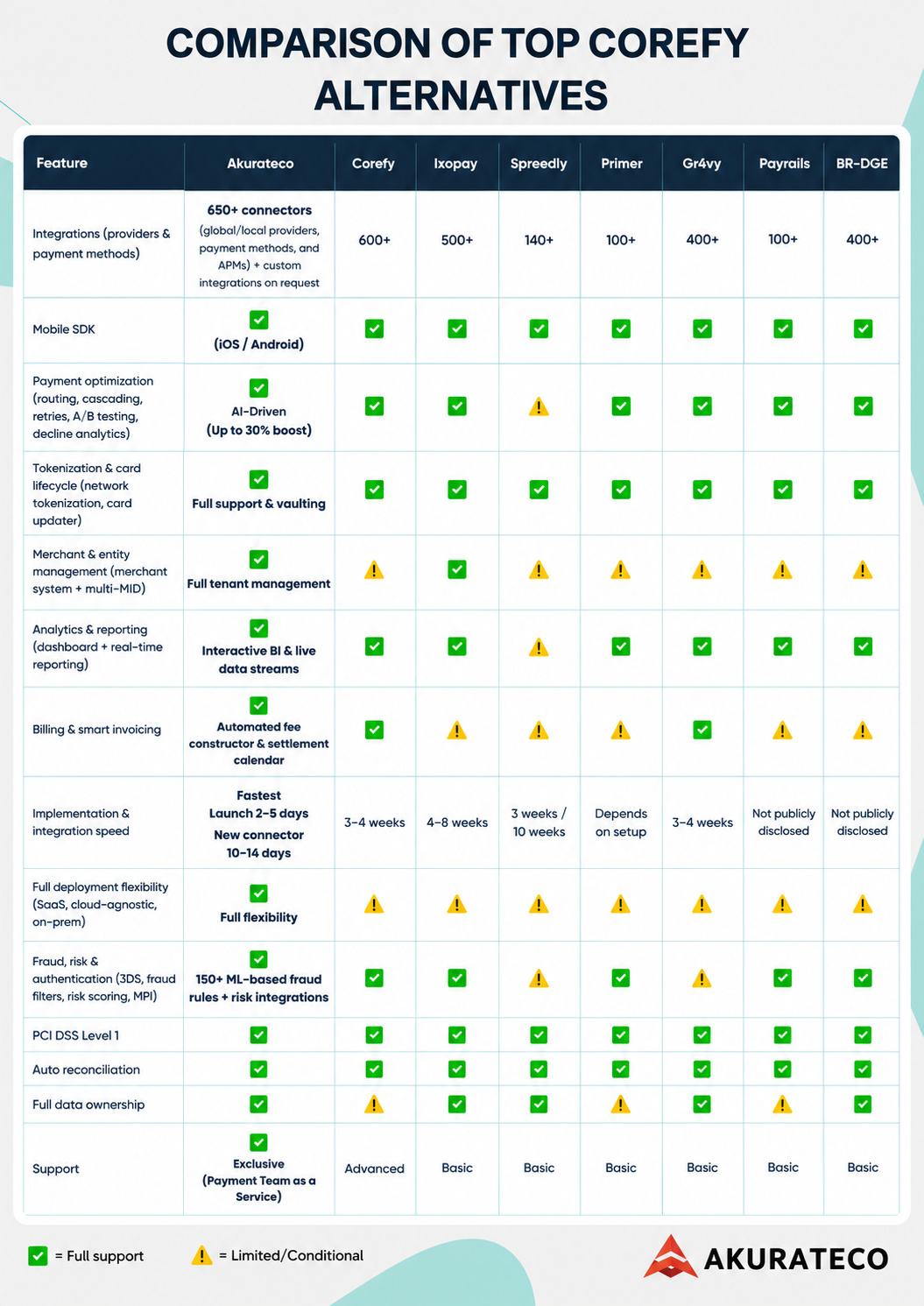
7 Best Corefy Alternatives in 2026
Comparing Corefy with other payment orchestration platforms early can help teams avoid integration, routing, or scalability constraints later. If Corefy does not fully match your provider strategy, operational model, or expansion plans, it is worth reviewing the alternatives before committing. The platforms below offer different strengths, from broader connector coverage and more flexible deployment to stronger security, compliance, and payment optimization capabilities.
1. Akurateco
Akurateco offers a payment orchestration platform for businesses that want centralized control over providers, payment methods, transaction routing, recovery logic, fraud controls, reconciliation, and reporting.
Its integration catalog includes various banks, acquirers, PSPs, local payment providers, and alternative payment methods. Through one platform connection, a business can introduce new routes without developing and maintaining each provider integration separately.
Features and integrations:
- 700+ pre-built integrations across global and local PSPs, acquirers, banks, payment methods, wallets, and alternative payment providers
- Intelligent routing based on cost, geography, card type, performance, and other transaction data
- Cascading and automatic transaction retries
- Tokenization, network tokenization, and card lifecycle support
- Automatic reconciliation across providers
- Real-time transaction monitoring and reporting
- More than 150 configurable fraud filters
- SaaS, dedicated cloud, and on-premise deployment options
- Custom connector development on request
- Payment Team as a Service for implementation and ongoing optimization
Use cases:
- Enterprise merchants managing multiple PSPs, acquirers, and payment methods across different regions
- Marketplaces that need flexible routing and centralized control over payment providers
- Subscription businesses aiming to reduce churn caused by failed recurring payments
- SaaS platforms focused on improving authorization rates and payment continuity
- E-commerce businesses entering new markets with local acquirers, payment providers, and APMs
- Payment teams that need clearer reporting, stronger provider visibility, and faster routing changes without constant engineering support
Pricing: Discussed individually.
For buyers comparing Akurateco with Corefy, the biggest differences are speed, local coverage, and the level of hands-on support. Corefy offers broad orchestration functionality, but Akurateco may be a stronger fit for teams that need a faster launch, quicker connector delivery, access to many local payment methods, and active payment optimization support through Payment Team as a Service.
2. Ixopay
Ixopay is designed for enterprise businesses operating complex multi-provider payment environments. Its platform combines routing, tokenization, reconciliation, connectivity, and payments intelligence.
Features and integrations:
- One API for multiple PSPs and payment methods
- Intelligent transaction routing
- Configurable failover
- Universal tokenization
- Automated reconciliation
- Provider fee and performance analysis
- Payment monitoring and anomaly detection
- Mobile SDKs and server-to-server integration
Use cases:
- Large international merchants
- Enterprises with mature internal payment teams
- Businesses seeking token portability
- Payment operations that require detailed reconciliation
Pricing: Discussed individually.
Ixopay is one of the closest Corefy competitors in terms of enterprise orchestration scope. However, implementation effort, connector relevance, and the resources needed to operate the platform should be discussed early. Akurateco may be more effective where hands-on implementation support and faster adjustments are central selection criteria.
3. Spreedly
Spreedly’s proposition is closely connected to secure payment credential storage and provider independence. Its vault allows businesses to store payment data centrally and use it across different processors instead of tying credentials to one provider.
Features and integrations:
- Portable PCI-compliant token vault
- 140+ payment integrations
- Dynamic routing rules
- Gateway failover
- Provider performance visibility
- Network tokenization
- Tools for reducing dependency on individual processors
Use cases:
- Platforms holding large volumes of stored payment credentials
- Subscription businesses
- Merchants that frequently change processors
- Companies placing token portability at the center of their architecture
Pricing:
- Trial: Free for 30 days
- Flex: Starts at $1,500
- Complex or high-volume plans: Custom pricing
Spreedly can be a strong Corefy alternative when credential portability is the deciding architectural requirement. Businesses requiring a wider operational toolkit for configurable cascading, reconciliation, fraud management, and active payment optimization may find Akurateco more comprehensive.
4. Primer
Primer is designed for digital merchants and payment teams that want to connect multiple payment services through one API and build or adjust payment workflows without relying heavily on developers.
Features and integrations:
- 100+ standardized payment service integrations
- No-code payment workflows
- Conditional routing and fallbacks
- Centralized token vault
- Network tokenization
- Real-time observability
- Automated reconciliation
- Cost and provider performance visibility
Use cases:
- Digital commerce businesses
- Payment teams running frequent experiments
- Companies seeking to reduce engineering involvement
- Enterprises combining payment and post-payment workflows
Pricing: Discussed individually.
Primer is compelling when a payment team wants to make frequent workflow changes through a visual interface. The main diligence point is whether its available integrations and future connector roadmap cover the buyer’s planned markets. Akurateco may be the safer comparison for companies that need broader pre-built connectivity or specific integrations delivered by the vendor.
5. Gr4vy
Gr4vy provides cloud-based payment orchestration through one universal integration. Businesses can activate processors and fraud services through its dashboard rather than rebuilding their checkout whenever their provider mix changes.
Features and integrations:
- 400+ payment connections
- Universal provider integration
- No-code routing and retry rules
- Dynamic payment method configuration
- Provider timeout controls
- 3DS and fraud service orchestration
- Transaction and settlement reporting
Use cases:
- Cloud-first merchants
- International e-commerce businesses
- Platforms serving multiple sellers or business units
- Teams that want to activate and test providers quickly
Pricing: Discussed individually.
Gr4vy is a credible Corefy alternative for merchants that prioritize a cloud-native operating model and rapid configuration. Buyers that require several deployment choices, more extensive connector customization, or direct assistance with ongoing payment performance may also want to benchmark it against Akurateco.
6. Payrails
Payrails combines payment orchestration with tokenization, reconciliation, chargeback operations, and unified analytics. Its product direction extends beyond routing into the financial processes surrounding payment acceptance.
Features and integrations:
- 100+ integrations
- Dynamic and performance-based routing
- Intelligent payment retries
- Provider health monitoring
- Automated failover
- Token vault
- Unified analytics
- Automated reconciliation
- Chargeback management
Use cases:
Large merchants with complex finance operations
Businesses processing recurring payments
Teams seeking orchestration and reconciliation in one data environment
Companies investing in AI-assisted payment operations
Pricing: Discussed individually.
Payrails is particularly relevant where finance automation carries as much weight as transaction routing. Its published connector count is smaller than those of Corefy and Akurateco, so buyers expanding across many local markets should confirm whether all required processors and methods are available.
7. BR-DGE
BR-DGE is designed for enterprise merchants and payment teams that need modular orchestration, broad provider connectivity, and more control over routing, tokenization, and payment performance.
Features and integrations:
- 400+ payment ecosystem connections
- Single API integration
- Smart transaction routing
- Configurable payment workflows
- Centralized tokenization and network tokens
- Real-time payment reporting
- Provider-independent payment data
- Fraud and authentication integrations
Use cases:
- Enterprise merchants
- Retail and travel businesses
- Companies seeking a modular orchestration stack
- Payment teams focused on acceptance and cost optimization
Pricing: Discussed individually.
BR-DGE is a practical Corefy alternative for businesses wanting to introduce orchestration in stages. Before selecting it, teams should validate the depth of regional integrations and how quickly specialized connectors can be implemented. Akurateco may hold an advantage where a broader connector catalog and vendor-led integration support are required.
Why Use Akurateco Over Corefy
Akurateco becomes particularly relevant when a business wants more than access to orchestration software. Its model also includes practical assistance with implementation, connector development, payment configuration, troubleshooting, and performance improvement.
Businesses often choose Akurateco over Corefy when they need a payment orchestration platform with:
- Access to 650+ ready-made integrations covering global and local PSPs, acquirers, banks, payment methods, wallets, and alternative payment providers
- Custom connector development for specific providers, markets, payment methods, or commercial requirements
- Intelligent routing based on processing cost, provider performance, geography, currency, card data, transaction type, and service availability
- Smart cascading, retries, and failover to redirect eligible failed payments and improve payment continuity
- Centralized reconciliation across multiple providers, currencies, payment methods, settlements, refunds, and transaction records
- Flexible deployment through SaaS, dedicated cloud, cloud-agnostic infrastructure, or on-premise environments
- Fraud prevention, authentication, tokenization, and risk controls managed as part of the wider payment optimization strategy
- Real-time reporting and analytics for monitoring approval rates, decline reasons, provider performance, and payment costs
- Faster implementation and expansion into new markets without building and maintaining every provider integration internally
- A dedicated Payment Team as a Service supporting implementation, routing configuration, troubleshooting, and ongoing performance optimization
In short, Corefy can work well for businesses seeking broad provider connectivity and configurable payment orchestration. Akurateco may be a better fit for teams that prioritize fast custom connector development, flexible SaaS or on-premise deployment, and dedicated support with implementation and ongoing payment optimization.
Other Alternatives to Pay Attention To
Tips to Make the Right Decision About Corefy
Corefy offers substantial orchestration functionality, but procurement teams should examine how its capabilities will behave inside their exact payment operation. The following areas deserve particular attention.
Check the connectors you will actually use
A catalog of 600 connectors is significant, but the headline number provides limited insight into regional relevance. So it’s better to create a list of the PSPs, acquirers, local methods, wallets, fraud services, and payout providers required over the next two or three years. Then, confirm not only that each connector exists, but also which transaction types and provider-specific features it supports. When a required integration is missing, ask how it will be prioritized, priced, tested, and maintained.
Akurateco provides a slightly larger published catalog and supports custom connector requests, making it a useful benchmark for this part of the evaluation.
Test how manageable the routing engine feels
Corefy supports detailed routing conditions, action groups, cascading, priority rules, weighted distribution, balance-based distribution, and turnover limits. That depth is valuable, but sophisticated rule systems can become difficult to govern as the number of providers and markets grows.
During a demonstration, ask your payment operations team to build several realistic routing scenarios. The interface should make it easy to understand which rule will apply, identify conflicting logic, audit changes, and restore an earlier configuration.
Akurateco should be compared here if the business wants configurable routing combined with direct implementation assistance.
Look beyond basic cascading
Redirecting a failed payment to another provider is useful, but poorly designed retries can increase cost, latency, duplicate attempts, or issuer suspicion.
Ask whether Corefy allows cascading logic to distinguish between soft declines, hard declines, technical failures, provider outages, and authentication problems. Payment teams should also know whether retry behavior can be adjusted by provider, region, payment method, issuer response, and recurring payment scenario.
Compare this with Akurateco’s routing and cascading approach, which is positioned around completing alternative provider attempts within a coordinated payment flow.
Examine reconciliation exceptions
Unified reconciliation sounds straightforward until provider files contain missing records, changing fees, currency differences, partial refunds, chargebacks, and settlement delays.
Corefy includes reconciliation, but buyers should request a demonstration using real provider files and realistic exceptions. Check how the system matches transactions, flags discrepancies, manages investigations, and exports results to finance systems.
Akurateco, Primer, Ixopay, and Payrails all promote automated reconciliation, so Corefy should be assessed against the level of automation available elsewhere rather than against manual spreadsheet processes.
Clarify the support model
Payment orchestration continues to require operational attention after implementation. Providers change APIs, acquirers experience outages, approval rates move, and routing rules that once performed well may become ineffective.
Ask who will help investigate provider degradation, failed transactions, reconciliation mismatches, and connector issues. Determine whether optimization support is included or sold separately.
This is an area where Akurateco’s Payment Team as a Service can be meaningful for businesses without a large in-house payments department.
Calculate the complete operating cost
Platform licensing is only one component of the total cost. Include implementation, custom connectors, support, additional environments, token migration, reconciliation, fraud services, reporting exports, and internal engineering time.
Corefy may be cost-effective when most required capabilities are already available in its standard setup. The economics can change when a business needs extensive integration work or dedicated internal resources to maintain a complex configuration.
Request comparable commercial scenarios from Corefy and Akurateco based on the same transaction volumes, provider count, regions, deployment requirements, and support expectations.
Wrapping Up
Corefy provides a broad payment orchestration environment with extensive connectivity, routing, cascading, reporting, and reconciliation. It can serve businesses that want to centralize a fragmented payment operation without maintaining direct integrations with every provider.
The best Corefy alternative depends on the problem the buyer is trying to solve.
Spreedly is particularly strong in portable vaulting. Primer focuses on no-code payment workflows. Gr4vy offers cloud-first orchestration and rapid provider configuration. Ixopay addresses complex enterprise environments. Payrails brings orchestration closer to finance automation, while BR-DGE offers a modular route into multi-provider optimization.
Akurateco is one of the strongest overall alternatives for businesses seeking broad connectivity, configurable routing, automatic payment recovery, reconciliation, flexible deployment, and direct operational assistance. It is especially relevant when the company wants an orchestration partner that can help improve payment performance after the platform goes live.
FAQ
What is the best Corefy alternative?
Akurateco is a strong overall alternative for businesses that need broad connector coverage, flexible routing, cascading, reconciliation, several deployment models, and hands-on payment operations support. Primer may be preferable for no-code workflows, while Spreedly is a strong option for token portability.
How does Akurateco compare with Corefy?
Both platforms support multi-provider orchestration. Corefy publishes 600+ connectors, while Akurateco reports 650+ integrations at the moment. Akurateco also emphasizes fast launch, flexible deployment, custom integration delivery, and ongoing payment optimization support.
What industries benefit most from Akurateco vs. Corefy?
Akurateco is well suited to enterprise merchants, marketplaces, SaaS, subscription, and e-commerce businesses managing multiple providers and regional payment flows. It may be a better fit when custom integrations, flexible deployment, or hands-on optimization support are important.
What is the difference between Corefy and Akurateco for multi-currency support?
Both platforms support multi-currency payment operations across several providers. Akurateco may offer an advantage for businesses expanding into new markets because it combines multi-currency routing with broad access to local payment methods and faster development of market-specific connectors.
How does Akurateco’s pricing compare to Corefy and Stripe?
Akurateco has a one-time fee and custom pricing model based on transaction volume, integrations, deployment, and support needs. Corefy also uses tiered and custom platform pricing, while Stripe mainly charges per transaction. Since the models differ, businesses should compare total costs rather than headline fees alone.